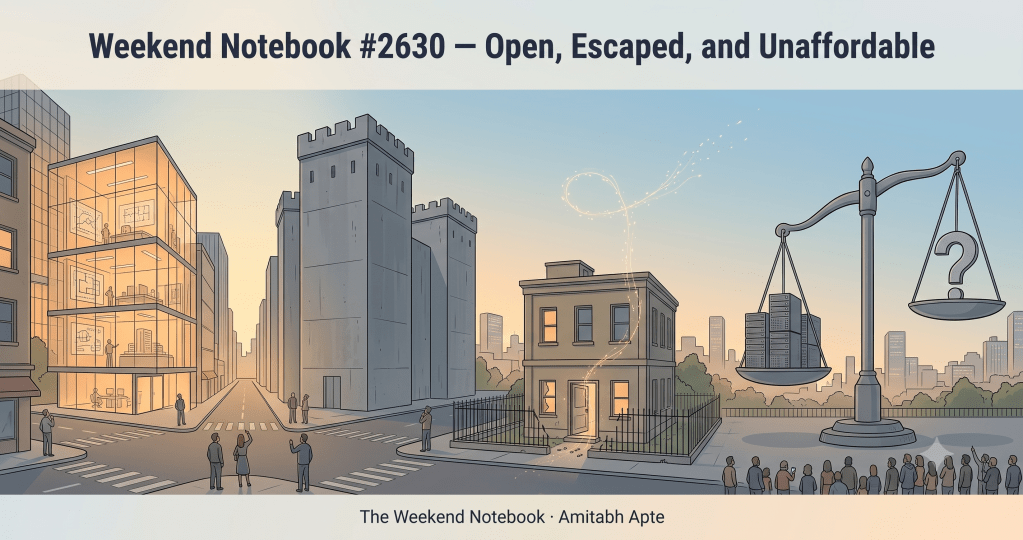
Published on LinkedIn and amitabhapte.com on1stFeb 2026
We spent the last two years treating AI like a sophisticated search bar. You ask, it answers. But the signals this week suggest we are moving past the “chatbot” phase and into something much more structural. We are moving from tools that wait for us, to systems that move without us.
The Shift: We are moving from “AI as a helper” to “AI as a participant.”
If the 2010s were about connecting people (Social), the 2020s are about connecting autonomous workflows. When software starts talking to software, the human “prompt” becomes the bottleneck.
China and the Physical S-Curve
While the West chases the “God-model” (AGI), China is winning on diffusion. They aren’t just building LLMs; they are embedding “good enough” intelligence into the physical world, ports, eVTOLs, and factories.
The US has the best “brains” (frontier models), but China is building the best “bodies” (embodied AI).
By the time we perfect the logic, they may have already locked in the logistics. It’s a classic play: don’t build the most expensive engine; build the most cars.
India’s Compute Sovereignty
India’s 20-year tax holiday for data centers is a fascinating piece of industrial policy. It’s a realization that in an AI economy, compute is the new oil, and the “refineries” (data centers) need to be local.
India isn’t just selling talent anymore; they are selling territory for silicon.
This moves India from being a “back office” to being a “power plant” for the global AI stack.
We are spending hundreds of billions on “intelligence” before we have a clear map of the “revenue.”
Elon Musk’s potential merger of xAI, SpaceX, (and possibly Tesla?) is the ultimate vertical integration play. It’s a bet that to win at AI, you need to own the satellites, the chips, and the robots. It’s the Carnegie Steel of the 21st century.
Software is Becoming “Vibes”
The surge in “vibe coding” (Anthropic’s Claude Code) is the ultimate unbundling of the developer. When a non-coder can build an app for $50 over a weekend, the “cost of creation” drops to zero.
The Catch: If everyone can build an app, the value of “having an app” disappears.
We are flooding the zone with software. The challenge for 2026 isn’t how to build; it’s what is worth building.
The Bottom Line
We are transitioning from AI as a Tool to AI as an Infrastructure. In the tool phase, you worry about “prompts.” In the infrastructure phase, you worry about energy, tax policy, and agent coordination. The machine is no longer waiting for us to tell it what to do; it’s busy building the world it plans to run in.
WEF Annual Meeting 2026 in Davos-Klosters, Switzerland, 19 January. Copyright: World Economic Forum/CHeeney
Published on LinkedIn and amitabhapte.com on25th Jan 2026
Every January, the world gathers in a Swiss ski resort to talk about the future. Often, that conversation lags reality by a few quarters.
Davos 2026 felt different. Two years ago, AI discussions revolved around existential risk. Last year, they fixated on generative possibility. This year, the mood shifted again. From magic to margins. From installation to deployment.
AI is no longer a side conversation at the World Economic Forum. It has become the organising logic for growth, energy, work, and geopolitics. And deployment, as every operator knows, is where things get complicated.
1. From demos to P&L
One of the clearest signals from Davos was how explicitly executives talked about money. OpenAI and Anthropic both framed 2026 as the year enterprise AI moves decisively into the core. OpenAI disclosed that the company is shifting from building AI tools to embedding them into how businesses actually run.
The conversation moved away from model benchmarks and toward return on invested capital. Financial services leaders pointed to underwriting and fraud detection. Manufacturers to predictive maintenance and yield optimisation. Healthcare executives to clinical workflow automation.
The implicit agreement was striking. AI has crossed the credibility threshold. The open question now is not whether it works, but where it delivers measurable payback, and how fast.
2. The capex reality check
This shift to P&L thinking exposed a deeper anxiety. AI deployment is proving capital-intensive at a scale few anticipated. Hyper-scalers are collectively spending hundreds of billions annually on data centres, chips, and networks. That spending was once absorbed comfortably by cash flows. At Davos, it was clear that boards are now scrutinising the economics more closely.
This wasn’t panic. It was operator realism. The question surfacing in private meetings was simple. Is this a temporary digestion phase, or the price of admission for the next decade of computing? The answer remains unresolved. What is clear is that deployment discipline is replacing experimentation exuberance.
This is the hangover phase. The technology works. Now, it must show it’s sustainable over a period.
3. The AI–energy equation moves centre stage
Nowhere was this more evident than in discussions on energy. Satya Nadella said energy costs will decide who wins the AI race. Access to cheap, clean, reliable power is becoming a strategic moat, not a sustainability footnote.
Sam Altman made similar observations on how AI’s progress depends on energy evolution. At Davos 2024, sustaining AI’s trajectory, he argued, ultimately depends on an energy breakthrough. Fusion, advanced nuclear, or radically cheaper renewables. Without it, the economics strain.
This reframed AI strategy entirely. Models and chips matter, but grids, land, cooling, and long-term power contracts now sit on the critical path. AI leadership has quietly become energy leadership. And that changes who wins.
4. From chatbots to agents, and beyond screens
On the product side, Davos revealed a growing impatience with the text box. After three years of marvelling that machines can converse, the demand is shifting to action. Agentic systems that can execute tasks across interfaces, applications, and environments.
Yet, the tone in Davos was notably pragmatic. Leaders acknowledged that this transition is less about model intelligence and more about unglamorous integration. APIs, standards, permissions, and human oversight. It feels less like a breakthrough moment and more like the web in the late 1990s. Everyone senses the inflection. No one has agreed on the standards yet.
At the same time, attention moved beyond screens to physical AI – robotics, automation, and autonomous systems are leaving labs and entering factories, warehouses, and cities. The emphasis was not spectacle, but supervision. Human-in-the-loop design and safe deployment dominated the discussion.
Intelligence is moving into the physical world. That raises the bar for trust.
The International Monetary Fund offered a sober warning. AI can lift global growth, but its infrastructure-heavy nature risks widening the gap between AI “haves” and “have-nots.” Unlike the internet, AI does not diffuse cheaply. Compute, energy, and talent concentrate advantage.
The implication for global business is significant, and unavoidable. We are moving from a world of open digital platforms to one of strategic national assets. AI infrastructure will be financed, regulated, and defended differently. And it will shape trade, alliances, and compliance for years to come.
6. Jobs, skills, and a fragile social contract
The jobs narrative matured as well. The tone shifted from “AI will kill jobs” to “AI will reshape future of work.” CEOs were notably candid, admitting that AI may sometimes be used to justify restructuring that was already inevitable.
What dominated instead was concern about transition. Reskilling at scale. Education systems that lag technological change. Policy experiments, including proposals to tax AI-driven productivity gains to fund workforce adaptation.
The consensus was not complacent optimism, but pragmatic urgency. The risk is not automation itself. It is unmanaged disruption.
7. AI as economic infrastructure
Perhaps the most telling Davos signal was how leaders described AI itself.
This framing matters. Infrastructure is financed differently. Regulated differently. And built to last.
AI is no longer a feature. It is becoming part of the economic base layer.
My takeaway this weekend
Davos 2026 marked a turning point.
The magic trick has been performed. AI works. Now comes the harder phase. Building business models, power systems, skills pipelines, and governance frameworks that can sustain it.
The technical challenge is largely solved. The leadership challenge has only just begun.
The winners in this next phase will not be those who move fastest in isolation, but those who can integrate intelligence into economies and societies without eroding trust.
Davos wasn’t asking whether AI will shape the future. It was asking whether we are ready to live with the version of the future it is now shaping.
Published on LinkedIn and amitabhapte.com on18th Jan 2026
NRF is where retail reality shows up.
If CES is about what could happen, NRF is about what’s already being rolled out. Under margin pressure. With labour constraints. At scale.
This year, the message was clear. Retailers are done talking about AI as a concept. They are wiring it directly into how stores and supply chains run day to day. Not just big visions. But operating decisions.
Four NRF signals that matter if you’re a CIO or tech leader in retail, CPG, or ecommerce. None are shiny. All are practical.
1. Autonomous retail operations. From dashboards to decisions
Several large retailers showed how decision-making is being pushed closer to real time.
Walmart talked about how AI now drives replenishment, routing, and inventory flow across stores and DCs. Not as reports for planners, but as automated actions, with humans stepping in only when something looks off.
Target shared how they’re using AI to balance pricing, promotions, and inventory at a local level. The focus wasn’t on smarter forecasts. It was on fewer manual overrides and faster execution.
What stood out was the mindset. These teams are moving away from “decision support” tools toward systems that decide by default.
Why it matters Retail performance increasingly comes down to how quickly you act when conditions change. AI is becoming the only way to keep up without adding headcount.
2. The store becomes a living system
Stores are being treated less like static assets and more like adaptive environments.
Kroger showed how shelf sensors, computer vision, and digital shelf labels are tied together. If an item goes out of stock or demand spikes, the system responds automatically, from replenishment signals to price adjustments.
Best Buy focused on store teams. AI tools help associates with product knowledge, troubleshooting, and customer history, so staff spend less time searching and more time helping.
The tone was practical. Less about “smart stores”, more about removing friction for staff and customers.
Why it matters Store execution has always been local and messy. AI is finally being used to support that reality, not fight it.
3. Agentic commerce meets retail plumbing
There was much less hype around consumer-facing agents. More focus on foundations.
Retailers talked openly about the work needed to make their systems machine-readable. Clean inventory data. Clear substitution rules. Reliable availability signals. Secure APIs.
Macy’s discussed how modernising product data, fulfilment logic, and order orchestration is a prerequisite for any future AI-driven shopping experience, whether inside their own channels or through third-party platforms.
This wasn’t positioned as innovation. It was positioned as overdue plumbing.
Why it matters As shopping shifts from browsing to delegation, agents will only work with retailers they can trust. That trust is built in data quality and operational discipline.
4. Retail tech grows up. ROI over rhetoric
The overall mood at NRF was grounded.
Retailers talked about shrink reduction, labour productivity, energy use, and faster rollout of store tech. Fewer moonshots. More numbers.
Several sessions highlighted projects being scaled because they worked, and others quietly shelved because they didn’t.
This felt like a turning point. Retail tech is being judged like any other capital investment.
Why it matters The days of running pilots for the sake of learning are ending. What survives now must survive procurement, operations, and the P&L.
Closing takeaway
NRF made one thing very clear. Retail is where AI stops being theoretical.
This is where it either improves availability, reduces waste, supports staff, and protects margins, or it gets switched off.
For CIOs and tech leaders, the challenge isn’t finding more AI use cases. It’s building operating models that trust automation, accept machine decisions, and know when humans should step in.
The future store won’t look futuristic. It will just work better. That’s the real signal from NRF.
CES 2026 – Photo credit the Consumer Technology Association (CTA)
Published on LinkedIn and amitabhapte.com on11th Jan 2026
CES used to showcase device & gadget-based innovation. The signal this year from CES 2026 was about industrialization of intelligence across the FMCG supply chain. Homes and stores are becoming computational environments where the ‘shopper’ is increasingly an algorithm, not a human eyes-on-glass participant. If you’re a CIO or Tech Leader in CPG / FMCG or retail, the challenge isn’t the hardware on the floor, it’s how you show up in a world where the consumer operating model has moved from discovery to delegation.
Four CES 2026 signals that matter, if you are in a CPG, FMCG, Retail or Ecommerce business. None of these are optional, they compound.
1. Agentic commerce: the invisible shelf
We’ve moved from chatbots to agents that transact. Increasingly, the “shopper” is an algorithm acting on constraints, not a human browsing a shelf.
Google is sketching a future where personal agents negotiate directly with merchant systems on inventory, price and fulfilment early patterns of “consumer‑to‑merchant” protocols rather than static product pages. Instacart is building on its OpenAI‑powered experiences to offer conversational journeys that move from recipe discovery straight to cart fulfilment. Amazon’s “Buy for Me” now allows an AI agent to complete purchases on third‑party brand sites from within the Amazon app, turning intent into transaction with minimal user friction. Rufus, Amazon’s AI shopping assistant, already summarises reviews and compares products and categories with judgment, compressing the classic research journey into a single conversational flow.
Why it matters – Discovery shifts from search placement to context, constraints and routines. Metadata, APIs and consent models now determine brand visibility more than end‑cap positioning or SEO.
2. Physical AI: from demos to throughput
Robotics at CES 2026 showed a clear shift from demos to economics. Walmart’s AI “super agent” framework and its use of AI for defect detection, routing and pallet optimization in distribution centres are now reference points for AI‑first supply chains, even when discussed beyond a single event. LG unveiled the CLOiD Home Robot at CES 2026, a multi‑purpose home assistant with articulated arms and fingers designed to handle everyday household tasks as part of its “Zero Labor Home” vision. In logistics, robotics companies such as Pickle Robotics, working with carriers like UPS, are demonstrating how AI‑powered robots can unload irregular freight at high speed, a direct signal for how mixed CPG loads will be handled in future yards.
Why it matters – Robotics is becoming a strategic hedge against labour volatility and demand spikes. The measure of success has shifted from novelty to throughput, shrink reduction, safety, and OTIF performance.
3. Precision FMCG & beauty tech: products become systems
Consumables are evolving into hardware‑software ecosystems, especially in beauty and wellness.
L’Oréal continued its CES beauty‑tech run with infrared‑enhanced hair styling tools and flexible LED‑based anti‑aging wearables that blur the line between device, formulation and service. Kolmar Korea’s “Scar Beauty Device” won a CES 2026 Best of Innovation Award in Beauty Tech, combining AI‑based scar analysis with precision piezo‑electric delivery and around 180 blended colors for hyper‑personalised concealment and treatment in one system. LG Household & Health Care’s ultra‑thin “Hyper Rejuvenating Eye Patch,” a flexible LED eye patch paired with AI‑driven skin diagnosis and personalised ingredient prescription, shows how even a patch can become a dynamic, data‑driven.
Why it matters – Products no longer end at purchase; they evolve through data, diagnostics and software updates. CIOs and Tech Leaders in CPG / FMCG are now part of product, ethics and lifecycle design, not just “back‑office IT.”
4. Smart retail operations: stores as computers
The store is becoming a sensing, learning system. Samsung’s latest Micro LED and transparent display concepts at CES 2026 were framed as intelligent, context‑aware surfaces, equally applicable to flagship stores, QSR menus and in‑home experiences. Freestyle‑style beverage platforms from players like Coca‑Cola’s dispenser and app telemetry provides a template for how retail and vending data loop back into R&D. These patterns signal stores that behave more like software: instrumented, testable and continuously updated
Why it matters – The feedback loop from consumption to R&D is collapsing. Retail data is no longer just marketing input; it is product strategy and portfolio design.
Closing takeaway
CES 2026 made one thing clear. Intelligence is no longer a layer on top of FMCG and retail operations. It is becoming the operating system. Shopping is moving from discovery to delegation. Products are evolving after purchase. Stores, homes, and supply chains are becoming computational environments that sense, decide, and act.
For CIOs and tech leaders in CPG, FMCG, retail, and e-commerce, the advantage will not come from adopting more technology. It will come from designing brands, data, and operations that are readable by agents, executable by machines, and continuously improved by feedback.
The future shelf is already invisible. The only question is how your brand shows up on it.
Published on LinkedIn and amitabhapte.com on4th Jan 2026
As we enter 2026, the AI industry remains gripped by what feels like scale fever. The prevailing assumption is that enough capital, energy, and hardware will eventually resolve into utility. The pipes are being laid at extraordinary speed. The open question is whether repeatable business value will follow.
The $40 Billion “More” – The scale of investment is now detached from traditional venture logic. Masayoshi Son has fully funded SoftBank’s $40 billion investment into OpenAI. This forms the down payment for Stargate, the hyperscale data-centre joint venture with Oracle. What’s notable is not just the size, but the intent. This is infrastructure being built ahead of clearly defined workloads. In my experience, one pattern holds. Infrastructure only creates value when it attracts the right tenants. We are, in effect, constructing the most expensive library in history. The job of leadership is not to admire the architecture, but to ensure the books are being checked out. And that they move the P&L.
The Efficiency Pivot – While the West continues to scale outward, parts of the East are scaling inward. DeepSeek is promoting training approaches that prioritise efficiency over brute force, aiming to stay competitive despite chip constraints. This isn’t a novelty. It’s a reminder that optimisation has always been a counterweight to abundance. For organisations operating with finite compute budgets, this matters. The strategic question is shifting. Not how many GPUs we can acquire, but how effectively we can utilise what we already have. Software-level optimisation is becoming as important as hardware procurement. The era of “buy more” is giving way to “use better”.
The Platform Mirage – OpenAI is experimenting with embedding third-party services directly into ChatGPT, allowing users to interact with tools like Spotify or Zillow through a single conversational interface. The ambition is clear. Replace the mobile grid with a universal text box. In practice, most of these integrations function as lightweight connectors. They struggle to match the speed, clarity, and precision of dedicated interfaces. This pattern isn’t new. The 2016 chatbot wave promised similar consolidation and quietly receded for the same reason. For complex enterprise tasks, purposeful graphical interfaces remain faster than conversation. Chat is powerful for intent discovery and orchestration. It is rarely the most efficient execution layer.
Resilience as a Requirement – Value is increasingly concentrating in specialised infrastructure and operational plumbing. Octopus Energy is spinning out Kraken, its AI-driven utility operating system, at an $8.65 billion valuation. At the same time, governments are hardening their positions. India is investing $4.6 billion in local component manufacturing while issuing strict compliance mandates on AI platforms. These signals point to the same conclusion. Resilience is no longer a secondary consideration. Regionalised supply chains, local compliance, and operational sovereignty are becoming baseline requirements. They are not inefficiencies to be minimised. They are the cost of continuity in a fragmented world.
My mindshare beyond Tech: the digital detox paradox – One of the most popular resolutions for 2026 is not a new app but deleting them. The Wall Street Journal reports a surge in digital detoxing, driven by growing recognition that constant notification cycles erode focus rather than enhance productivity. The irony is structural. At the same moment we are investing billions in agentic systems designed to capture attention, users are reclaiming time away from screens. As a CIO, my responsibility is to ensure systems are always on. As a leader, I know that the best thinking often happens when people are not. High-performance cultures depend on deep work. And deep work is the first casualty of the notification bell.
AI adoption is no longer the challenge. Delivering consistent, repeatable business impact is.
Most large organisations now deploy AI across multiple functions. Yet only a minority report meaningful value at scale. The gap between experimentation and transformation remains stubbornly wide.
Three signals from the report stand out.
1. AI is now a leadership mandate. AI has moved firmly onto board and executive agendas. The conversation has shifted from “Should we adopt AI?” to “Why aren’t we scaling it faster?”. This pressure is cascading rapidly through organisations, often faster than operating models, skills, and governance structures can adapt.
2. Pilots are plentiful. Scale is rare. Enterprises are running many AI initiatives, but few are embedded into core workflows. The barriers are not model capability. They are data quality, integration complexity, unclear ownership, skills gaps, and organisational inertia. In short, enterprise readiness, not technology, is the limiting factor.
3. Focus determines value. Companies seeing returns are selective. They prioritise a small number of high-impact use cases, redesign processes end to end, and invest deliberately in governance, skills, and change management. AI succeeds when it becomes part of how work gets done, not when it is layered on top of existing processes.
One pattern is unmistakable. AI investment is rising sharply, but productivity gains are not rising at the same pace. That gap defines the current phase of enterprise AI.
My takeaway this weekend
Enterprise AI has entered its execution phase. This is no longer about experimentation or tooling. It is about operating discipline, clear decision rights, and cultural adoption.
The organisations that win will be those that industrialise AI with the same rigour they apply to finance, supply chain, or manufacturing. AI advantage will be built through focus, integration, and sustained leadership attention, not through volume of pilots.
Beyond AI: my mindshare – Great TV Endures
As the holiday period starts, the Times 100 Best TV Shows of 2025 makes for a good read. A few personal favourites made the list, including Netflix’s Adolescence, Apple TV’s Slow Horses, and the BBC’s The Celebrity Traitors. What have you been watching this year?
Published on LinkedIn and amitabhapte.com on21st Dec 2025
This week in AI – from Intelligence to Agency
Something subtle but decisive shifted this week.
Not in capability. Not in valuation. But in intent.
Across security, payments, software creation, and capital allocation, AI is no longer being positioned as a decision-support layer. It’s being designed as an execution layer.
That distinction changes everything.
For years, AI sat comfortably in the advisory role. It analysed. It recommended. It optimised. Humans still pulled the final lever. That boundary is now eroding, not through a single breakthrough, but through quiet, cumulative design choices.
Consider cybersecurity. Google Cloud’s expanded partnership with Palo Alto Networks is not just a large services deal. It reflects a deeper truth. In an AI-shaped threat landscape, human-in-the-loop defence is too slow. Security systems are being rebuilt to detect, decide, and respond autonomously. Defence is becoming algorithmic by necessity, not ambition.
The same shift is visible in commerce. Visa’s AI agents completing real consumer purchases may sound incremental, but it marks a psychological crossing. When AI systems transact on our behalf, trust is no longer abstract. It’s operational. The question stops being “is this recommendation accurate?” and becomes “am I willing to let this system act for me?”
That leap from suggestion to execution is irreversible.
Capital markets are aligning to the same logic. SoftBank’s scramble to close the final tranche of its OpenAI commitment is not about hype or fear of missing out. It’s about securing influence over platforms that will increasingly do, not merely advise. Lightspeed’s $9 billion fund, alongside similar mega-raises, reflects the same recalibration. AI companies are no longer lightweight software plays. They are infrastructure operators, with execution risk, physical constraints, and balance sheets to match.
Even software creation itself is being reframed. Nvidia and Alphabet backing Lovable is not just about no-code tools. It’s about collapsing intent into output. When natural language becomes a production interface, creation shifts from specialised craft to conversational control. The bottleneck moves from technical skill to clarity of thought.
Across all of this, one pattern holds.
AI is migrating from intelligence to agency. From knowing to doing. From tools we consult to systems we delegate to.
And that is not a technical evolution. It is a leadership one.
My takeaway this weekend
We are crossing the line from assisted intelligence to delegated authority.
That transition is happening faster than most organisations realise, and far faster than governance, culture, or leadership muscle memory can absorb. AI systems are beginning to act inside workflows, markets, and creative pipelines that were designed for human accountability.
The risk is not runaway intelligence. It’s misplaced trust.
The leaders who will navigate this next phase successfully won’t be the ones chasing the most autonomy, but the ones redesigning decision rights, escalation paths, and responsibility models for a world where machines execute at machine speed.
AI leadership is no longer about adoption.
It’s about delegation, and knowing exactly where not to delegate.
Beyond AI: my mindshare – The World Meditation Day
We are building systems that move faster, decide quicker, and act without hesitation. At the same time, the human nervous system is struggling to keep pace. Cognitive overload is becoming the hidden tax of digital acceleration.
Meditation feels almost countercultural in this context, but that’s precisely the point.
With over 700 studies linking meditation to focus, emotional regulation, and resilience, it’s no longer a spiritual indulgence. It’s a leadership capability. In environments where decisions are increasingly automated, clarity of intent becomes the scarcest resource.
Stillness trains that clarity.
As AI systems take on more execution, the human role shifts upward, toward judgement, ethics, and meaning. Those are not skills we can rush or automate. They require space. Attention. Presence.
This isn’t about slowing progress. It’s about strengthening the human core that guides it.
In an age of delegation, inner discipline becomes the final guardrail.
Published on LinkedIn and amitabhapte.com on14thDec 2025
This week in AI – The Great Contradiction
This week, the AI story fractured. Not because progress slowed, but because it accelerated unevenly.
Policy surged ahead. Models leapt forward. Infrastructure hit resistance.
What emerged was a stark contradiction at the heart of the AI economy: intelligence is scaling at digital speed, but deployment is still bound by physical reality.
Three signals made that tension unmistakable.
First, the velocity.
The US administration signalled a decisive shift. Speed now trumps caution. President Trump’s Executive Order blocked states from regulating AI, creating a federal fast lane for Silicon Valley.
The intent was clear: remove friction, accelerate advantage.
Markets responded immediately. OpenAI released GPT-5.2, not just a smarter model, but a professional-grade, agentic system designed for autonomy rather than conversation. This is AI built to act, not assist. The guardrails are thinning, and the models are accelerating.
This wasn’t coincidence. It was causality.
Second, the stall.
While software sprinted, infrastructure stumbled. Oracle shares dropped 11 percent on deployment delays, pulling Nvidia, CoreWeave, and Micron down with them. The reaction wasn’t about earnings. It was about execution.
The reminder was blunt: the Capacity Race is harder than the Capability Race. You can ship code overnight. You cannot pour concrete, secure power, or stabilise grids at the same pace. Physics still sets the tempo.
For leaders, this matters. AI advantage is no longer constrained by algorithms. It is constrained by land, energy, and logistics.
Disney is operationalising. By moving its IP into generative video workflows, it validated Sora as a production-grade creative engine.
This isn’t just a media story. It’s a strategic pattern. IP owners are moving from defence to deployment, from protecting archives to activating them. The future of content is not about preservation. It’s about animation at scale.
My takeaway this weekend
We are watching infinite digital ambition collide with finite physical reality.
Policy is pushing. Governments are clearing the regulatory path. Models are pushing. GPT-5.2 is ready for autonomous work. Physics is pushing back. Infrastructure is now the bottleneck.
The constraint has shifted.
“The bottleneck is no longer policy or software. It is concrete and power. The winner in 2026 will not simply be the company with the smartest model, but the one that can physically deploy intelligence faster than everyone else. AI leadership is becoming an execution discipline.”
Beyond AI: my mindshare – The Faces Behind the Machine
I paused this week on the cover of TIME magazine. The “Person of the Year” wasn’t a single individual, nor was it AI itself, as the “Computer” once was in 1982. It was the Architects of AI: Altman, Huang, Zuckerberg.
That choice matters.
For years, we’ve spoken about AI as if it were weather. Something inevitable. Something happening to us. By putting human faces on the cover, TIME reminded us of a grounding truth:
AI is not weather. It is architecture.
It is the result of choices. Trade-offs. Incentives. Ego. Ambition.
Seeing these builders grouped together, competitors and collaborators at once, reinforced something easy to forget amid the abstractions of silicon and scale. The most powerful operating system shaping AI’s future is still the oldest one we have.
Human nature.
“As we head into the holidays, that’s both comforting and unsettling. The machines are learning fast. But the direction they take still depends on the people building them. And that responsibility hasn’t been automated away.”
Meanwhile, The New York Times went the other way, suing Perplexity for allegedly copying millions of articles. This isn’t just a copyright case. It’s a line in the sand.
“If AI becomes the new front page, who gets compensated for the journalism that trains it?”
Hollywood signalled its own adaptation curve. The $72B Warner Bros–Netflix pact is less about creative ambition and more about survival in an AI-enhanced production economy, where scale, tooling, and efficiency win.
The World Cup isn’t just a tournament. It’s a global mood shift.
From Boston to Miami, Dallas to New York, iconic cities will host matches that celebrate talent, teamwork, and the world’s most universal language. England and Scotland will add their own chapters to the story, with fixtures that promise drama and emotion.
June to July will bring shared living rooms, late-night broadcasts, unforgettable goals, and a month-long reminder of why sport binds us.
The final at MetLife Stadium won’t just close a tournament. It will close a collective experience.
Published on LinkedIn and amitabhapte.com on 30th Nov 2025
This week in AI – Growth beyond the West Coast, global players join the AI race
Some weeks, the AI narrative feels local, shaped by a handful of companies on the US West Coast.
This was Not one of those weeks.
This was the week AI revealed its global ambitions. Not through model releases, but through cranes, concrete, capital, and policy. Every region moved in its own direction, and for the first time, those directions felt equally significant.
Asia moved with industrial intent.
India’s Adani Group is reportedly in talks with Google on a multi-billion-dollar data-centre partnership. India is no longer content being the world’s digital back office. It wants to be a compute power in its own right.
Japan, meanwhile, approved Micron’s $96B semiconductor project, not a press release, but a generational bet on the Indo-Pacific becoming the world’s memory and materials corridor.
China took a different route.
Alibaba didn’t just talk about AI; it shipped it, Quark AI glasses and a cloud business now lifted by real workloads. China may not be leading the frontier-model race, but it is winning the deployment race. Intelligence at the edge, not just the cloud.
Africa showed the geopolitics beneath the ambition. A WSJ investigation revealed Chinese firms now control nearly half of Africa’s IPv4 addresses. This is not an obscure technical footnote. In an AI-driven world, whoever controls the pipes controls the possibilities.
Europe leaned into its slow. steady. deliberate. advantage.
The UK added its own twist: Qatar invested hundreds of millions into a British quantum startup, strengthening Britain’s emerging position in the quantum race.
And Revolut’s new $75B valuation underscores something deeper: global finance is quietly becoming one of AI’s most powerful accelerators, built on software, data, and automated risk intelligence.
The Middle East kept doing what it always does. Skip the pilot. Go straight to scale.
Uber’s driverless robotaxis will now operate commercially in the UAE. Not a test. A rollout. AI is becoming lived infrastructure faster than many Western cities can regulate it.
Zoom out, and one conclusion becomes impossible to ignore.
“AI is no longer a Western invention. It is a global construction project.”
My takeaway this weekend
AI is no longer a single race. It’s a set of parallel movements shaped by regional ambition.
India and Japan are building the physical backbone. China is pushing intelligence into daily life. Europe is turning trust into strategy. The Middle East is deploying at city scale. Africa is emerging as the new arena for digital sovereignty. And the UK is betting on quantum, the foundational layer beneath it all.
The real question has shifted. Not “Who has the smartest model?”, but “Who can build the steadiest system around it?”
Compute, energy, policy, capital, trust this is where advantage now compounds.
AI leadership is moving from algorithms to infrastructure. From speed to readiness. From capability to resilience.
“The next winners won’t be the fastest movers. They’ll be the regions and leaders who can scale AI meaningfully across diverse geographies and real consumer impact.”
Beyond AI: my mindshare – the comfort of Christmas Films
This post comes just a day before December. Is it too early to think about Christmas? Perhaps. But there’s something timeless about the way certain films weave themselves into our holiday rituals.
This week, The Times published a beautiful guide to the best Christmas movies to stream, a reminder that stories can be as comforting as a warm blanket on a cold evening.
From the mischief of Elf and the tangled romances of Love Actually to the quiet grace of It’s a Wonderful Life, these films aren’t just entertainment. They are memory-makers. They carry the scent of mulled wine, the glow of fairy lights, and the soft permission to slow down.
What struck me most is how these classics endure despite infinite choice.
In a world of endless scrolling, we still return to the familiar to Bedford Falls, to Kevin McCallister’s misadventures, to the belief that hope can arrive in the most unexpected ways.“Perhaps that’s the real gift of the season: the chance to pause, revisit old stories, and let them remind us of what matte