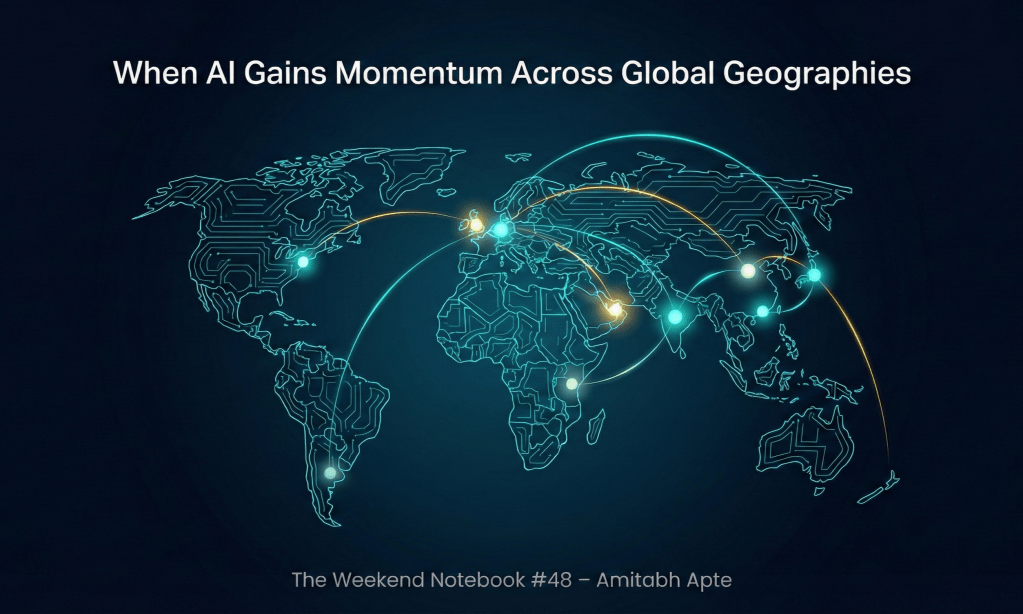
Weekend Notebook #48 – When AI gains momentum across global geographies

Published on LinkedIn and amitabhapte.com on 30th Nov 2025


This week in AI – Growth beyond the West Coast, global players join the AI race

Some weeks, the AI narrative feels local, shaped by a handful of companies on the US West Coast.

This was Not one of those weeks.

This was the week AI revealed its global ambitions.
Not through model releases, but through cranes, concrete, capital, and policy.
Every region moved in its own direction, and for the first time, those directions felt equally significant.

Asia moved with industrial intent.

India’s Adani Group is reportedly in talks with Google on a multi-billion-dollar data-centre partnership. India is no longer content being the world’s digital back office. It wants to be a compute power in its own right.

Japan, meanwhile, approved Micron’s $96B semiconductor project, not a press release, but a generational bet on the Indo-Pacific becoming the world’s memory and materials corridor.

China took a different route.

Alibaba didn’t just talk about AI; it shipped it, Quark AI glasses and a cloud business now lifted by real workloads. China may not be leading the frontier-model race, but it is winning the deployment race. Intelligence at the edge, not just the cloud.

Africa showed the geopolitics beneath the ambition.
A WSJ investigation revealed Chinese firms now control nearly half of Africa’s IPv4 addresses. This is not an obscure technical footnote. In an AI-driven world, whoever controls the pipes controls the possibilities.

Europe leaned into its slow. steady. deliberate. advantage.

A new CNBC analysis suggests Europe’s measured approach may age better than Silicon Valley’s “move fast” doctrine. Markets seem to agree, Germany’s stock market is climbing again. Siemens Energy is emerging as one of Europe’s biggest beneficiaries of the AI-driven infrastructure boom with nearly a 100B Euro valuation.

The UK added its own twist: Qatar invested hundreds of millions into a British quantum startup, strengthening Britain’s emerging position in the quantum race.

And Revolut’s new $75B valuation underscores something deeper: global finance is quietly becoming one of AI’s most powerful accelerators, built on software, data, and automated risk intelligence.

The Middle East kept doing what it always does. Skip the pilot. Go straight to scale.

Uber’s driverless robotaxis will now operate commercially in the UAE. Not a test. A rollout. AI is becoming lived infrastructure faster than many Western cities can regulate it.

Zoom out, and one conclusion becomes impossible to ignore.

“AI is no longer a Western invention. It is a global construction project.”


My takeaway this weekend

AI is no longer a single race.
It’s a set of parallel movements shaped by regional ambition.

India and Japan are building the physical backbone. China is pushing intelligence into daily life. Europe is turning trust into strategy. The Middle East is deploying at city scale. Africa is emerging as the new arena for digital sovereignty. And the UK is betting on quantum, the foundational layer beneath it all.

The real question has shifted. Not “Who has the smartest model?”, but “Who can build the steadiest system around it?”

Compute, energy, policy, capital, trust this is where advantage now compounds.

AI leadership is moving from algorithms to infrastructure.
From speed to readiness.
From capability to resilience.

“The next winners won’t be the fastest movers. They’ll be the regions and leaders who can scale AI meaningfully across diverse geographies and real consumer impact.”


Beyond AI: my mindshare – the comfort of Christmas Films

This post comes just a day before December. Is it too early to think about Christmas? Perhaps. But there’s something timeless about the way certain films weave themselves into our holiday rituals.

This week, The Times published a beautiful guide to the best Christmas movies to stream, a reminder that stories can be as comforting as a warm blanket on a cold evening.

From the mischief of Elf and the tangled romances of Love Actually to the quiet grace of It’s a Wonderful Life, these films aren’t just entertainment. They are memory-makers. They carry the scent of mulled wine, the glow of fairy lights, and the soft permission to slow down.

What struck me most is how these classics endure despite infinite choice.

In a world of endless scrolling, we still return to the familiar to Bedford Falls, to Kevin McCallister’s misadventures, to the belief that hope can arrive in the most unexpected ways.“Perhaps that’s the real gift of the season: the chance to pause, revisit old stories, and let them remind us of what matte
Weekend Notebook #47 – When models mature and the world stretches

Published on LinkedIn and amitabhapte.com on23rd Nov, 2025


This week in AI – Gemini 3 and the new infrastructure race

This was the week Google forced the AI narrative to tilt again. Not through hype, but through the release of Gemini 3, a model that signals a deeper shift in where the frontier now sits. For the first time in a while, the conversation wasn’t about clever demos or novelty features. It was about capability that feels embedded, a model designed to sit inside Google’s full ecosystem of search, cloud, devices, and productivity tools.

Gemini 3 lands as an integrated intelligence layer, not a standalone chatbot. And that matters. In AI, distribution consistently beats brilliance. Google’s advantage is not just the model. It’s the hundreds of millions of moments, queries, clicks, sessions, and decisions where that model can quietly shape outcomes.

But the more revealing signal came from inside Google itself: the acknowledgement that its AI-serving infrastructure must double every six months just to stand still. That single line says more about the state of the AI race than any model release could. We are no longer in a software cycle. We are in an industrial one, where progress depends on data centres, silicon supply, energy availability, physical footprint, and geopolitical access.

You could see that geopolitical undercurrent everywhere this week.

The UAE’s decision to invest $1 billion into African AI infrastructure is not a regional experiment, it is a strategic expansion of influence through compute. Data centres are becoming diplomatic instruments. Sovereign infrastructure is becoming soft power.

Markets echoed this momentum. Nvidia delivered another strong quarter, easing concerns of an AI slowdown while intensifying questions about global dependence on a single hardware backbone. When one company becomes the proxy for the world’s AI appetite, you realise this is no longer an industry story, it’s an economic architecture story.

My takeaway from the weekend

Put these threads together and the picture becomes clear. AI has split into two races:

• A capability race, where models like Gemini 3 reset expectations.
• A capacity race, where the world scrambles to build the physical, political, and economic foundations required to run those models at scale.

“The leaders who stay ahead will be the ones who understand that competitive advantage is shifting from “Who has the smartest model?” to “Who can deploy intelligence reliably, responsibly, and at scale?”


Beyond AI: my mindshare – when a Yogi meets an AI pioneer

I came across a fascinating conversation from two iconic leaders;  Spiritual leader and a great Yogi, Sri Sri Ravi Shankar and a leading AI thought leader, Andrew Ng.

One speaks about clarity of mind, the other about clarity of capability. Yet point to the same truth. AI will only move as fast as humans are ready to trust it, understand it, and work with it.

“Sri Sri emphasises inner steadiness. Andrew emphasises skill and confidence. Together, they outline the real leadership agenda: prepare the people as much as the model. Because in the AI age, intelligence is abundant. Readiness is not.”

Weekend Notebook #46 – Gartner IT Symposium Special Edition

Published on LinkedIn and amitabhapte.com on16th Nov, 2025


This week in AI – Five AI Signals from Barcelona

Barcelona had a different energy this year. The conversation has moved on from what AI can do. That phase is over. The focus now is on how organisations absorb the speed, scale, and structural change AI is introducing.

Across the keynotes, roundtables, and research sessions, five themes kept surfacing, sometimes quietly, sometimes unmistakably.

Theme One: The widening transformation gap.
Some organisations have begun treating AI as infrastructure, with governance, data foundations, ownership, and responsible deployment embedded into normal operations. Others remain stuck in pilot mode, experiments that never scale, uneven adoption, unclear accountability, and a general hesitancy to move. As one analyst put it: AI capability is rising fast, but organisational readiness is not. That tension is now shaping the competitive landscape.

Theme Two: The rise of agentic architecture.
By 2028, most B2B buying will be mediated by AI agents, and most customer processes will be handled by multiagent systems. This is not workflow automation. It is workflow replacement. Processes that once followed structured steps are becoming dynamic, context-aware, and decision-driven. Interfaces are shifting toward conversations. Enterprise platforms, from ERP to CRM, are reorganising around intelligence that acts, not waits.

Theme Three: Governance as the new accelerator.
Not in the traditional compliance sense. Governance has become the mechanism that determines speed. The organisations moving fastest weren’t the ones with the most models; they were the ones with clean data, disciplined model management, strong provenance, clear policies, and embedded risk thinking. In a world shaped by evolving regulation, geopolitical pressure, and rising expectations of trust, governance is no longer the brake, it is the runway.

Theme Four: Real value from AI.
This was the moment the conversations got honest. Leaders are discovering that “time saved” does not equal “value created”. Productivity gains are only the beginning. Real value emerges when organisations reengineer processes, redesign decision flows, renegotiate outsourcing, adopt hybrid human–agent operating models, and build AI-native products and services. The organisations making genuine progress are not adding more AI, they are rethinking how the enterprise works.

Theme Five: The shift in leadership expectations.
Technology leadership is expanding from delivery to direction. CIOs, CDOs, and emerging CAIOs are increasingly expected to influence beyond their function, connecting strategy, architecture, operating models, and transformation; converting AI potential into outcomes; and aligning people and processes around new ways of working. Influence, not technical mastery, is becoming the real differentiator.

My takeaway from the weekend

“The next chapter of AI will not be won by those with the most initiatives. It will be won by those with the most coherent organisational design, the strongest architecture, the clearest governance, and the most aligned leadership.”


Beyond AI: my mindshare – Four Human Lessons from Barcelona

Ironically, the most impactful sessions had nothing to do with technology. Four speakers; Bear Grylls, Jo Malone, Chris Barton, and Charles Duhigg, offered a blueprint for the human side of transformation, which felt even more relevant amid all the agent diagrams and architecture slides.

Bear Grylls spoke about resilience. Fear is normal. Vulnerability builds trust. Pressure creates capability. And isolation, not danger, is what truly undermines performance. In a world where leaders face ambiguous AI decisions daily, his message felt practical and grounding.

Jo Malone spoke about instinct. Her philosophy was disarmingly simple: notice what others overlook, trust your senses before the data arrives, and treat simplicity as a form of intelligence. AI may amplify creativity, but instinct and taste continue to differentiate great work from average output.

Chris Barton, the founder of Shazam, spoke about perseverance. Shazam was considered impossible for years. Constraints became catalysts. A thousand small iterations produced a breakthrough. His message was clear: as AI automates the easy work, human advantage shifts to originality, first-principles thinking, and unreasonable persistence.

Charles Duhigg delivered a masterclass in communication. Great leaders, he argued, are “supercommunicators”, people who ask deeper questions, match the type of conversation others are having, loop back understanding, and create psychological safety. In an AI-powered world where information is abundant, but alignment is scarce, communication becomes a strategic asset.

“Together, these four voices reveal the traits organisations need most now: resilience, intuition, perseverance, and connection. These are the qualities that anchor teams through uncertainty and accelerate transformation. AI can amplify what we do, but only character determines what we become.”

Weekend Notebook #45 – The Cost of Intelligence

Published on LinkedIn and amitabhapte.com on 9th Nov, 2025


This week in AI – When Ambition meets Arithmetic

The AI boom is now running on infrastructure, not imagination.

OpenAI’s CFO Sarah Friar spent much of the week clarifying that the company isn’t asking for a government backstop on its $1.4 trillion infrastructure plan, a figure so vast it rivals national energy budgets. Her comments drew a sharp response from Trump’s new AI czar, David Sacks, who declared there would be “no federal bailout for AI.” The exchange revealed the growing tension between private ambition and public patience. The industrialisation of intelligence is proving as capital-intensive as any past revolution, and just as politically fraught.

Yet the capital keeps flowing. OpenAI signed a $38 billion cloud-computing deal with Amazon, making AWS its primary engine for model training and deployment. For Amazon, it’s a strategic coup; for OpenAI, a hedge against the global shortage of compute and chips. The partnership underscores how the AI stack is consolidating, fewer players, bigger bets, tighter dependencies.

Apple talking with Google to power a new Siri using Gemini AI marks a pragmatic turn for the company once obsessed with control. Even Apple is realising that no single firm can build the full AI stack alone. The new race isn’t to own the model; it’s to own the infrastructure, the energy, and the ecosystem.

Tesla shareholders approved a record-breaking $1 trillion pay package, a figure that defies logic until you see the scale of his ambition: turning Tesla from an automaker into an AI-and-robotics platform that spans cars, humanoids, and autonomous fleets. His reward is tied not to quarterly profits, but to an $8.5 trillion valuation. The math may be extraordinary, but it captures the mood of the moment, an economy running on belief as much as balance sheets.

My takeaway this weekend

The age of AI infrastructure is here and it’s expensive.

Across these stories runs the same current: the strain is showing. Building intelligence at planetary scale demands not just algorithms and GPUs, but grids, land, and trillions in capital. The numbers are breath-taking, but so are the risks. The question is no longer can we build it, but how much can the world afford to spend chasing it. Musk’s trillion-dollar vision shows what’s possible when belief meets capital. Friar’s clarification reminds us what happens when optimism meets arithmetic. The future of AI won’t be limited by imagination. It will be priced by reality.


Beyond AI: my mindshare – Human Code Behind Technology Buying

Earlier this week, I joined fellow technology leaders Tom Clark (Everywhen), Rebecca Reynolds Jones (Institute of Directors), and Charlotte Walters (HSBC) on a panel at Computing’s Future of B2B Tech Marketing event, moderated by Computing editor Tom Allen.

Our discussion explored how technology buyers and marketers are navigating an era of automation, AI, and hyper-personalisation and what trust really looks like when so much outreach is now machine-generated.

My core message was simple: credibility begins with relevance.

The best outreach doesn’t just know your name; it understands your business, your pressures, and your purpose. The quickest way to lose a CIO’s trust? Treat technology like a product rather than a partnership.

As AI personalisation scales, human authenticity becomes the real differentiator.
Integrity, empathy, and business fluency still open more doors than algorithms ever will.

“The future of technology marketing won’t belong to those who automate the fastest, but to those who empathise the deepest.”

Weekend Notebook #44 – When the Machine spoke back

Published on LinkedIn and amitabhapte.com on2nd Nov, 2025


This week in AI – The Infrastructure Age Deepens

The AI boom is no longer about smarter algorithms; it’s about the race to build the physical backbone of intelligence.

Nvidia has now passed $5 trillion in market value, while OpenAI is reportedly preparing a $1 trillion IPO. Together they symbolize the next industrial age, where compute, capital, and energy converge. Global AI infrastructure spending could hit $3–$4 trillion by 2030, rivalling the scale of past industrial revolutions.

This wave extends far beyond tech. Data centres are the new ports, energy grids the new railways, and silicon the new steel. Nations are competing for compute sovereignty; companies are re-architecting their balance sheets around it. The economy of intelligence is becoming tangible, steel, silicon, and power.

Earnings this week underlined the shift.

Amazon’s AWS surged 20% to $33B, reigniting growth and investor confidence. Microsoft’s Azure jumped 40%, even as it warned of record 2026 capex. Alphabet lifted its AI investment to $93B, Meta pledged “hundreds of billions” to build superintelligence, and Apple delivered a record $100B quarter through pricing power and premium design.

Across the board, the message was unmistakable: AI’s centre of gravity has moved from models to machines, from ideas to infrastructure.


This is the industrialisation of intelligence, when data becomes infrastructure, and infrastructure becomes intelligent. When five of the world’s biggest companies post record quarters for the same reason, it’s not a trend, it’s a transformation.


Beyond AI: my mindshare – when the Machine spoke back

It started with a beep.
My washing machine froze mid-cycle, flashing an error code I didn’t understand, then came the smell of something burning.

Normally, I’d begin the usual ritual: search for the paper manual (lost years ago), Google it (wrong model, always!), trawl through forums (half the links broken), and finally land on a YouTube video that spends more time asking me to like and subscribe than showing how to fix it.

This time, I asked ChatGPT.

Within seconds, it decoded the error, explained the cause, asked for a photo to confirm, and calmly walked me through the fix, no pop-ups, no ads, no noise. Just reasoning, relevance, and reassurance.

When the machine started humming again, I realised something had shifted.
For the first time, I hadn’t searched for information, I’d been guided to understanding.


It felt less like fumbling in the dark and more like talking to someone who’d solved this problem a few times before. The internet gave us answers on demand; AI now offers understanding on request.
We once taught machines what to do, now they’re starting to teach us how to think differently.

Weekend Notebook #43 – From Tabs to Tasks: The AI Browser Wars Begin

Published on LinkedIn and amitabhapte.com on 26th Oct, 2025


This week in AI – The web starts thinking

For three decades, the web browser has been the quiet constant of our digital lives, a passive frame for everything else that changed. This week, that frame began to think.

OpenAI’s new Atlas browser isn’t built for people to browse the web; it’s built for agents to operate within it. Atlas can reason, navigate, and act, booking flights, summarising research, filling forms, all on our behalf. Two days later, Microsoft’s Copilot Mode in Edge arrived, turning every tab into a live workspace that understands context, compares options, and completes tasks without a single click.

The world’s most familiar software is being rewritten around intelligence. If the 2000s belonged to search and the 2010s to apps, the 2020s may belong to interfaces that think. Browsers are no longer windows; they’re companions that interpret intent and orchestrate action.

Behind these headlines runs a deeper current. Microsoft’s autumn Copilot release, with twelve major updates and its own MAI multimodal models, marks a pivot from OpenAI reliance to proprietary reasoning. Anthropic’s million-TPU deal with Google shows that the new scarcity isn’t data but energy. Mondelez, cutting marketing costs through generative workflows, and CrowdStrike, fusing AI with cybersecurity, prove that intelligence is moving from experimentation to execution.

Even hardware is catching the drift: Alibaba’s AI glasses and Amazon’s smart lenses for delivery drivers bring cognition to the edge of human experience, while Google’s quantum breakthrough, computing 13,000 times faster than a supercomputer, points to the next epoch altogether.

Across all of it, a single idea connects the dots, context is the new code.
The most powerful systems will not just know more; they’ll understand where they are, who they serve, and why it matters.

This is not just a redesign of software; it’s the quiet re-architecture of digital work, where intent meets intelligence and the interface becomes the collaborator.


Beyond AI: my mindshare – Jurgen Klopp on Leading with Energy

Leadership, like football, is a game of emotion and endurance. In his conversation with The Diary of a CEO, Jurgen Klopp reflected on self-discipline, love, and drive, the unseen engines behind his years at Liverpool. His philosophy is deceptively simple: “The first person you have to lead is yourself.”

He spoke of turning pressure into purpose and building systems that run on belief as much as strategy. His famous gegenpressing mantra, “If you are not Lionel Messi, you have to defend”, is less about tactics than about trust and accountability.

For leaders navigating transformation, Klopp offers a playbook for the AI age:
lead yourself first, energise others through clarity, and remember that resilience is a renewable resource.

Weekend Notebook #42 – Lights of Progress: from Smart Glasses to Smart Economies

Published on LinkedIn and AmitabhApte.com on 19th Oct, 2025


This week in AI – When AI Becomes Tangible

This week, AI stepped further out of the cloud and into the real world, shaping markets, moving currencies, and rewriting the geography of innovation.

EssilorLuxottica’s record-breaking quarter sent its shares up nearly 14% to an all-time high. The driver? Its AI-powered Ray-Ban Meta smart glasses. Once a novelty, they now represent a powerful convergence of hardware, intelligence, and design. The blend of form, function, and data is transforming wearables from accessories into interfaces, subtle, seamless, and socially acceptable. When design meets purpose, adoption accelerates.

Meanwhile, OpenAI’s new partnership with Broadcom marks a decisive move from software to silicon. By co-designing custom AI chips, OpenAI aims to reduce dependence on Nvidia and secure its own compute future. This is the next wave of integration, from algorithms to architecture, from models to metal, giving OpenAI control over both intelligence and infrastructure.

Finance, too, is recalibrating around AI’s physical footprint. Goldman Sachs is building a new lending unit to finance AI infrastructure, while BlackRock’s $20 billion acquisition of Aligned Data Centers ranks among the largest in the sector’s history. Infrastructure is now investable; data centres, cooling systems, and energy grids are becoming the new ports and pipelines of the digital age.

The wave is global, and India is fast becoming one of its most ambitious players. Google’s $15 billion investment in a new AI data centre in Visakhapatnam, , underscores India’s “swadeshi tech” ambition to localise AI infrastructure. To power this growth sustainably, the country is also exploring small modular nuclear reactors (SMRs) for round-the-clock clean energy, a bold shift from renewables that opens its nuclear sector to private and foreign investment.

Beyond India, the ripple effects are being felt across economies. Sterling and the Swedish krona are both strengthening as capital flows into new AI data hubs in London and Stockholm. Analysts call it the “compute capital effect”: when technology investment starts to influence currency strength and macro stability. Innovation, in other words, is becoming an economic moat.

And as AI enters new domains, society is adapting in parallel. Instagram’s upcoming parental controls for AI chatbots show how platforms are finally acknowledging their responsibility for young users’ wellbeing. In healthcare, AI is reducing administrative load and clinician burnout, yet only 28% of doctors feel ready to use it effectively. The technology is advancing faster than human capability to absorb it. That readiness gap is emerging as one of the defining leadership challenges of our time.


My Takeaway This Weekend

From eyewear to energy, from silicon to society, one theme connects it all: AI is crossing from the digital layer into the physical economy. It’s no longer something we log into; it’s something we live within.

“This is the industrialisation of intelligence, when data becomes infrastructure, and infrastructure becomes intelligent.”

For leaders, the task ahead is to design for that convergence, where compute, capital, and culture intersect. Because the next decade of AI won’t just be coded in labs; it will be built in factories, financed by markets, powered by clean energy, and worn on faces.


Beyond AI: My mindshare – the Light we share

This week, as millions around the world celebrate Diwali, the festival of lights, homes, offices, and streets glow with lamps, laughter, and the scent of homemade delicacies.
It’s a time to pause, reconnect with family and friends, and celebrate the warmth of togetherness.

For me, Diwali has always been about more than lighting diyas. It’s also a reminder to light the lamp within, the spark of compassion, curiosity, and kindness that brightens the lives of those around us. Each flame we light carries meaning: to share joy, to help someone find their spark, and to bring others along on our journey.

In a world that often feels fast and fragmented, Diwali invites us to slow down and rekindle what truly connects us, gratitude, generosity, and shared light.

“When we light a lamp for someone else, we illuminate our own path too.”

Weekend Notebook #41 – From Chat to Commerce: AI’s Next Platform Shift

Published on LinkedIn, Substack and AmitabhApte.com on 12th Oct, 2025


This week in AI – OpenAI DevDay & Market Slide

The past week offered a glimpse into what the next phase of AI-driven commerce might look like.

At the centre was OpenAI’s 2025 Dev Day, where the company introduced the Apps SDK and AgentKit, enabling developers to build apps and autonomous agents directly inside ChatGPT.

Early partners, Spotify, Canva, Zillow, and Mattel, showcased how everyday workflows, from designing visuals to booking homes or creating content, can now happen seamlessly within the chat experience.

This marks a shift from “AI that answers” to “AI that acts,” embedding intelligence across workflows, transactions, and creative ecosystems.

Elsewhere, Meta continued its hiring surge, adding over 50 researchers, including Andrew Tulloch, co-founder of Mira Murati’s Thinking Machines Lab, another reminder that the race for AI talent is intensifying even as markets cool.

And markets did cool. A $770 billion slide across megacaps like Amazon, Nvidia, and others marked the Nasdaq’s worst week since April, triggered by new U.S. tariffs on China and tightening export control signals.

Cybersecurity also stayed in sharp focus, with Qantas confirming a breach impacting 5.7 million customers, a stark reminder that as intelligence scales, so must resilience.


My Takeaway This Weekend

We got a glimpse of where AI is heading next, from chat to commerce, from tools to platforms, from answering to acting. But as innovation accelerates, markets cool and cyber risks rise, reminding us that the AI future must be built on stability, security, and societal balance, not speed alone.

The next phase of AI leadership isn’t about racing ahead; it’s about scaling responsibly.


Beyond AI: My mindshare – Jane Goodall

Jane Goodall who revolutionized primatology sadly passed away this week. Her outstanding work revealing chimpanzees’ use of tools, complex emotions, and social intelligence, reshaped our understanding of human evolution.

Through the Jane Goodall Institute and Roots & Shoots, she turned empathy into action, inspiring generations to protect what they understand.

Jane Goodall didn’t just study chimpanzees, she redefined what it means to be human.

If you haven’t yet, listen to her BBC Desert Island Disc from 2000, a timeless lesson in grace, conviction, and quiet strength.

Weekend Notebook #40 – AI Workslop Chaos to Calm Focus

Published on LinkedIn, Substack and AmitabhApte.com on 5th Oct, 2025


This week in AI – When Automation meets Dilution

Generative AI promised efficiency; what we got instead is workslop, a flood of machine-made noise now cluttering the modern workplace.

Recently, WSJ, HBR, and NYT all examined the same phenomenon: from hyper-realistic short films produced by OpenAI’s Sora and Meta’s Vibes to ChatGPT authored memos filling inboxes, AI is shaping what we read, watch, and even believe often with unintended consequences.

HBR calls it workslop: the avalanche of low-value, high-volume output that leaves humans tidying up after the machines meant to save us time. Instead of freeing us to think, many generative tools have made us editors of synthetic clutter. The real risk isn’t inefficiency; it’s the slow erosion of trust, creativity, and clarity.

Meanwhile, at the other end of the spectrum, Sam Altman is chasing trillion-dollar data-centre partnerships across East Asia and the Middle East, a quest to secure the world’s compute future. It’s a striking paradox: as AI’s physical footprint expands, its cognitive one risks dilution. We’re scaling servers faster than discernment.


My Takeaway This Weekend

AI won’t replace human work, it’s redefining what good work means. The next advantage won’t come from faster output, but from deeper understanding. In an age of AI slop, clarity is the new currency. The leaders who will win aren’t those automating the most, but those teaching their teams how to think with AI, not merely through it.


Beyond AI: My mindshare – Tom Hanks on Desert Island Discs

This week I listened to Desert Island Discs with Tom Hanks, a quiet masterclass in humility and humanity. He spoke of “the loneliness of a vagabond childhood,” and how even success can echo with silence. It reminded me that creativity isn’t born from abundance but from attention. Hanks found his voice not through noise, but through reflection; by turning the vocabulary of loneliness into empathy.

In a world racing toward noise, that half hour felt like a pause, a reminder that clarity, connection, and craft will always outlast speed.

Weekend Notebook #39 – When Capital Meets Compute

Published on LinkedIn, Substack and AmitabhApte.com on Sept 28, 2025


In spotlight this week: The $100 Billion Question

Nvidia is planning to pour $100 billion into OpenAI to build next-generation data centres, in what could become the most ambitious AI infrastructure bet ever. On paper, it’s a marriage of two giants: Nvidia supplies the silicon, OpenAI drives demand. The ambition signals nothing less than the industrialisation of AI.

But there’s a tension here. Much of this capital will circle back to Nvidia’s own chips, fuelling whispers of “closed-loop” deals that echo dot-com era excess. Analysts are already asking: are we funding productivity revolutions, or inflating another bubble?

The stakes couldn’t be higher. If this bet delivers, we could see an acceleration of AI capability at a planetary scale. If it falters, the correction could be sharp, reshaping both capital markets and public trust.

Walmart’s CEO Doug McMillon added a sobering perspective: headcount will stay flat even as business grows, because AI will take on roles that once required people. Coming from the world’s largest private employer, this isn’t abstract, it’s the front edge of a workforce reset that will ripple far beyond retail.

My take: We’ve entered the era where compute has become capital. AI is no longer just software; its steel, energy, land, and labour economics. Leaders must prepare for the dual challenge: harnessing unprecedented opportunity while cushioning society from unprecedented disruption.


Noteworthy this week: what caught my eye in the AI and tech world

I track the week’s big currents across leadership, geopolitics, policy, infrastructure, and people. Three themes stood out this week:

1. Cybersecurity: breaches are now brand events

  • Harrods confirmed a breach via a third-party vendor; customer names and contact details compromised. Another reminder that supply-chain risk is now brand risk.
  • JLR is recovering from a major September cyberattack that halted production and shipments. Global supply chains remain brittle, and resilience is now as important as efficiency.

2. Infrastructure – capital meets fragility

  • Beyond Nvidia’s $100bn, OpenAI also struck a $400bn partnership with Oracle and SoftBank, and tied up with Databricks to deepen enterprise adoption. Lofty projections of $125bn revenue by 2029 and “trillions” in future data-centre spend highlight both ambition and fragility.
  • Anthropic is tripling its workforce and expanding globally, with 80% of usage now outside the US. From pharma to finance to governments, we’re moving from AI pilots to enterprise-scale deployments. The AI arms race is now unmistakably global.

3. Policy & People – platforms redraw the line

  • Spotify removed 75 million low-quality AI-generated tracks. Platforms are drawing new lines between innovation and integrity. Protecting human creativity is now a business necessity.
  • Neon, an app that pays users to record calls for AI training, has triggered major privacy alarms. The trade-off between data, consent, and profit is becoming the next trust battleground.
  • Global talent shifts: Indian Global Capability Centres are no longer just back-offices; they’re producing CXOs for Tesco, Walmart, SAP, and Maersk. By 2030, an estimated 30,000 global leaders will emerge from this pipeline, a structural rebalancing of corporate power.

Beyond Tech & AI: my “mind share” this week

This week I tuned into Steven Bartlett’s Diary of a CEO podcast with Dr Pradip Jamnadas, a cardiologist known as “the fasting doctor.” is insights were striking: modern diets overload us with insulin spikes, while simple practices like intermittent fasting and better sleep can transform long-term health.

It’s a timely reminder that while AI scales our external capability, it’s disciplined self-care that sustains our inner resilience.


In summary: my key takeaway this weekend

“Capital is racing into compute. Leadership must race just as hard to scale responsibility