
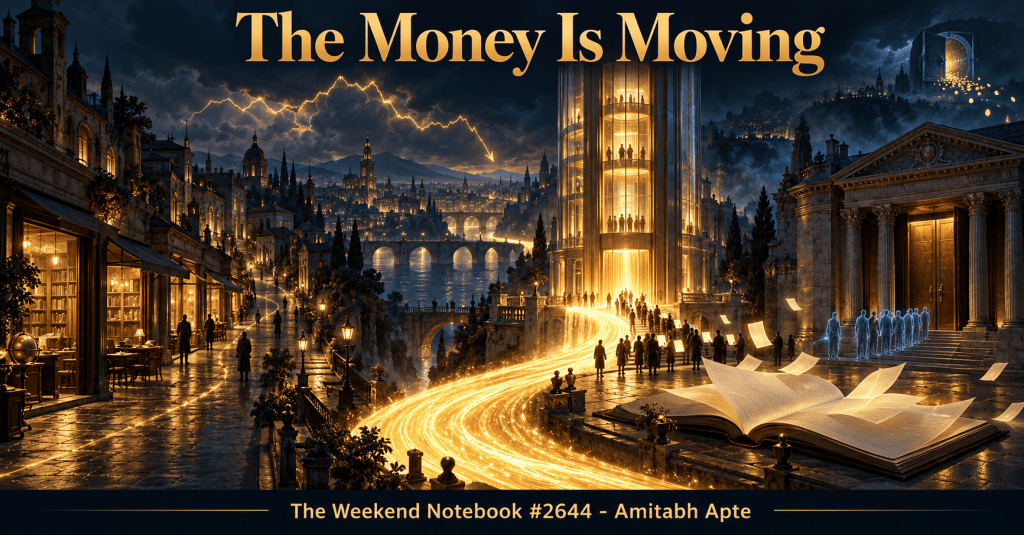
The Weekend Notebook #2644 – The Money Is Moving

Published on LinkedIn and amitabhapte.com  |  1 November 2026

Key developments and opinions which caught my attention this week.

This Is What I Read This Week

The biggest story this week was where the ad money goes when AI answers the question. Meta and Google showed two sides of it. Meta’s ad revenue grew 26% to $63.1bn, helped by AI targeting tools. Google’s search revenue grew 12%, down from 19% at the start of the year, and Google admitted that its AI Mode earns less per query than a classic results page. Alphabet lost about $475bn of market value in a day, its worst session since it listed in 2004. The pain spread. Reddit fell 29%, its worst day ever, after US daily users dropped 5% in the quarter. Its CEO pointed to Google’s AI answers, which are sending fewer people to the site. Pinterest slid too, on slower revenue growth and lower ad prices.

Investors are tired of the bill. The Nasdaq 100 was on course to lose more than $2 trillion in October, as the largest tech companies raised spending plans again and leaned harder on debt to fund data centres. JP Morgan expects global AI capex of $900bn this year.

Agents hit another wall. JPMorgan now restricts outside AI agents that log in with customers’ bank details, allowing read-only access such as checking a balance. Schwab is blocking unauthorised agents from moving money, and Amazon has kept Meta’s Muse off its store since September. The common worry: who is responsible when an agent gets it wrong.

Security had a heavy week. The New York Times reported that AI is finding bugs faster than Silicon Valley can fix them. Microsoft issued more than 1,400 patches in October alone, more than in all of 2025, and Chrome has fixed more bugs since June than in the previous two years combined. And Binance lost about $6.3bn in a hack that reportedly began with one compromised engineer’s laptop. Stablecoin issuers froze around $3bn, and Binance says it has set aside its own funds to cover the losses.

So What? My PoV and Takeaway This Weekend

The web ran on a simple deal for twenty years. Search sent people to your site, and you earned from the visit. AI answers are quietly breaking that deal. The answer arrives, the click never happens, and the money flows to whoever owns the conversation and the data behind it. A community site losing a million search referrals a week tells you the shift is already here.

The same pattern shows up in agents and security. Banks are blocking agents because nobody has agreed who carries the risk. AI finds flaws faster than teams can fix them. One laptop opened the door to a multi-billion-dollar theft. In each case the technology moved first, and the rules and the people behind it are catching up. Markets noticed. A $2 trillion month is investors asking the biggest spenders when the returns arrive.

My takeaways this week. Map how your customers find you when an AI gives the answer instead of a list of links, and treat being cited in that answer as a channel worth measuring. Fund fixing as well as finding: scanning tools are cheap, while the engineers who patch are scarce. And give every AI investment a payback story your board can test, because the market just asked the largest companies in the world for exactly that.

Weekend Notebook #49 – When Media Learns to Live with AI

Published on LinkedIn and amitabhapte.com on7thDec 2025


This week in AI – Deals, lawsuits, and the new media survival playbook

This week, traditional media finally showed its hand in the AI era.

Some chose partnership. Others chose confrontation. And together they revealed a simple truth.

Media is no longer negotiating with platforms. It’s negotiating with algorithms.

Meta struck multiple AI licensing deals with publishers, a pragmatic shift from conflict to compensation. Better to pay for data than fight over it.

Meanwhile, The New York Times went the other way, suing Perplexity for allegedly copying millions of articles. This isn’t just a copyright case. It’s a line in the sand.

“If AI becomes the new front page, who gets compensated for the journalism that trains it?”

Hollywood signalled its own adaptation curve. The $72B Warner Bros–Netflix pact is less about creative ambition and more about survival in an AI-enhanced production economy, where scale, tooling, and efficiency win.

Regulators made their presence felt too. Elon Musk’s X was fined €140M by the EU.

Australia signalled tougher accountability measures as social platforms edge closer to bans.

And then came a preview of the next frontier, Tilly Norwood, a fully AI-generated actress, no agent, no schedule, no limitations.

Cinema isn’t just being disrupted. Its economics are.


My takeaway this weekend

This was the week media stopped asking “What is AI doing to us?”
And started showing “How we plan to survive it.”

Some will partner.
Some will litigate.
Some will scale.
Some will reinvent.

But the pattern is unmistakable.

“AI is now the terrain media must learn to operate on. The winners will defend their value, license smartly, and adapt faster than algorithms evolve.”


Beyond AI: my mindshare – the FIFA Football World Cup Draw

Football’s biggest stage returns in 2026, stretching across the USA, Canada, and Mexico.

The World Cup isn’t just a tournament. It’s a global mood shift.

From Boston to Miami, Dallas to New York, iconic cities will host matches that celebrate talent, teamwork, and the world’s most universal language. England and Scotland will add their own chapters to the story, with fixtures that promise drama and emotion.

June to July will bring shared living rooms, late-night broadcasts, unforgettable goals, and a month-long reminder of why sport binds us.

The final at MetLife Stadium won’t just close a tournament. It will close a collective experience.

Weekend Notebook #41 – From Chat to Commerce: AI’s Next Platform Shift

Published on LinkedIn, Substack and AmitabhApte.com on 12th Oct, 2025


This week in AI – OpenAI DevDay & Market Slide

The past week offered a glimpse into what the next phase of AI-driven commerce might look like.

At the centre was OpenAI’s 2025 Dev Day, where the company introduced the Apps SDK and AgentKit, enabling developers to build apps and autonomous agents directly inside ChatGPT.

Early partners, Spotify, Canva, Zillow, and Mattel, showcased how everyday workflows, from designing visuals to booking homes or creating content, can now happen seamlessly within the chat experience.

This marks a shift from “AI that answers” to “AI that acts,” embedding intelligence across workflows, transactions, and creative ecosystems.

Elsewhere, Meta continued its hiring surge, adding over 50 researchers, including Andrew Tulloch, co-founder of Mira Murati’s Thinking Machines Lab, another reminder that the race for AI talent is intensifying even as markets cool.

And markets did cool. A $770 billion slide across megacaps like Amazon, Nvidia, and others marked the Nasdaq’s worst week since April, triggered by new U.S. tariffs on China and tightening export control signals.

Cybersecurity also stayed in sharp focus, with Qantas confirming a breach impacting 5.7 million customers, a stark reminder that as intelligence scales, so must resilience.


My Takeaway This Weekend

We got a glimpse of where AI is heading next, from chat to commerce, from tools to platforms, from answering to acting. But as innovation accelerates, markets cool and cyber risks rise, reminding us that the AI future must be built on stability, security, and societal balance, not speed alone.

The next phase of AI leadership isn’t about racing ahead; it’s about scaling responsibly.


Beyond AI: My mindshare – Jane Goodall

Jane Goodall who revolutionized primatology sadly passed away this week. Her outstanding work revealing chimpanzees’ use of tools, complex emotions, and social intelligence, reshaped our understanding of human evolution.

Through the Jane Goodall Institute and Roots & Shoots, she turned empathy into action, inspiring generations to protect what they understand.

Jane Goodall didn’t just study chimpanzees, she redefined what it means to be human.

If you haven’t yet, listen to her BBC Desert Island Disc from 2000, a timeless lesson in grace, conviction, and quiet strength.