
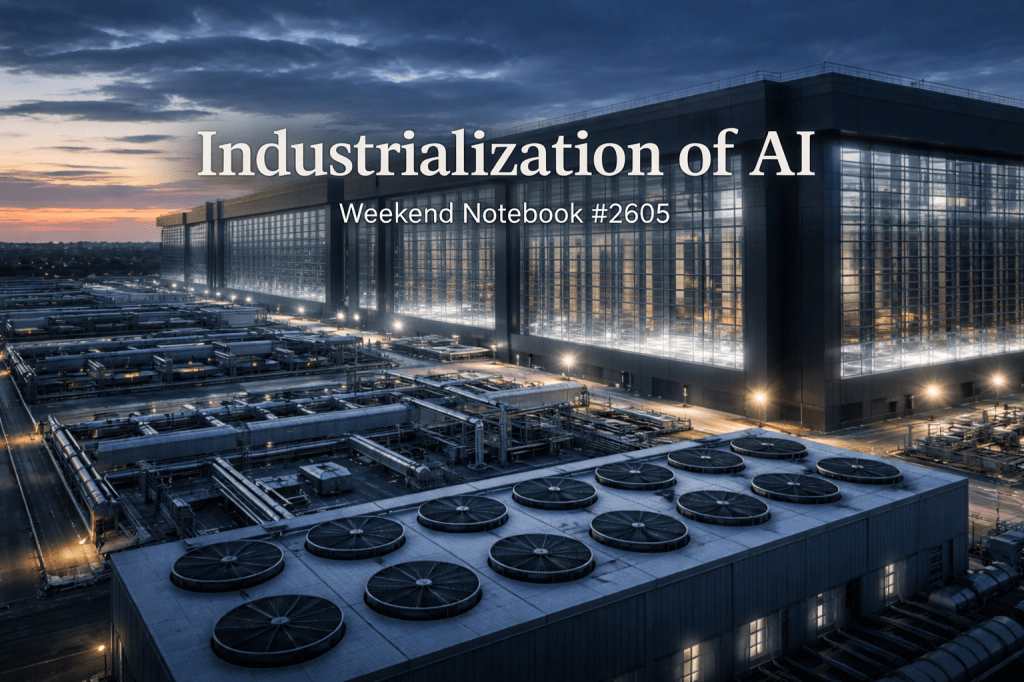
Weekend Notebook #50 – When Guardrails Drop and Hardware Stalls

Published on LinkedIn and amitabhapte.com on14thDec 2025


This week in AI – The Great Contradiction

This week, the AI story fractured. Not because progress slowed, but because it accelerated unevenly.

Policy surged ahead. Models leapt forward. Infrastructure hit resistance.

What emerged was a stark contradiction at the heart of the AI economy: intelligence is scaling at digital speed, but deployment is still bound by physical reality.

Three signals made that tension unmistakable.

First, the velocity.

The US administration signalled a decisive shift. Speed now trumps caution. President Trump’s Executive Order blocked states from regulating AI, creating a federal fast lane for Silicon Valley.

The intent was clear: remove friction, accelerate advantage.

Markets responded immediately. OpenAI released GPT-5.2, not just a smarter model, but a professional-grade, agentic system designed for autonomy rather than conversation. This is AI built to act, not assist. The guardrails are thinning, and the models are accelerating.

This wasn’t coincidence. It was causality.

Second, the stall.

While software sprinted, infrastructure stumbled. Oracle shares dropped 11 percent on deployment delays, pulling Nvidia, CoreWeave, and Micron down with them. The reaction wasn’t about earnings. It was about execution.

The reminder was blunt: the Capacity Race is harder than the Capability Race. You can ship code overnight. You cannot pour concrete, secure power, or stabilise grids at the same pace. Physics still sets the tempo.

For leaders, this matters. AI advantage is no longer constrained by algorithms. It is constrained by land, energy, and logistics.

Third, the shift.

Disney invested $1 billion in OpenAI to license its characters for Sora. While others litigate,

Disney is operationalising. By moving its IP into generative video workflows, it validated Sora as a production-grade creative engine.

This isn’t just a media story. It’s a strategic pattern. IP owners are moving from defence to deployment, from protecting archives to activating them. The future of content is not about preservation. It’s about animation at scale.


My takeaway this weekend

We are watching infinite digital ambition collide with finite physical reality.

Policy is pushing. Governments are clearing the regulatory path.
Models are pushing. GPT-5.2 is ready for autonomous work.
Physics is pushing back. Infrastructure is now the bottleneck.

The constraint has shifted.

“The bottleneck is no longer policy or software. It is concrete and power. The winner in 2026 will not simply be the company with the smartest model, but the one that can physically deploy intelligence faster than everyone else. AI leadership is becoming an execution discipline.”


Beyond AI: my mindshare – The Faces Behind the Machine

I paused this week on the cover of TIME magazine. The “Person of the Year” wasn’t a single individual, nor was it AI itself, as the “Computer” once was in 1982. It was the Architects of AI: Altman, Huang, Zuckerberg.

That choice matters.

For years, we’ve spoken about AI as if it were weather. Something inevitable. Something happening to us. By putting human faces on the cover, TIME reminded us of a grounding truth:

AI is not weather. It is architecture.

It is the result of choices. Trade-offs. Incentives. Ego. Ambition.

Seeing these builders grouped together, competitors and collaborators at once, reinforced something easy to forget amid the abstractions of silicon and scale. The most powerful operating system shaping AI’s future is still the oldest one we have.

Human nature.

“As we head into the holidays, that’s both comforting and unsettling. The machines are learning fast. But the direction they take still depends on the people building them. And that responsibility hasn’t been automated away.”

Weekend Notebook #32 – GPT-5, Early AI Winners & Losers

Published on LinkedIn and AmitabhApte.com on August 10, 2025


In spotlight this week: GPT-5 lands but not everyone’s cheering

The AI world has been holding its breath for GPT-5, the long-promised leap forward. Now it’s here. But instead of unanimous applause, the launch has landed like a blockbuster film breaking box office records while dividing critics.

OpenAI calls GPT-5 its most capable, reliable, and safe model yet, a multimodal workhorse for coding, writing, health, and complex reasoning. It’s faster, hallucinates less, remembers more, and can now work seamlessly across text, images, and code. Microsoft Copilot is already running on it, meaning millions will soon be using GPT-5 without even knowing it.

On paper, this is the AI assistant we’ve been promised:

  • Longer memory & context so it can finally act like a long-term colleague, not a one-off chatbot.
  • Multimodal fluency for integrated text, image, and code workflows.
  • Enterprise-grade reliability & safety for regulated industries and mission-critical work.

My early take? This is a strategic reset, simplifying model choices for users while pushing benchmark-beating features that play well in health, enterprise, and developer spaces. But some of the most enticing tools, like Google Calendar integration, sit behind the pricier Pro tier, risking a fragmented user experience.

And the user feedback? A mixed bag. Some love the speed and precision. Others miss GPT-4o’s personality describing GPT-5 as shorter, blunter, and less emotionally intelligent. My bet: early quirks will be ironed out. Whether GPT-5 is better for day-to-day use than GPT-4 or GPT-4o will be decided not by benchmarks, but by how it feels in the hands of real users.


Noteworthy this week: the AI fault lines widen

1. AI revenue champions

2. Strategic shifts

3. Human cost & disruption


In summary: my key takeaway this weekend

GPT-5’s debut shows the next chapter in AI: sophistication, integration, and enterprise deployment. OpenAI’s bet is to make AI the default productivity layer. But capability alone isn’t enough, user experience still wins hearts and adoption.

This week’s wider news makes the contrast sharper. AI is accelerating the rise of companies like Harvey, Palantir, and Duolingo, turning algorithms into revenue and market advantage. But it’s also rewriting the scoreboard in real time, pushing some players off the field entirely.

The lesson? In the AI era, the same force that fuels the winners can just as quickly leave others behind. The future of productivity isn’t just being built, it’s being fought for.