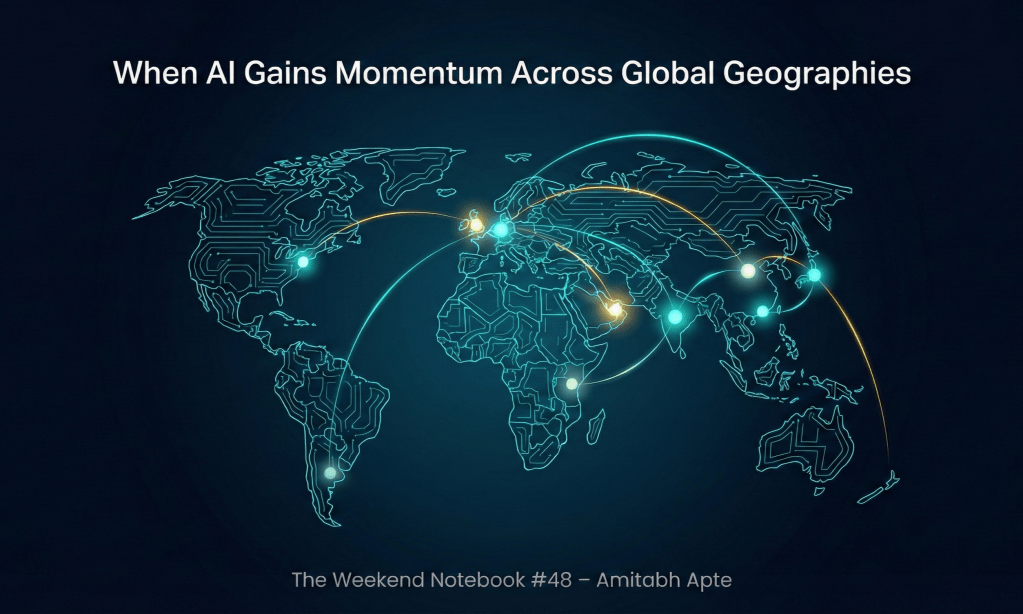
Weekend Notebook #48 – When AI gains momentum across global geographies

Published on LinkedIn and amitabhapte.com on 30th Nov 2025


This week in AI – Growth beyond the West Coast, global players join the AI race

Some weeks, the AI narrative feels local, shaped by a handful of companies on the US West Coast.

This was Not one of those weeks.

This was the week AI revealed its global ambitions.
Not through model releases, but through cranes, concrete, capital, and policy.
Every region moved in its own direction, and for the first time, those directions felt equally significant.

Asia moved with industrial intent.

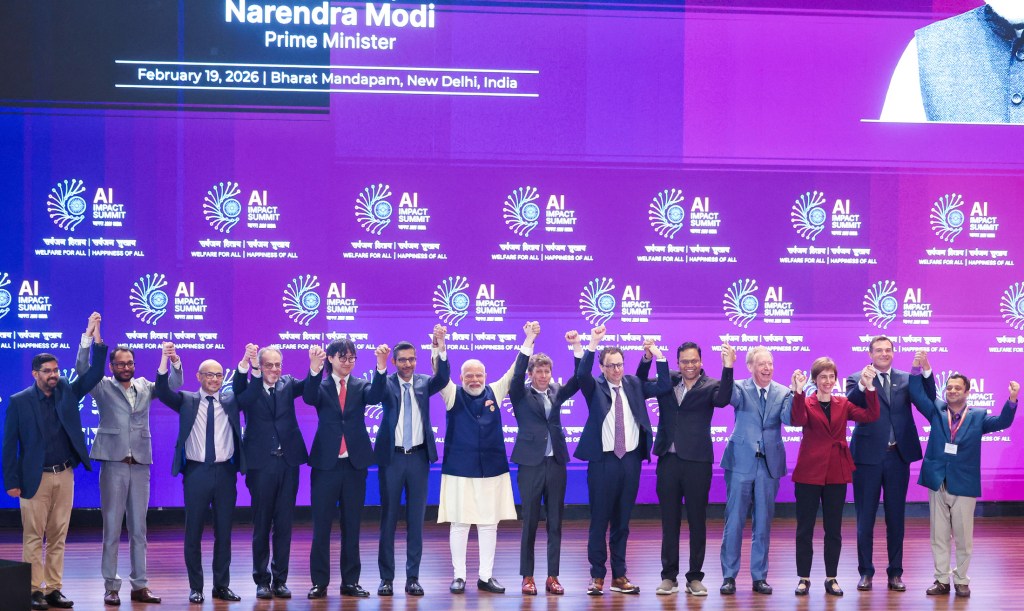
India’s Adani Group is reportedly in talks with Google on a multi-billion-dollar data-centre partnership. India is no longer content being the world’s digital back office. It wants to be a compute power in its own right.

Japan, meanwhile, approved Micron’s $96B semiconductor project, not a press release, but a generational bet on the Indo-Pacific becoming the world’s memory and materials corridor.

China took a different route.

Alibaba didn’t just talk about AI; it shipped it, Quark AI glasses and a cloud business now lifted by real workloads. China may not be leading the frontier-model race, but it is winning the deployment race. Intelligence at the edge, not just the cloud.

Africa showed the geopolitics beneath the ambition.
A WSJ investigation revealed Chinese firms now control nearly half of Africa’s IPv4 addresses. This is not an obscure technical footnote. In an AI-driven world, whoever controls the pipes controls the possibilities.

Europe leaned into its slow. steady. deliberate. advantage.

A new CNBC analysis suggests Europe’s measured approach may age better than Silicon Valley’s “move fast” doctrine. Markets seem to agree, Germany’s stock market is climbing again. Siemens Energy is emerging as one of Europe’s biggest beneficiaries of the AI-driven infrastructure boom with nearly a 100B Euro valuation.

The UK added its own twist: Qatar invested hundreds of millions into a British quantum startup, strengthening Britain’s emerging position in the quantum race.

And Revolut’s new $75B valuation underscores something deeper: global finance is quietly becoming one of AI’s most powerful accelerators, built on software, data, and automated risk intelligence.

The Middle East kept doing what it always does. Skip the pilot. Go straight to scale.

Uber’s driverless robotaxis will now operate commercially in the UAE. Not a test. A rollout. AI is becoming lived infrastructure faster than many Western cities can regulate it.

Zoom out, and one conclusion becomes impossible to ignore.

“AI is no longer a Western invention. It is a global construction project.”


My takeaway this weekend

AI is no longer a single race.
It’s a set of parallel movements shaped by regional ambition.

India and Japan are building the physical backbone. China is pushing intelligence into daily life. Europe is turning trust into strategy. The Middle East is deploying at city scale. Africa is emerging as the new arena for digital sovereignty. And the UK is betting on quantum, the foundational layer beneath it all.

The real question has shifted. Not “Who has the smartest model?”, but “Who can build the steadiest system around it?”

Compute, energy, policy, capital, trust this is where advantage now compounds.

AI leadership is moving from algorithms to infrastructure.
From speed to readiness.
From capability to resilience.

“The next winners won’t be the fastest movers. They’ll be the regions and leaders who can scale AI meaningfully across diverse geographies and real consumer impact.”


Beyond AI: my mindshare – the comfort of Christmas Films

This post comes just a day before December. Is it too early to think about Christmas? Perhaps. But there’s something timeless about the way certain films weave themselves into our holiday rituals.

This week, The Times published a beautiful guide to the best Christmas movies to stream, a reminder that stories can be as comforting as a warm blanket on a cold evening.

From the mischief of Elf and the tangled romances of Love Actually to the quiet grace of It’s a Wonderful Life, these films aren’t just entertainment. They are memory-makers. They carry the scent of mulled wine, the glow of fairy lights, and the soft permission to slow down.

What struck me most is how these classics endure despite infinite choice.

In a world of endless scrolling, we still return to the familiar to Bedford Falls, to Kevin McCallister’s misadventures, to the belief that hope can arrive in the most unexpected ways.“Perhaps that’s the real gift of the season: the chance to pause, revisit old stories, and let them remind us of what matte

Weekend Notebook #42 – Lights of Progress: from Smart Glasses to Smart Economies

Published on LinkedIn and AmitabhApte.com on 19th Oct, 2025


This week in AI – When AI Becomes Tangible

This week, AI stepped further out of the cloud and into the real world, shaping markets, moving currencies, and rewriting the geography of innovation.

EssilorLuxottica’s record-breaking quarter sent its shares up nearly 14% to an all-time high. The driver? Its AI-powered Ray-Ban Meta smart glasses. Once a novelty, they now represent a powerful convergence of hardware, intelligence, and design. The blend of form, function, and data is transforming wearables from accessories into interfaces, subtle, seamless, and socially acceptable. When design meets purpose, adoption accelerates.

Meanwhile, OpenAI’s new partnership with Broadcom marks a decisive move from software to silicon. By co-designing custom AI chips, OpenAI aims to reduce dependence on Nvidia and secure its own compute future. This is the next wave of integration, from algorithms to architecture, from models to metal, giving OpenAI control over both intelligence and infrastructure.

Finance, too, is recalibrating around AI’s physical footprint. Goldman Sachs is building a new lending unit to finance AI infrastructure, while BlackRock’s $20 billion acquisition of Aligned Data Centers ranks among the largest in the sector’s history. Infrastructure is now investable; data centres, cooling systems, and energy grids are becoming the new ports and pipelines of the digital age.

The wave is global, and India is fast becoming one of its most ambitious players. Google’s $15 billion investment in a new AI data centre in Visakhapatnam, , underscores India’s “swadeshi tech” ambition to localise AI infrastructure. To power this growth sustainably, the country is also exploring small modular nuclear reactors (SMRs) for round-the-clock clean energy, a bold shift from renewables that opens its nuclear sector to private and foreign investment.

Beyond India, the ripple effects are being felt across economies. Sterling and the Swedish krona are both strengthening as capital flows into new AI data hubs in London and Stockholm. Analysts call it the “compute capital effect”: when technology investment starts to influence currency strength and macro stability. Innovation, in other words, is becoming an economic moat.

And as AI enters new domains, society is adapting in parallel. Instagram’s upcoming parental controls for AI chatbots show how platforms are finally acknowledging their responsibility for young users’ wellbeing. In healthcare, AI is reducing administrative load and clinician burnout, yet only 28% of doctors feel ready to use it effectively. The technology is advancing faster than human capability to absorb it. That readiness gap is emerging as one of the defining leadership challenges of our time.


My Takeaway This Weekend

From eyewear to energy, from silicon to society, one theme connects it all: AI is crossing from the digital layer into the physical economy. It’s no longer something we log into; it’s something we live within.

“This is the industrialisation of intelligence, when data becomes infrastructure, and infrastructure becomes intelligent.”

For leaders, the task ahead is to design for that convergence, where compute, capital, and culture intersect. Because the next decade of AI won’t just be coded in labs; it will be built in factories, financed by markets, powered by clean energy, and worn on faces.


Beyond AI: My mindshare – the Light we share

This week, as millions around the world celebrate Diwali, the festival of lights, homes, offices, and streets glow with lamps, laughter, and the scent of homemade delicacies.
It’s a time to pause, reconnect with family and friends, and celebrate the warmth of togetherness.

For me, Diwali has always been about more than lighting diyas. It’s also a reminder to light the lamp within, the spark of compassion, curiosity, and kindness that brightens the lives of those around us. Each flame we light carries meaning: to share joy, to help someone find their spark, and to bring others along on our journey.

In a world that often feels fast and fragmented, Diwali invites us to slow down and rekindle what truly connects us, gratitude, generosity, and shared light.

“When we light a lamp for someone else, we illuminate our own path too.”

Weekend Notebook #39 – When Capital Meets Compute

Published on LinkedIn, Substack and AmitabhApte.com on Sept 28, 2025


In spotlight this week: The $100 Billion Question

Nvidia is planning to pour $100 billion into OpenAI to build next-generation data centres, in what could become the most ambitious AI infrastructure bet ever. On paper, it’s a marriage of two giants: Nvidia supplies the silicon, OpenAI drives demand. The ambition signals nothing less than the industrialisation of AI.

But there’s a tension here. Much of this capital will circle back to Nvidia’s own chips, fuelling whispers of “closed-loop” deals that echo dot-com era excess. Analysts are already asking: are we funding productivity revolutions, or inflating another bubble?

The stakes couldn’t be higher. If this bet delivers, we could see an acceleration of AI capability at a planetary scale. If it falters, the correction could be sharp, reshaping both capital markets and public trust.

Walmart’s CEO Doug McMillon added a sobering perspective: headcount will stay flat even as business grows, because AI will take on roles that once required people. Coming from the world’s largest private employer, this isn’t abstract, it’s the front edge of a workforce reset that will ripple far beyond retail.

My take: We’ve entered the era where compute has become capital. AI is no longer just software; its steel, energy, land, and labour economics. Leaders must prepare for the dual challenge: harnessing unprecedented opportunity while cushioning society from unprecedented disruption.


Noteworthy this week: what caught my eye in the AI and tech world

I track the week’s big currents across leadership, geopolitics, policy, infrastructure, and people. Three themes stood out this week:

1. Cybersecurity: breaches are now brand events

  • Harrods confirmed a breach via a third-party vendor; customer names and contact details compromised. Another reminder that supply-chain risk is now brand risk.
  • JLR is recovering from a major September cyberattack that halted production and shipments. Global supply chains remain brittle, and resilience is now as important as efficiency.

2. Infrastructure – capital meets fragility

  • Beyond Nvidia’s $100bn, OpenAI also struck a $400bn partnership with Oracle and SoftBank, and tied up with Databricks to deepen enterprise adoption. Lofty projections of $125bn revenue by 2029 and “trillions” in future data-centre spend highlight both ambition and fragility.
  • Anthropic is tripling its workforce and expanding globally, with 80% of usage now outside the US. From pharma to finance to governments, we’re moving from AI pilots to enterprise-scale deployments. The AI arms race is now unmistakably global.

3. Policy & People – platforms redraw the line

  • Spotify removed 75 million low-quality AI-generated tracks. Platforms are drawing new lines between innovation and integrity. Protecting human creativity is now a business necessity.
  • Neon, an app that pays users to record calls for AI training, has triggered major privacy alarms. The trade-off between data, consent, and profit is becoming the next trust battleground.
  • Global talent shifts: Indian Global Capability Centres are no longer just back-offices; they’re producing CXOs for Tesco, Walmart, SAP, and Maersk. By 2030, an estimated 30,000 global leaders will emerge from this pipeline, a structural rebalancing of corporate power.

Beyond Tech & AI: my “mind share” this week

This week I tuned into Steven Bartlett’s Diary of a CEO podcast with Dr Pradip Jamnadas, a cardiologist known as “the fasting doctor.” is insights were striking: modern diets overload us with insulin spikes, while simple practices like intermittent fasting and better sleep can transform long-term health.

It’s a timely reminder that while AI scales our external capability, it’s disciplined self-care that sustains our inner resilience.


In summary: my key takeaway this weekend

“Capital is racing into compute. Leadership must race just as hard to scale responsibility

Weekend Notebook #38 – Building AI nations, not just AI models

Published on LinkedIn, Substack and AmitabhApte.com on Sept 21, 2025


In spotlight this week: UK’s $200B AI Moonshot


President Trump’s UK visit culminated in a Tech Prosperity Deal with Prime Minister Keir Starmer, announcing over $200 billion in US–UK tech and AI investment. Microsoft pledged $30B over four years to expand AI and cloud infrastructure, Google committed $5B to boost AI and data centre capacity, and Nvidia invested £500M in Nscale as part of a broader £11B push into UK-based AI factories powering projects like OpenAI’s Stargate and Microsoft’s new supercomputer.


This deal signals a decisive shift: the UK is not just regulating AI, it is building itself into a sovereign AI hub. Tens of thousands of jobs will be created, supply chains for GPUs and compute will be strengthened, and Britain’s role in transatlantic AI collaboration will deepen. In an era where compute is the new oil, data centres and sovereign infrastructure are the new battlegrounds for economic and geopolitical advantage.


My PoV – This is the UK’s moonshot moment. Infrastructure at this scale could anchor Britain as a global AI leader, but steel and silicon alone aren’t enough. The real test is whether investment translates into skills, trust, and adoption that benefit society as well as industry. For business leaders, the takeaway is clear: the future of AI competitiveness isn’t about building smarter models, it’s about building the foundations that let those models thrive.


Noteworthy this week: what caught my eye in the AI and tech world

Talent, regulation & geopolitics

  • The U.S. has escalated its H-1B visa crackdown, imposing a $100,000 fee that is forcing Indian IT firms to curb onshore rotations and accelerate offshore models. Tech giants like Microsoft, Amazon, Meta, and JPMorgan are warning foreign employees not to travel, underscoring how policy shifts directly reshape global talent flows.
  • TikTok has won a reprieve in America under a new deal that reduces Chinese ownership below 20% and places Oracle in charge of U.S. data, a blueprint for how national security concerns could reshape tech governance going forward.

Consumer trust under pressure

  • The Amazon Prime trial will test whether subscription giants have been deliberately making cancellations too complex. If the FTC prevails, Amazon could be forced to simplify flows, setting new norms for consumer rights in digital services.
  • Across the Atlantic, a cyberattack on European air travel systems grounded flights at Heathrow, Berlin, and Brussels, shaking public trust in critical infrastructure and spotlighting how fragile digital-first services remain in the face of cyber risk.

The infrastructure arms race

Hardware sovereignty & intelligence on the edge

  • Apple is accelerating its in-house chip strategy, prioritising AI-optimised silicon that boosts on-device intelligence, efficiency, and privacy while reducing reliance on third parties. Taken with Nvidia and Oracle’s bets, the story is clear: hardware design and infrastructure control are becoming the new frontiers for competitive differentiation in AI.

Beyond Tech & AI: my “mind share” this week

Being back at Barilla’s Parma HQ in the heart of Italy’s Food Valley was both inspiring and grounding. While plenty of Data, Tech and AI conversations kept me busy, what made the week truly special was the chance to sit with colleagues across cyber, data, infrastructure, and sales. Listening, learning, and aligning on our shared priorities. Moments like these remind me that while AI, digital, and data drive transformation, the culture, humility, and human connection that give those technologies meaning and staying power.


In summary: my key takeaway this weekend

“From moonshots in London to conversations in Parma, the same truth echoed: AI’s future won’t be written only in code or capital. It will be written in the bridges we build between technology and trust, scale and society, steel and soul.”

Weekend Notebook #34 – From Cloud to Chip- The AI Assistant Revolution

Published on LinkedIn, Substack and AmitabhApte.com on August 24, 2025


In spotlight this week: AI assistants go mainstream – Apple eyes Gemini, Google embeds it.

What if your phone didn’t just respond to you, but anticipated your needs before you spoke? This week, AI assistants took a giant leap from cloud-based helpers to embedded, proactive companions. Apple is reportedly in talks with Google to integrate Gemini into Siri, potentially transforming its underwhelming assistant into a multimodal powerhouse. While no deal is confirmed, the move signals Apple’s openness to external AI partnerships, including ongoing discussions with OpenAI and Anthropic. The goal: to bring richer, more conversational intelligence to iPhones and across Apple’s ecosystem.

Meanwhile, Google has taken a decisive leap forward with the launch of its Pixel 10 smartphone lineup, embedding Gemini AI directly into the device via its new Tensor G5 chip. The Pixel 10 series introduces features like Magic Cue, which proactively surfaces relevant info across apps, and Gemini Live, which offers real-time visual assistance based on what the phone sees. Other AI-powered upgrades include Voice Translate for multilingual calls, NotebookLM integration for smarter notetaking, and Pixel Journal for wellbeing tracking. The Pixel 10 Pro models even come bundled with a year of Google AI Pro subscription, unlocking creative tools like Imagen 4 and Veo 3.

My key takeaway: The battleground is no longer just software. It’s the device, the chip, and the ecosystem. Apple is pivoting strategically, Google is executing decisively. Both point to the same future: assistants that are native, multimodal, and deeply personal.


Noteworthy this week: what caught my eye in the AI and tech world

Meta + Midjourney – Meta has struck a deal to license Midjourney’s image-generation tech for future products. It’s a boost in visual creativity and a possible hedge against the lukewarm response to its own Llama 4. Partnerships like this are signals. Meta knows it needs an edge beyond its own labs.

Intel agrees 10% U.S. stake –Intel is selling a 10% stake to the U.S. government, one of the largest federal equity moves since the 2008 auto bailout. It strengthens chip sovereignty but also raises a hard question: what happens when governments become shareholders in the engines of tomorrow?

New turn in Nvidia’s chip for China – Nvidia has stopped producing its H20 chip for China after Beijing told local firms not to buy it, despite U.S. approval. It’s the latest flashpoint in the U.S.–China tech standoff. Critical AI infrastructure is seen as differentiator in increasing tense geo-political scenarios.

Coinbase firing engineers for not onboarding AI – Engineers who failed to adopt tools like GitHub Copilot were let go. Coinbase calls it “AI fluency or out.” Yes, fluency in AI is now non-negotiable. But enforced adoption without empathy risks losing talent and trust.

TCS opens AI-led operations centre in LATAM – A new AI-led operations centre marks its eighth in the region. Jobs, skills, and digital transformation are the pitch. Indian IT giants are exporting AI at scale, and LATAM is the next growth frontier.

TikTok to replace UK staff with AI –Over 85% of moderation is now automated, with thousands of roles at risk. Efficiency is up but user trust may not be. Platforms can’t trade human oversight for pure automation without ethical safeguards.

In summary: my key takeaway this weekend

This week marks a turning point. AI assistants are no longer cloud novelties, they’re becoming embedded essentials. Apple is courting Gemini. Google is hard-wiring it into Pixel 10. Meta, Intel, Nvidia, Coinbase, TikTok, each move adds to the same message: AI isn’t just a feature. It’s the new operating system of everything. The question now is not if you’ll use an assistant, but whose ecosystem you’ll live in.