
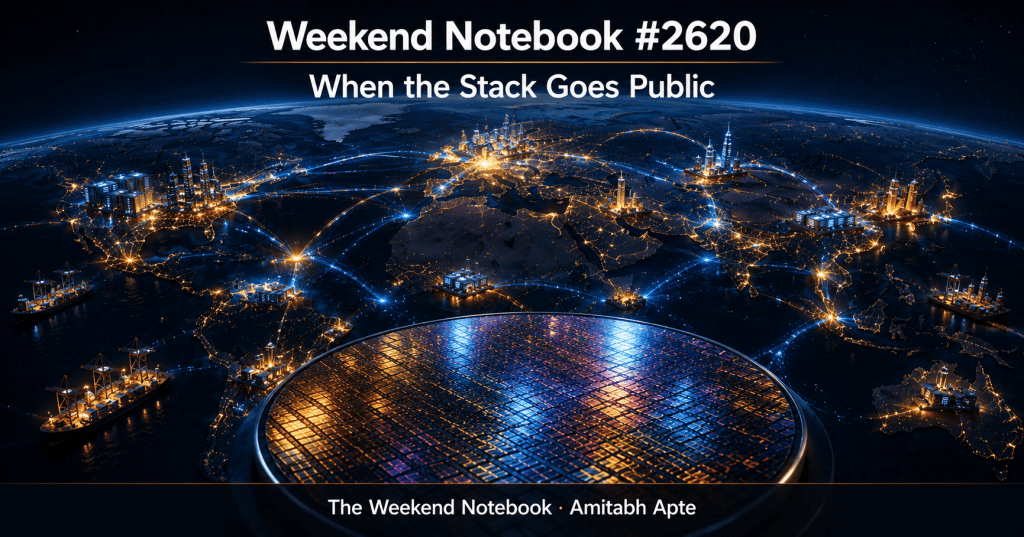
Weekend Notebook #2620 – when the Stack goes Public

Published on LinkedIn and amitabhapte.com  |  17 May 2026

This week, three very different stories arrived at the same conclusion. A chipmaker went public and nearly doubled on its first day. India signed a deal to build its first semiconductor fab. And AI-powered robots quietly took over 40 Los Angeles neighbourhoods while AI rewired the world’s largest e-commerce search bar. The infrastructure of intelligence is no longer being planned. It is being built, listed, traded, and deployed on your nearest pavement.

1. The Capital Signal: Chips, Memory and Public Markets

The Cerebras Systems IPO was the largest US tech listing since Uber in 2019. Priced at $185 per share, it raised $5.55 billion and surged 68% on its first day of trading, valuing the company at nearly $50 billion. The company makes wafer-scale AI chips. Its WSE-3 processor is the size of a dinner plate, packing over 4 trillion transistors, and is purpose-built for inference, running trained AI models fast and cheaply rather than training them. With AWS and OpenAI already as anchor customers, the order book closed 20 times oversubscribed.

The headline, though, is not just the company. It is the queue behind it. SpaceX, OpenAI, and Anthropic are all reportedly preparing listings, with SpaceX and OpenAI alone expected to raise a combined $135 billion. The public markets are signalling something clear: AI infrastructure is now a provable, priceable asset class, not a speculative bet.

And yet, as capital celebrates the chip layer, a different bottleneck is quietly tightening. High-bandwidth memory (HBM) has become AI’s most critical constraint. Data centres now consume an estimated 70% of global high-end memory production. Samsung, SK Hynix, and Micron have reallocated the vast majority of their fab capacity to HBM for AI accelerators, producing 3x less conventional DRAM per wafer as a result. DRAM prices have surged sharply in early 2026, with memory sold out across the supply chain into 2027. The irony is structural: we are celebrating the intelligence layer while quietly starving the memory layer that makes it run.

My PoV The Cerebras IPO is important, but memory is the signal that matters more. When three manufacturers control 95% of global DRAM production and have committed most of it to AI data centres through 2027, every enterprise architecture conversation should include a memory procurement question. If your AI roadmap does not account for infrastructure scarcity, it is optimistic by design.

2. Geography as Strategy: Capital, Compute and Sovereignty

The most telling signal this week was not a product launch. It was a portfolio filing. A Reuters analysis of nearly 6,000 institutional investor 13-F filings showed that more than 4,000 funds added to or initiated positions in AI infrastructure stocks in Q1 2026. Only 146 sold. Not only that: there were no net sellers of utility stocks in the quarter, as pension funds and endowments moved money toward the power and cooling layer that keeps AI running. The Magnificent Seven are being treated selectively. The infrastructure beneath them is being bought without hesitation.

This capital movement is not random. It is following a geography. AWS committed €33 billion to Spain, framing the country as its European AI epicentre. Tata Electronics and ASML signed an MoU to build India’s first commercial 300mm semiconductor fab in Dholera, Gujarat, backed by an $11 billion investment. The deal, signed in the presence of both nations’ heads of government, covers ASML’s full lithography suite, talent development, and supply chain resilience, targeting chips for automotive, mobile, and AI from 28nm to 110nm. On services, TCS declaring its ambition to become the world’s largest AI-led technology services company, with 130 of its top 139 enterprise clients already on board and over 270,000 employees upskilled in AI in a single year. TCS Chairman N. Chandrasekaran describing AI as “the infrastructure of intelligence”, a deliberate echo of how the internet was framed in the late 1990s. Silicon, services, and strategy, converging at the same moment.

The broader pattern is clear. AI leadership is being contested not just in model benchmarks but in megawatts, fab nodes, data centre land, and sovereign infrastructure decisions. The race has moved from algorithms to atlases.

My PoV When 4,000 institutions buy AI infrastructure and zero sell utilities in the same quarter, that is not a trend. It is a conviction. The smart money has concluded that the physical layer of AI, power, chips, cooling, connectivity, is where durable advantage compounds. For enterprise technology leaders, the implication is concrete: your AI strategy is increasingly shaped by decisions being made in fabs, power grids, and diplomatic meetings, not just in model releases. Understanding your infrastructure dependencies by geography is no longer optional. 

3. AI Meets Culture: From Cannes to the Pavement

Two very different scenes this week, both telling the same story about normalisation.

At Cannes, filmmakers shifted from resistance to pragmatism. French director Xavier Gens noted that AI would have cut his Netflix hit’s visual effects budget in half and saved eight months of post-production time. Demi Moore, serving as a jury member, said simply: “AI is here. To fight it is to fight something that is a battle we will lose.” The distinction that emerged from Cannes was useful and important: directors broadly agreed that using AI to generate scripts or entire films from a prompt should not be allowed, but its use in production and post-production is increasingly accepted. Guillermo del Toro put it well, noting that lumping all AI applications under one label makes productive discussion impossible. That nuance, creativity vs. craft, authorship vs. tooling, is the conversation every industry will eventually need to have. Cannes just had it in public first.

On the commerce side, Amazon replaced Rufus with Alexa for Shopping, embedding an AI assistant directly into the default search bar of the world’s largest e-commerce platform. No click required. AI answers now appear by default for complex queries, completing the shift from search as retrieval to search as conversation. The assistant can also shop third-party retailers and execute purchases autonomously through Buy for Me. Meanwhile, on the streets of Los Angeles, Serve Robotics has deployed over 500 sidewalk delivery bots across 40 neighbourhoods, up from just two in 2023. Cities are scrambling to draft regulations in real time.

The pattern across Cannes, Amazon, and the pavements of Los Angeles is the same. The debate has moved from “will AI arrive?” to “how do we live with it?” That is a meaningful shift. It means AI is no longer being evaluated. It is being negotiated.

My PoV The Cannes conversation matters for leaders well beyond media. Every industry will face the same negotiation: which parts of creative and knowledge work can be augmented, which parts should remain human, and how do you draw that line without either losing competitive ground or losing your people? The organisations that will navigate this best are those that have the conversation explicitly, rather than letting it resolve through default or drift. 

My Takeaway This Weekend

Three things became measurably more real this week. The chip layer went public and priced at scale. The geographic layer hardened, with capital, fabs, and services converging by region rather than by company. And the consumer layer normalised, quietly and irreversibly, from the search bar to the pavement.

The window between “this is coming” and “this has already happened” keeps closing faster than planning cycles allow. The organisations best positioned are not necessarily those with the most AI projects. They are the ones that understand where their infrastructure dependencies sit geographically, which parts of their work they are willing to delegate, and which parts they are determined to protect.
Weekend Notebook #47 – When models mature and the world stretches

Published on LinkedIn and amitabhapte.com on23rd Nov, 2025


This week in AI – Gemini 3 and the new infrastructure race

This was the week Google forced the AI narrative to tilt again. Not through hype, but through the release of Gemini 3, a model that signals a deeper shift in where the frontier now sits. For the first time in a while, the conversation wasn’t about clever demos or novelty features. It was about capability that feels embedded, a model designed to sit inside Google’s full ecosystem of search, cloud, devices, and productivity tools.

Gemini 3 lands as an integrated intelligence layer, not a standalone chatbot. And that matters. In AI, distribution consistently beats brilliance. Google’s advantage is not just the model. It’s the hundreds of millions of moments, queries, clicks, sessions, and decisions where that model can quietly shape outcomes.

But the more revealing signal came from inside Google itself: the acknowledgement that its AI-serving infrastructure must double every six months just to stand still. That single line says more about the state of the AI race than any model release could. We are no longer in a software cycle. We are in an industrial one, where progress depends on data centres, silicon supply, energy availability, physical footprint, and geopolitical access.

You could see that geopolitical undercurrent everywhere this week.

The UAE’s decision to invest $1 billion into African AI infrastructure is not a regional experiment, it is a strategic expansion of influence through compute. Data centres are becoming diplomatic instruments. Sovereign infrastructure is becoming soft power.

Markets echoed this momentum. Nvidia delivered another strong quarter, easing concerns of an AI slowdown while intensifying questions about global dependence on a single hardware backbone. When one company becomes the proxy for the world’s AI appetite, you realise this is no longer an industry story, it’s an economic architecture story.

My takeaway from the weekend

Put these threads together and the picture becomes clear. AI has split into two races:

• A capability race, where models like Gemini 3 reset expectations.
• A capacity race, where the world scrambles to build the physical, political, and economic foundations required to run those models at scale.

“The leaders who stay ahead will be the ones who understand that competitive advantage is shifting from “Who has the smartest model?” to “Who can deploy intelligence reliably, responsibly, and at scale?”


Beyond AI: my mindshare – when a Yogi meets an AI pioneer

I came across a fascinating conversation from two iconic leaders;  Spiritual leader and a great Yogi, Sri Sri Ravi Shankar and a leading AI thought leader, Andrew Ng.

One speaks about clarity of mind, the other about clarity of capability. Yet point to the same truth. AI will only move as fast as humans are ready to trust it, understand it, and work with it.

“Sri Sri emphasises inner steadiness. Andrew emphasises skill and confidence. Together, they outline the real leadership agenda: prepare the people as much as the model. Because in the AI age, intelligence is abundant. Readiness is not.”

Weekend Notebook #42 – Lights of Progress: from Smart Glasses to Smart Economies

Published on LinkedIn and AmitabhApte.com on 19th Oct, 2025


This week in AI – When AI Becomes Tangible

This week, AI stepped further out of the cloud and into the real world, shaping markets, moving currencies, and rewriting the geography of innovation.

EssilorLuxottica’s record-breaking quarter sent its shares up nearly 14% to an all-time high. The driver? Its AI-powered Ray-Ban Meta smart glasses. Once a novelty, they now represent a powerful convergence of hardware, intelligence, and design. The blend of form, function, and data is transforming wearables from accessories into interfaces, subtle, seamless, and socially acceptable. When design meets purpose, adoption accelerates.

Meanwhile, OpenAI’s new partnership with Broadcom marks a decisive move from software to silicon. By co-designing custom AI chips, OpenAI aims to reduce dependence on Nvidia and secure its own compute future. This is the next wave of integration, from algorithms to architecture, from models to metal, giving OpenAI control over both intelligence and infrastructure.

Finance, too, is recalibrating around AI’s physical footprint. Goldman Sachs is building a new lending unit to finance AI infrastructure, while BlackRock’s $20 billion acquisition of Aligned Data Centers ranks among the largest in the sector’s history. Infrastructure is now investable; data centres, cooling systems, and energy grids are becoming the new ports and pipelines of the digital age.

The wave is global, and India is fast becoming one of its most ambitious players. Google’s $15 billion investment in a new AI data centre in Visakhapatnam, , underscores India’s “swadeshi tech” ambition to localise AI infrastructure. To power this growth sustainably, the country is also exploring small modular nuclear reactors (SMRs) for round-the-clock clean energy, a bold shift from renewables that opens its nuclear sector to private and foreign investment.

Beyond India, the ripple effects are being felt across economies. Sterling and the Swedish krona are both strengthening as capital flows into new AI data hubs in London and Stockholm. Analysts call it the “compute capital effect”: when technology investment starts to influence currency strength and macro stability. Innovation, in other words, is becoming an economic moat.

And as AI enters new domains, society is adapting in parallel. Instagram’s upcoming parental controls for AI chatbots show how platforms are finally acknowledging their responsibility for young users’ wellbeing. In healthcare, AI is reducing administrative load and clinician burnout, yet only 28% of doctors feel ready to use it effectively. The technology is advancing faster than human capability to absorb it. That readiness gap is emerging as one of the defining leadership challenges of our time.


My Takeaway This Weekend

From eyewear to energy, from silicon to society, one theme connects it all: AI is crossing from the digital layer into the physical economy. It’s no longer something we log into; it’s something we live within.

“This is the industrialisation of intelligence, when data becomes infrastructure, and infrastructure becomes intelligent.”

For leaders, the task ahead is to design for that convergence, where compute, capital, and culture intersect. Because the next decade of AI won’t just be coded in labs; it will be built in factories, financed by markets, powered by clean energy, and worn on faces.


Beyond AI: My mindshare – the Light we share

This week, as millions around the world celebrate Diwali, the festival of lights, homes, offices, and streets glow with lamps, laughter, and the scent of homemade delicacies.
It’s a time to pause, reconnect with family and friends, and celebrate the warmth of togetherness.

For me, Diwali has always been about more than lighting diyas. It’s also a reminder to light the lamp within, the spark of compassion, curiosity, and kindness that brightens the lives of those around us. Each flame we light carries meaning: to share joy, to help someone find their spark, and to bring others along on our journey.

In a world that often feels fast and fragmented, Diwali invites us to slow down and rekindle what truly connects us, gratitude, generosity, and shared light.

“When we light a lamp for someone else, we illuminate our own path too.”

Weekend Notebook #36 – The future of work: written in code, judged by people

Published on LinkedIn, Substack and AmitabhApte.com on Sept 7, 2025


In spotlight this week: When AI efficiency meets human cost

This week, AI showed us both sides of its coin: efficiency celebrated in boardrooms, uncertainty felt in households.

Salesforce announced it will cut around 4,000 jobs, the latest in a wave of Big Tech restructuring. At the same time Stanford study reinforces a point that many feared: AI adoption is already reducing jobs in predictable, routine, or entry-level tasks and creating fewer immediate opportunities for displaced workers.

One signal from industry, one from academia. Together, they tell a stark story: the AI dividend is real, but unevenly distributed. Enterprises capture productivity gains and shareholder value. Workers face uncertainty, communities disruption. AI isn’t just augmenting; it’s replacing, even in white-collar domains once thought safe.

For leaders, the message is clear: redesign jobs, not just reduce them. Reskill, rebuild ladders of opportunity, and maintain trust while pursuing efficiency. Cutting costs with AI may deliver short-term wins, but without reinvestment in people, it risks long-term fracture.

The companies that thrive won’t be those that simply shrink their payrolls; they’ll be those that create new paths for human potential.

“The future of work won’t be written by AI alone. It will be judged by how we choose to keep humans in the story.”


Noteworthy this week: what caught my eye in the AI and tech world

Robinhood and AppLovin to join S&P 500 – Robinhood’s inclusion signals fintech’s growing legitimacy. AppLovin’s 77% revenue growth and pivot to high-margin adtech position it as a rising AI-driven advertising force.

OpenAI $115B spending surge – Revised projections show nearly $80B more than expected by 2029, as OpenAI seeks control of its infrastructure. It’s bold, but aligned with megacap-level AI investment. My take: AI is no longer R&D, it’s industrial policy.

Anthropic’s $1.5B copyright settlement – The largest in U.S. history, resolving piracy of books from shadow libraries. The judge upheld training AI on copyrighted works as fair use, but the case highlights the urgent need to modernize copyright law for the AI age.

AI upends search advertising model – Ad spend in AI-driven search projected to jump from $1B in 2025 to $25.9B by 2029. From static keywords to multimodal, dimensional queries, this shift will redefine attribution, monetization, and competition in the AI-native web.

Google gets to keep Chrome – Found guilty of monopolistic practices in search, but allowed to retain Chrome and default search deals. Exclusive AI distribution contracts are banned, leaving Google free to double down on AI dominance.

India IT Inc worries on Tariffs – U.S. is weighing tariffs on Indian software exports, endangering a $283B industry reliant on U.S. clients. Combined with AI disruption, it’s a wake-up call: Indian IT must pivot from cost-based outsourcing to AI-led value creation.

OpenAI Job Platform – OpenAI plans to launch a certification program and job marketplace, aiming to train and certify 10M Americans by 2030. With Walmart as a partner, this is a direct challenge to LinkedIn, reshaping how people find and prepare for jobs in an AI-first economy.


Beyond Tech & AI: my music / media / sport “mind share” this week

The BBC Proms 2025 season is in full swing. Orchestral premieres, global folk fusions, and immersive film scores, something for everyone. My favourite this season? Anoushka Shankar’s “Chapters” performed with Robert Ames and London Contemporary Orchestra. A transcendent blend of Indian classical, electronica, and storytelling. Still available on BBC iPlayer. Don’t miss it.


In summary: my key takeaway this weekend

The accelerating march of AI is no longer a distant drumbeat it’s the rhythm reshaping our economy, work, and institutions in real time. From Salesforce’s job cuts to OpenAI’s $115B moonshot, the signals are clear: efficiency is prized, but empathy cannot be lost. Innovation without inclusion risks deepening divides.


“AI may be rewriting the rules but it’s up to us to decide who gets to stay in the game.”

Weekend Notebook #33 – Beyond the launch: GPT-5’s real impact starts here

Published on LinkedIn and AmitabhApte.com on August 17, 2025


In spotlight this week: GPT-5’s Enterprise Rise & Personal Rediscovery

GPT-5’s launch drew mixed reactions, underwhelming for some consumers but rapidly adopted in enterprise settings for tasks like coding, reasoning, and agent-building. OpenAI has since responded with updates to tone and access, while expanding its ambitions beyond models into apps, browsers, and even brain-computer interfaces.

Despite early criticism, GPT-5’s API traffic doubled in 48 hours, and platforms like Cursor have made it their default. OpenAI’s pivot toward enterprise and infrastructure signals a broader strategy, possibly laying the groundwork for an IPO and a future resembling Alphabet, but with deeper AI integration.

As someone now building a new app with GPT-5, I’ve found myself reconnecting with my programming roots, exploring JavaScript, Python, Supabase, and more. AI helps scaffold ideas fast, but the real magic still lies in debugging, testing, and iterating. It’s a bit old-school and that’s the fun part.


Noteworthy this week: what caught my eye in the AI and tech world

AI Evolution Sparks Sell-Off in European Tech Stocks -European AI adopter stocks like SAP, Sage, and Capgemini have plunged amid fears that powerful new AI models, such as OpenAI’s GPT-5 and Anthropic’s Claude could disrupt their business models. Investors are reassessing high-valuation firms as AI’s rapid evolution challenges traditional software and data services.

Big Tech’s Energy Impact – Amazon, Google, and Microsoft are reshaping the U.S. power industry as their AI-driven data centers dramatically increase electricity demand. This surge could raise energy costs for individuals and small businesses nationwide.

Samsung Surges with Foldables – Samsung is gaining traction, boosting its U.S. market share from 23% to 31% while Apple slips. With innovative form factors, such as foldables and AI integration, Samsung is challenging Apple’s long-standing dominance.

Perplexity Bids for Chrome – Perplexity AI has made a bold $34.5bn unsolicited bid for Google Chrome, positioning it as a solution to Google’s ongoing antitrust troubles. The offer highlights growing confidence among AI firms to challenge Big Tech dominance.

Claude AI Sets BoundariesAnthropic’s Claude models can now end chats in extreme cases of harmful or abusive user behaviour, not to protect users, but potentially the AI itself. This experimental feature reflects growing interest in “model welfare” and ethical AI design.

In summary: my key takeaway this weekend

GPT-5’s enterprise momentum is undeniable, and its integration into infrastructure and tooling marks a shift from flashy consumer launches to deep, foundational impact. Meanwhile, my personal journey with coding reminds me that even in an AI-first world, human creativity and iteration remain irreplaceable. GPT-5 may be the future of enterprise AI, but the real revolution is rediscovering the joy of building with your own hands.