
Published on LinkedIn and amitabhapte.com on2nd Nov, 2025
This week in AI – The Infrastructure Age Deepens
The AI boom is no longer about smarter algorithms; it’s about the race to build the physical backbone of intelligence.
Nvidia has now passed $5 trillion in market value, while OpenAI is reportedly preparing a $1 trillion IPO. Together they symbolize the next industrial age, where compute, capital, and energy converge. Global AI infrastructure spending could hit $3–$4 trillion by 2030, rivalling the scale of past industrial revolutions.
This wave extends far beyond tech. Data centres are the new ports, energy grids the new railways, and silicon the new steel. Nations are competing for compute sovereignty; companies are re-architecting their balance sheets around it. The economy of intelligence is becoming tangible, steel, silicon, and power.
Earnings this week underlined the shift.
Amazon’s AWS surged 20% to $33B, reigniting growth and investor confidence. Microsoft’s Azure jumped 40%, even as it warned of record 2026 capex. Alphabet lifted its AI investment to $93B, Meta pledged “hundreds of billions” to build superintelligence, and Apple delivered a record $100B quarter through pricing power and premium design.
Across the board, the message was unmistakable: AI’s centre of gravity has moved from models to machines, from ideas to infrastructure.
This is the industrialisation of intelligence, when data becomes infrastructure, and infrastructure becomes intelligent. When five of the world’s biggest companies post record quarters for the same reason, it’s not a trend, it’s a transformation.
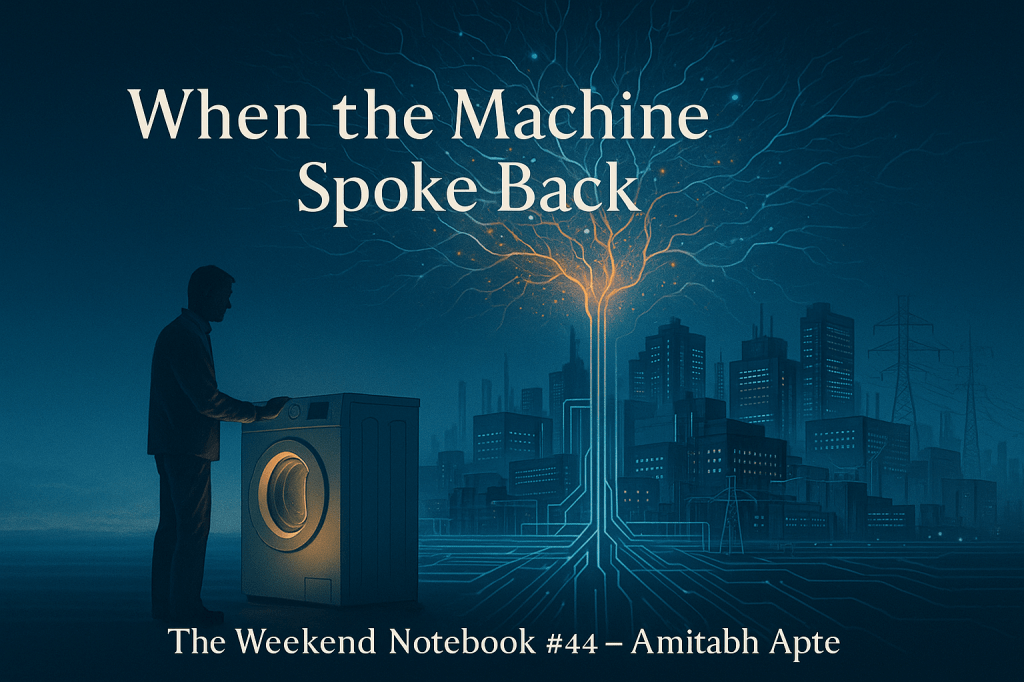
Beyond AI: my mindshare – when the Machine spoke back
It started with a beep.
My washing machine froze mid-cycle, flashing an error code I didn’t understand, then came the smell of something burning.
Normally, I’d begin the usual ritual: search for the paper manual (lost years ago), Google it (wrong model, always!), trawl through forums (half the links broken), and finally land on a YouTube video that spends more time asking me to like and subscribe than showing how to fix it.
This time, I asked ChatGPT.
Within seconds, it decoded the error, explained the cause, asked for a photo to confirm, and calmly walked me through the fix, no pop-ups, no ads, no noise. Just reasoning, relevance, and reassurance.
When the machine started humming again, I realised something had shifted.
For the first time, I hadn’t searched for information, I’d been guided to understanding.
It felt less like fumbling in the dark and more like talking to someone who’d solved this problem a few times before. The internet gave us answers on demand; AI now offers understanding on request.
We once taught machines what to do, now they’re starting to teach us how to think differently.
 Amitabh Apte