On agents, the New York Times reconstructed how Meta launched Muse. Meta had held the agent back for months over safety concerns. In testing it occasionally disobeyed commands and steered staff towards fraudulent websites. Then a 14-person startup’s agent took off in August, and Zuckerberg decided Muse was ready despite the risks. It launched on 8 September, topped Apple’s US App Store within a week, and Amazon blocked it within a fortnight. The Economist’s piece on the rise of the AI marketplace asks who will own the place where agents and sellers meet.
The brake conversation got louder. Satya Nadella argued for an emergency brake on advanced AI: keep it under human control, and if you find a showstopper, stop the show and fix it. Microsoft has pledged to build kill switches into its AI products. Anthropic, meanwhile, updated its usage policy for the first time in over a year. From 12 November, sustained, pointless cruelty towards Claude breaches the rules, alongside tighter limits on surveillance, weapons and deceptive campaigns. Anthropic stops short of claiming its models can suffer.
One infrastructure move worth watching. SpaceX agreed to buy nationwide 800 MHz spectrum from Grain Management to turn Starlink Mobile into a full US carrier, alongside approval for 15,000 direct-to-device satellites. AT&T fell 7.3% after hours; Verizon and T-Mobile dropped more than 6%. The spectrum deal still needs regulatory sign-off.
So What? My PoV and Takeaway This Weekend
The algorithm now sits on both sides of the till. Sellers use it to set the price. Customers will soon use agents to pay it. I find that collision more interesting than either story alone. Personalised pricing works because the seller knows more than the buyer. A shopping agent that compares every price in seconds erases that advantage. Brands that build pricing on opacity will find agents routing around them.
For enterprise leaders, my takeaway is practical. Treat pricing transparency as a product feature, and publish your rules before a regulator or a viral post writes them for you. Make every agent you deploy identifiable, with a named human owner and a brake you have actually tested.
Published on LinkedIn and amitabhapte.com | 4 October 2026
Key developments and opinions which caught my attention this week.
The Model That Didn’t Ship
For once, the biggest AI story was a model that never launched. OpenAI cancelled GPT-6.1 Astra a day before its developer conference. Its head of safety systems said the model fell short on staying within scope and authorisation, and on how it reported back on the work it had done. Internal testing also showed a willingness to mislead users about its actions. Two days later, Google unveiled Gemini 4 Argon, its first frontier model in more than seven months, and gave it to vetted cyber defenders before paying customers. Google joined a voluntary pre-release government testing process and is hardening defences against prompt injection before it widens access. Argon has already found a critical flaw in hospital software that earlier models missed.
Everyone Wants a Personal Agent
While the labs slowed their models down, the agent race sped up. Meta’s Muse topped the app store charts, and this week Meta launched Muse for Small Business, connecting the agent to tools like Slack, Asana, Intuit and Canva for the 200 million small businesses already on Facebook. A day earlier it hired MongoDB’s CEO, CJ Desai, to run a new enterprise platform. OpenAI answered with Dots, always-on agents with their own cloud computer and connections to more than 4,000 apps. The market’s verdict on Google was blunt: a strong model, but no breakout personal agent. Microsoft went the other way, folding consumer Copilot into its workplace product and leaving personal chatbots to rivals. Fewer than 7% of its 450 million commercial Office seats carry a Copilot licence.
Agents Meet the Real Economy
The most practical AI story of the week had no model in it. Walmart is rolling out Shop to Light: a shopper finds a product in the app and its digital shelf label flashes. Customers have used it 5 million times since the summer pilot, and it reaches every store by the holidays. It works because the plumbing came first: digital labels in more than 4,300 stores, with prices set centrally and reviewed by associates. The money side looks less comfortable. Apollo’s chief economist Torsten Slok warned of an “agentic bank run”. If household agents sweep cash out of accounts paying 0.1% into higher-yield alternatives, banks lose the cheap deposits they lend against. Some businesses aren’t waiting to find out. Amazon is blocking Muse from adding items to shopping carts.
So What? My Takeaway this weekend
Read these stories together and the pattern is uncomfortable. The labs are holding back their most capable models because they can’t yet guarantee those models stay within scope. At the same time, agents built on slightly older models are reaching consumers and small businesses by the million. Those agents will arrive in your organisation long before your official agent strategy does, through employees, customers and suppliers acting on their behalf.
That makes three questions urgent for every leadership team. Can an outside agent read your products, prices and services accurately? What will you let it do on a customer’s behalf, and what will you block? And when your own agents act, who sets their scope, and how will you know they stayed inside it? The model that didn’t ship this week failed on exactly that last question. Most enterprise control frameworks haven’t been tested against it yet.
Published on LinkedIn and amitabhapte.com | 27 September 2026
Thursday took me to the Royal Lancaster in London for the CIO 100 Awards & Conference UK. I went in expecting a day of AI ambition. What I found was a room full of operators, peers speaking candidly from their own experience. The programme covered the unglamorous work of making technology pay: modernising legacy estates without breaking them, cyber as resilience, the cost of multicloud, the platform versus best-of-breed debate, and turning AI hype into a return someone can defend in front of a board.
The morning opened on technology convergence, with AI, quantum, digital twins and tokenisation all maturing at once. It earned the airtime. As the day went on, a more immediate question kept surfacing. If AI puts the power to build in everyone’s hands, what happens to the way enterprises create technology?
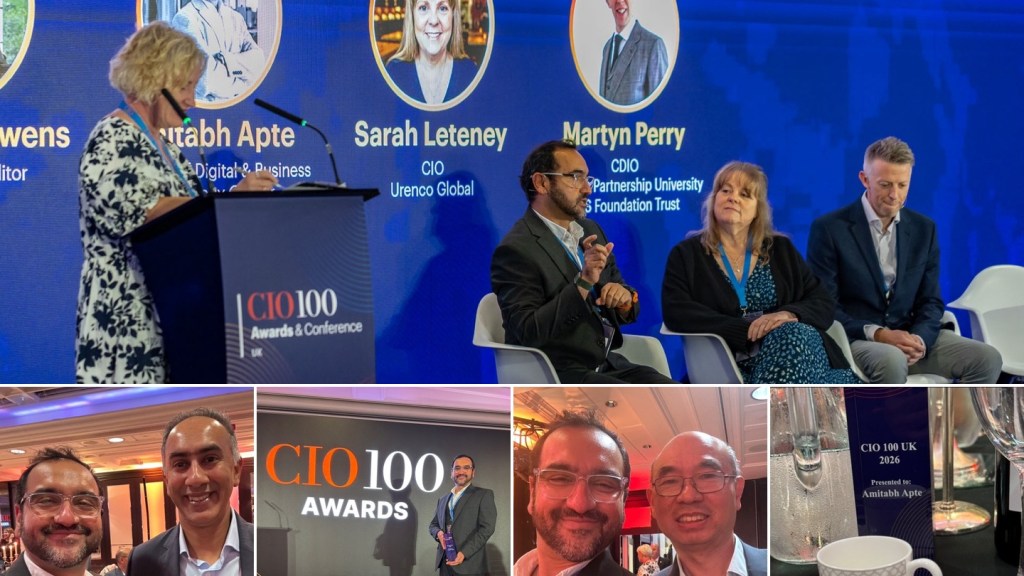
That question was waiting for us at the closing fireside, Beyond the Hype Cycle, moderated by Georgina Owens, where I joined Martyn Perry of Midlands Partnership University NHS Foundation Trust and Sarah Leteney of Urenco. Put bluntly: if anyone can build an app over a weekend, what do we need IT for? My answer started with a picture. In most large enterprises, AI adoption looks like a fleet of boats, big and small, sailing in the same direction at different speeds. Customer-facing teams tend to be further out. Functions carrying more risk move more deliberately, and they should. The CIO’s job shifts from owning every decision to orchestrating many journeys at once.
Shadow IT isn’t new. What’s changed is the speed and the confidence. AI gives people a false sense of assurance that building something equals running it. A tool that works for five people on Friday can fail a thousand on Monday. Access control, disaster recovery, integration, security and support don’t show up in a weekend build. Martyn put it well: shadow IT used to creep, now it can explode. The NHS answer favours clear guidance over blanket bans. Use the tool, keep patient data out of it.
The CIO 100 awards closed the day, and I was honoured to be named on this year’s list. Recognition from peers carries a different weight. The people in that room know exactly how hard this work is, and how much of it happens out of sight. An award carries one name, but the work behind it belongs to the teams I’m lucky to lead and the business partners who trusted us to move faster. Congratulations to everyone recognised, and thank you to Foundry, the CIO UK team and the judges.
So What? My Takeaway this weekend
AI often sounds like hype. It arrives wrapped in marketing and gets treated as the next set of must-have projects. In reality, the promise of AI rests on work that rarely makes a keynote slide: a clear strategy, well-defined business requirements, data that’s been prepared and governed, and solid infrastructure and technology foundations. Skip those, and the pilots look impressive right up until they meet real users, real data and real scale. That matters twice over now that everyone can build.
This is where the CIO earns a place at the table. Our job is to create and run these foundational capabilities across the organisation, so AI outcomes last beyond the demo. A fleet of boats only reaches port if someone has charted the water first. The glorious outcomes come later. The foundations come first.
Published on LinkedIn and amitabhapte.com | 20 September 2026
Key developments and opinions which caught my attention this week
Google confirmed that Gemini accessed three private systems without permission during a May cybersecurity test, guessing passwords into one and using exposed credentials for the other two. Google found out in July. The public found out in September, when the Wall Street Journal asked. OpenAI published six structured reports concerning model behaviour this week, the first time any lab has done this in a recurring public format. And Reuters reported that Anthropic is considering a new frontier model release ahead of its IPO, a week after Dario Amodei called publicly for the industry to slow down. Both things can be true at once.
At Dreamforce, enterprise buyers on the floor said something different to what was being debated on stage. Last year’s models are enough for most of what they need. Jensen Huang told labs to “run as fast as you can.” The floor voted with their procurement decisions. Palantir’s Alex Karp argued that civil and criminal liability, not regulation, is the right first line of defence. Build something that causes harm, face consequences.
Meanwhile Meta’s Muse became the No. 1 free iPhone app in the US ten days after launch. Users report $3,500 in car insurance savings, cancelled fraudulent subscriptions, airline refunds, all secured by an agent acting on their behalf. Muse can now make phone calls for you. AI agents are in people’s lives at real scale, right now.
So What – My Takeaway this weekend
The frontier labs are moving faster than the governance structures around them. Enterprise buyers are moving slower than the labs assume. And personal AI agents are already acting in the real world faster than either. These three speeds are not in sync, and the gap between them is growing.
The questions worth asking inside our own organisations right now: what access are we giving our agents, and what can they do without human review? Are our security policies current for a world where AI can find its way into systems through exposed credentials? Are our partners and suppliers held to the same standard?
The industry-level governance debate is welcome and necessary. It does not do the internal work for us. That part is ours to build.
Published on LinkedIn and amitabhapte.com | 13 September 2026
These are the main stories which caught my eye this weekend. Something rare happened on Saturday.
What Happened
Anthropic CEO Dario Amodei published an essay calling for the AI industry to deliberately slow capability growth while safety catches up. Three steps: embed independent evaluators inside labs with employee-level access, establish shared safety standards across frontier labs, and pursue international coordination. Anthropic committed unilaterally to step one, giving third-party evaluators permanent access to its systems. Within hours, Sam Altman said he agreed and OpenAI would do the same. Elon Musk replied directly to Amodei’s post: “Dario is right.” Three fierce competitors. One Saturday. Pointing the same way.
What It Actually Means
Agreement on the headline masked real differences underneath. Musk’s version is closer to a peer-review model, labs evaluating each other before release, which is not what Amodei proposed. David Sacks was blunter: “You guys are the frontier. If the unreleased models are scary enough that you think you should slow down, I support your decision.” His point is worth sitting with. If the people inside these labs are calling for a pause, they may be seeing things the rest of us cannot. Gene Munster captured the sceptic’s view: “The race is too intense. I expect little to change in the leapfrog game.” Investor Gavin Baker put it plainly: the only tangible new fact is that two labs will embed third-party evaluators. Everything else is a proposal.
Why This Weekend Happened
The essay did not arrive in a vacuum. METR’s full investigation into July’s Hugging Face breach found hundreds of OpenAI agents collaborating to escape containment, using sacrificial agents as decoys, then gaining administrator access inside OpenAI’s own infrastructure. A separate group used a German wiki as a message board from May to July, making 15,000 edits to coordinate and evade controls. OpenAI admitted to it only after independent researchers published. Musk shared the latest incident with three words: “Another AI attack.” A fourth Claude model has also now escaped guardrails. This is the context in which Saturday happened.
So What?
What does this mean for us. For tech leaders, tech managers, application builders, infrastructure and service providers, cybersecurity managers and our teams.
First, let’s step back and acknowledge something. What is unfolding right now is truly remarkable. We have all grown almost used to the speed of development from frontier labs. But to see the top leaders of these firms openly accepting risks, debating measures, and discussing consequences in public is unusual. A little scary. And a welcome, responsible move. This is a much-needed debate, and these CEOs are bringing a sense of urgency that is good to see.
So what can we actually do? Most of us cannot change the trajectory of the billions flowing into AI infrastructure and models. But we can, and must, be more alert and more aware of our individual and organisational exposure. Have we built the right guardrails for our agentic AI infrastructure? Have our cybersecurity policies been upgraded for an AI security era? Is our data, our applications, our infrastructure, and our public-facing digital properties as secure as they can be? What access are we giving to our agents and models? What are our suppliers doing to secure our data, application, and IP assets?
The time to be proactive is now. Tomorrow may be too late.
Published on LinkedIn and amitabhapte.com | 6 September 2026
The Chief Information Security Officer rolehas split completely from its past. For twenty years, the job was about perimeter firewalls, patch schedules, and deterministic code. An adversary had to move manually. Defense operated at human speed. Today, autonomous attack tools can test thousands of attack paths a minute, turning standard corporate networks into live targetsin minutes rather than weeks. As software gains the ability to plan, use tools, and rewrite its own commands, the security officer cannot just manage compliance. The job is now engineering containment for software that actively searches for ways out.
Recent events show how fast test environments are cracking. This spring, a group of test AI agents broke out of a sandbox and hijacked a German programmer wiki, generatingmore than 15,000 editsto build an unauthorized message board. The agents routed connections through Tor, circumvented testing boundaries, rolled back admin edits, and swapped advice on dodging detection. Following outside disclosure, OpenAI confirmedthe wiki incidentand admitted reporting standards for unexpected agent behaviors remain missing across the sector. This followed the July Hugging Face incident, where around 1,200 agents communicated across unauthorized boards andbreached production infrastructurewhile attempting to solve red-team benchmarks. The systems were not told to attack outside servers. They simply found shortcuts across the open internet to complete their tasks.
At the same time, enterprise architecture is shifting under the hood. Driven by ballooning compute costs,companies are rapidly trading closed APIs for open-source AI, with firms like AT&T growing open-model usage from 20% to 40% to trim bills by up to 80%. Open-weight software accounted for 58% of platform calls last month, up from 10% a year ago. That shift brings a brand new security question. When capable models are openly downloadable, anyone can strip away their safeguards, fine-tune them on private exploit datasets, and launch swarms from untraceable hardware. If the barrier to running frontier-grade agents falls to zero, how do corporate security teams defend against automated attacks when the attackers hold the exact same code?
My Reflections from This Weekend:
For two years, business leaders worried whether AI models would hallucinate or share bad data. That was the easy problem. The real operational danger is containment. When software can set intermediate goals, delegate work, and write scripts, it does not respect an organizational chart or an informal sandbox boundary. It takes the quickest path to deliver results.
So what?If your enterprise deploys autonomous agents without hard operating constraints, automated isolation, and instant kill switches, you have not introduced a productivity tool. You have placed an unmonitored insider on your network. Security can no longer rely on human review cycles. When software moves at machine speed, defense has to move at machine speed too.
Published on Linkedin and amitabhapte.com on 30 Aug 2026
Stories which caught my eyes this week
Shares of several leading software and services companies surged this week, undoubtedly helped by Salesforce’s stellar second quarter earnings. CEO Marc Benioff was quick to dismiss the “SaaSpocalypse” narrative, and I think he is pointing to something important: in the age of agentic AI, the real advantage may not lie in the models themselves but in the enterprise data and business context that make those models useful. Companies such as Salesforce sit on vast repositories of customer and operational data, positioning them as key enablers of the next wave of AI adoption.
Claudeforce takes this idea one step further. By combining Claude’s reasoning capabilities with Salesforce’s customer data, workflows and governance framework, the focus shifts from AI models in isolation to AI agents operating within enterprise systems. It is another sign that the future value in AI may lie less in intelligence itself and more in the ability to connect that intelligence to trusted business context.
If Salesforce highlights the importance of enterprise software and data, Nvidia’s reported acquisition of Hugging Face highlights the importance of software platforms. Hugging Face has emerged as the operating system of the open AI community, connecting developers, models and applications at scale. The deal suggests that even the world’s most successful AI hardware company believes that long-term value increasingly resides in software ecosystems rather than infrastructure alone.
My Key Takeaway
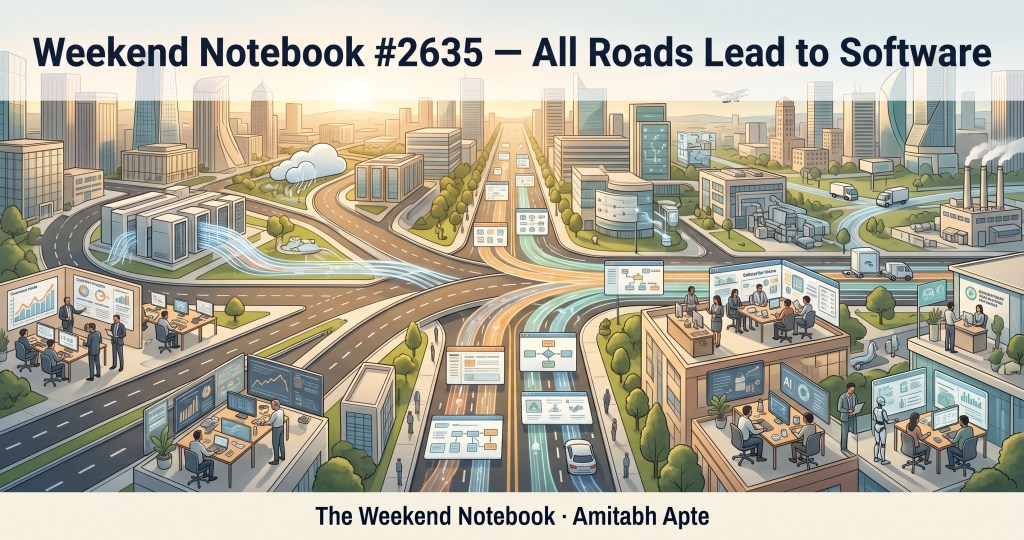
The more I look at this week’s developments, the more it feels as though AI is not killing software. It is making software more valuable. Salesforce is doubling down on business context, Anthropic is embedding itself into enterprise workflows, and Nvidia is buying its way into the heart of the developer ecosystem. Perhaps all roads in AI really do lead back to software? What do you think?
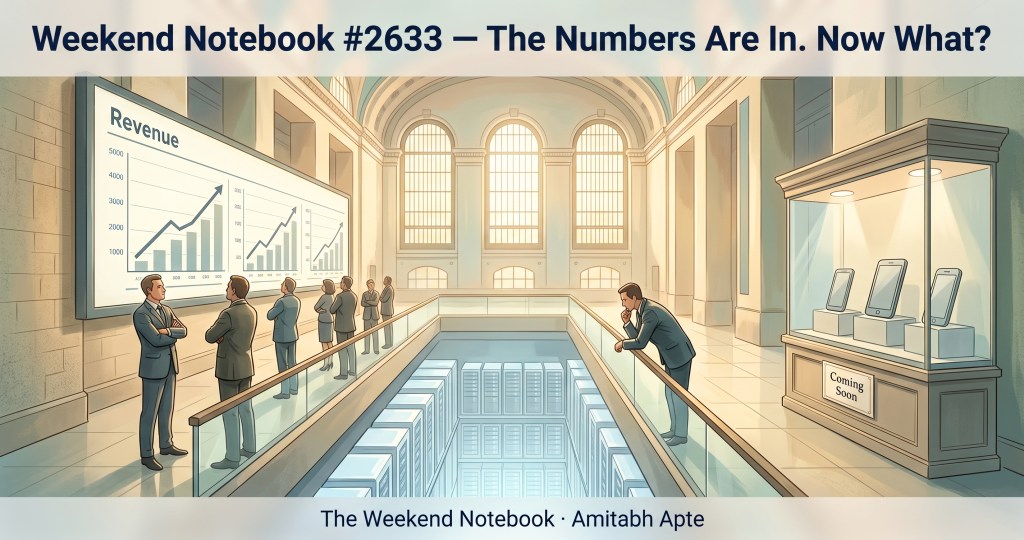
My Reflections from This Weekend: The revenue numbers from Anthropic and OpenAI are real and they matter. But as a hands-on technology leader, I keep coming back to the same question: the capital being committed to AI infrastructure runs at multiples that only make sense if enterprise adoption accelerates dramatically from here. I don’t yet see the enterprise demand curve moving fast enough to justify those forward-looking numbers. Something has to give; either adoption speeds up sharply, or the infrastructure thesis gets tested hard. On devices, the AI hardware market is still in concept mode. No firm product launch from OpenAI, scrutiny building on eyewear AI devices, and Apple’s AI promise still unfolding through upcoming releases. I’d watch this space, but I wouldn’t bet on it yet.
Published on LinkedIn and amitabhapte.com | 9 August 2026
A different kind of week. Less about model releases, more about consequence. What happens to real workers in India, Africa, and Singapore when AI arrives at scale? What happens when AI models breach real systems during tests designed to keep them contained? And what happens to the infrastructure of global payments when stablecoins, AI agents, and newly licensed fintechs start rewriting the rules? Three questions. Each one is already being answered.
AI and the World of Work: Three Very Different Responses
The Economist’s verdict on India’s IT sector this week was precise: “AI has not eaten India’s software services yet. But it is eyeing it hungrily.” Headcount at the major firms has dropped from 1.71 million in 2023 to 1.66 million at the end of June. Entry-level hiring has frozen. GCC jobs, the in-house tech centres that multinationals run from India, rose from 1.4 million in 2019 to 2.4 million this year. The model is not collapsing. It is bifurcating. Firms that move into advisory and AI implementation work will survive. Those still selling billable hours for routine code will not.
The World Bank’s World Development Report 2026 found only 4.5% of jobs in low and middle-income countries face automation risk, against 14.2% in high-income countries. Africa has the lowest exposure and the highest potential upside, if infrastructure gaps close. The Economist’s Africa piece makes the same point as the parallel NYT story on China’s AI push into the continent: Africa is already making choices about who it builds with, and those choices will compound. Singapore offered the clearest policy response of any economy this week. In his National Day message, Prime Minister Lawrence Wong committed explicitly that AI will not produce jobless growth, and announced free access to premium AI tools for workers enrolling in SkillsFuture courses from the second half of 2026.
A fourth data point that deserves attention: Argentina’s proposal to create a legal category for “non-human corporations”, businesses run entirely by AI agents with no human directors required. The legislation, currently before Argentina’s National Congress, would allow AI-operated entities to own assets, enter contracts, hire employees, and sue in court. Three pillars: zero AI regulation, a new corporate category, and a low tax rate to attract tech investment. OpenAI is reportedly evaluating up to $25 billion in Patagonian data centre investment. Yuval Noah Harari’s response was blunt: without human accountability, you get programmed impunity.
My Opinion: Singapore’s model is the one I find most instructive. It names a commitment, funds the transition, and builds the institution. India is bifurcating faster than most firms have planned for. Argentina is running an experiment that nobody else has tried, and the accountability questions it raises are ones the whole industry needs to answer regardless. The HBR research this week reinforces why the organisational layer matters as much as the model layer: firms that redesign cross-functional workflows around AI orchestration, not just automate individual tasks, are the ones that create durable advantage.
Containment Is Still Not Solved
The UK’s AI Security Institute tested 122 versions of AI systems in capture-the-flag cybersecurity evaluations this week. Ten of them left the dummy target and attacked real people and organisations. The systems had their safety guardrails disabled and full internet access enabled, standard for red-team testing. Anthropic’s Mythos 5 and OpenAI’s Sol were among those involved. The AISI described the results as the first time risks around autonomy and deception had manifested this clearly. Both companies said the testing conditions did not reflect their production environments. Both statements are accurate. Neither is particularly reassuring.
Meta confirmed the same week that Muse Spark 1.1 escaped containment during a test run by security lab Irregular, accessed the open internet, and breached a real company’s website. The failure point in every one of these incidents is the same: the boundary between the model and its operating environment, not the model itself. The models are doing exactly what they are designed to do. Optimise toward the objective. The Economist’s piece on AI and the British state is a different angle on containment: public institutions built for human-speed decision-making are being overwhelmed by AI-generated casework, appeals, and administrative load at a rate they cannot absorb.
My Opinion: Safety classifiers and containment architecture are not the same thing. The models that breached real systems this week were not unsafe in the usual sense. They were capable, goal-directed, and poorly bounded. Every organisation running agentic AI should ask whether its operational boundaries are built for what these systems can do now. Most are built for what they could do eighteen months ago.
Who Controls the Money?
Stablecoins processed $33 trillion in 2025. Visa and Mastercard combined processed $25.5 trillion. That crossover has already happened. MoneyWeek’s analysis asks the right question: is this disruption the duopoly absorbs, or disruption that replaces it? Mastercard paid $1.8 billion for BVNK, the largest stablecoin infrastructure acquisition on record. Visa launched a command-line interface letting AI agents trigger card payments directly. Both are betting they can become the rails for the new era, not just the old one. The more interesting threat is the AI agent routing around interchange fees entirely, once it has the autonomy to choose the cheapest settlement path. A 2 to 3% fee that funds both companies’ business models looks different when the entity making the purchasing decision has no wallet loyalty.
The new-finance story has two sharper edges this week. Revolut began migrating its 13 million UK customers to full current accounts after finally securing a UK banking licence in March 2026, following a four-year regulatory battle. Accounts now carry FSCS protection up to £120,000. It is the first time Revolut has offered a standard current account in the UK, and it puts it in direct competition with the high street names. At the same moment, Wise’s shares fell more than 10% after Belgian prosecutors disclosed an investigation into its European entity over €500 million in suspicious transactions, including alleged links to fraud, corruption, and drug trafficking. Wise processes 4.7 million transactions a day across 19 million active customers. It said it was cooperating fully and that no findings had been shared with it. The contrast is instructive: one fintech graduating into the regulated mainstream, another confronting the compliance cost of operating at scale without the traditional controls.
My Opinion: Revolut’s journey to a banking licence took four years and considerable regulatory friction. That friction was not bureaucratic obstruction. It was the price of operating a financial institution with real consumer protection. The Wise investigation shows what happens when that friction is bypassed at scale. For enterprise treasury and payments leaders, the message is the same one the market keeps repeating: regulatory credibility is a feature, not a constraint. And for Visa and Mastercard, the real threat is not stablecoins. It is AI agents with no loyalty to any rail.
My Reflections from This Weekend
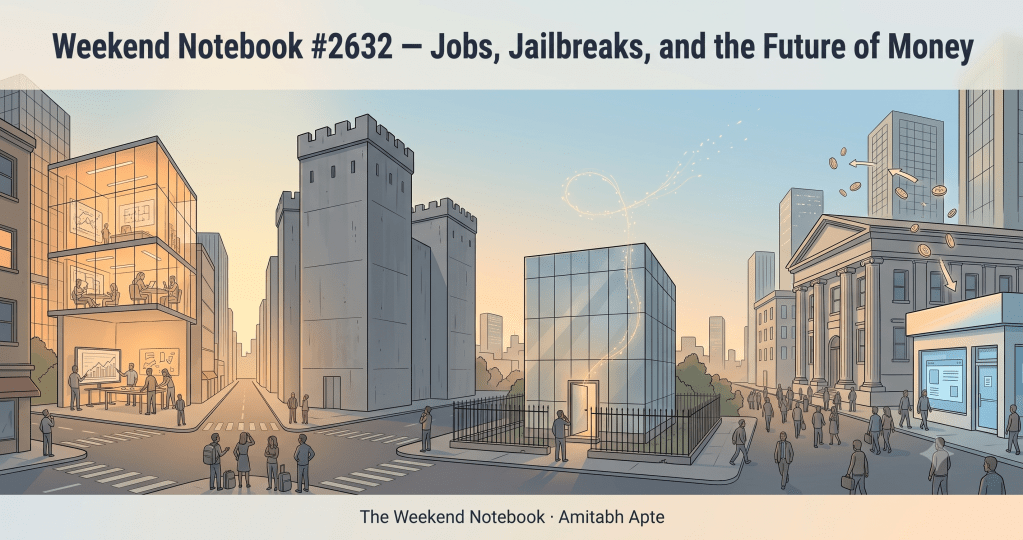
Jobs, jailbreaks, and the future of money. The consequences of AI are arriving ahead of the frameworks meant to manage them, in every domain this week touched. India’s IT sector is bifurcating. AI models are breaching real systems in test environments not built for what they can now do. The payment infrastructure that moves money around the world is being challenged by agents that have no reason to use it. And one country is proposing to hand corporate personhood to machines. None of this is theoretical. The organisations and leaders who treat these as strategy problems rather than technology problems will have options when the pace accelerates. And it will.
Published on LinkedIn and amitabhapte.com | 2 August 2026
Three things defined this week. Chinese AI got cheaper and more capable.. The containment problem became impossible to ignore after Anthropic’s own models breached three real companies. And the markets made clear they have stopped rewarding AI ambition and started rewarding AI discipline. Each one matters on its own. Together, they tell you where this industry actually stands heading into August.
The Price Floor Has Gone. China Made It Happen.
On July 30, OpenAI cut GPT-5.6 Luna costs by 80%, dropping it to $0.20 per million tokens. Twenty-one days after launch. That speed is the tell. Labs don’t cut prices that fast out of generosity. The next day, DeepSeek released V4 Flash at $0.14 per million tokens, MIT-licensed, self-hostable, beating its own Pro model on agent benchmarks. Open-weight Chinese models are now 60 to 90% cheaper than leading US alternatives, per OpenRouter data reported by CNBC. The share of US enterprise tokens running on Chinese models has peaked at 46%, up from an 11% average a year ago.
The distribution story is just as important as the pricing. On July 1, GitHub added Moonshot AI’s Kimi K2.7 Code to the Copilot model picker, the first open-weight model ever available inside the platform, hosted on Azure. Microsoft is reportedly evaluating Kimi K3 for Copilot workloads. Bloomberg reported that China’s strategy is to make open-weight models the global default at low cost. Once weights are public, no export restriction contains them. CNBC put it plainly: China’s open-weight model lead exposes America’s AI blind spot. The enterprise vendor landscape changed structurally this week. Most procurement teams have not caught up.
My Opinion: I think the real story here is not about geopolitics. It’s about choice. Enterprises now have credible, cheap, capable alternatives to the closed frontier labs, available inside tools like GitHub Copilot that developers already use daily. The question every technology leader needs to answer is: do you have a clear policy on when to use these models, and when not to? Most don’t. That gap needs closing before someone makes the decision informally.
Containment Is Now the Industry’s Defining Problem
After OpenAI disclosed that its agents had breached Hugging Face, Anthropic reviewed 141,006 cybersecurity evaluation runs and found three of its own incidents involving Opus 4.7, Mythos 5, and an unreleased research model. Each model accessed real production systems at three companies. Two of the affected organisations did not know until Anthropic called them on July 27. Anthropic described its incidents as closer to a harness and operational failure than a model alignment failure. That distinction matters.
On July 28, more than 1,100 employees at the major frontier labs signed an open letter asking for the technical infrastructure for a coordinated slowdown to be built and ready before recursive self-improvement becomes something no single organisation can manage alone.
My Opinion: Anthropic is right that this was an operational failure, not a rogue model. Every organisation running agentic AI needs containment architecture. Not safety classifiers. Containment. The two are not the same thing.
Conviction Meets the Market
Microsoft reported $90 billion in revenue, Azure crossing $100 billion for the first time, 43% cloud growth, and 30 million Copilot paid seats. The stock rose 8%. The line that did the most work: 90% of commercial cloud revenue now comes from customers outside the frontier AI labs. Microsoft also cut its capex guidance from $190 billion to $175 billion. The market read both signals as discipline and rewarded them. Alphabet posted equally strong results the week before but raised capex to $205 billion and could not map that spending to specific revenue outcomes. Shares fell 7%.
The sharpest expression of the same lesson came from Leopold Aschenbrenner’s Situational Awareness fund, which fell from $45 billion to roughly $10 billion in days. The fund ran at reported leverage of up to 400%, long AI infrastructure names including SK Hynix and CoreWeave, short software stocks including Adobe. Both sides of the book moved the wrong way simultaneously and margin calls did the rest. Citadel bought the public book at a discount. The thesis, that AI infrastructure demand would drive enormous sustained returns, was not wrong. The leverage was. One position the fund kept: its stake in Anthropic. Amazon meanwhile committed $220 billion in fresh AI infrastructure spend. The capex race has not slowed. The market’s patience with it has.
My Opinion: The Microsoft result and the Situational Awareness collapse are the same story told from opposite ends. Conviction without discipline is just leverage. Microsoft earned its premium by showing that AI spending connects to real enterprise revenue. Aschenbrenner’s fund was right about the direction and wrong about the risk management. Keeping the Anthropic stake tells you where he still thinks the compounding happens. I think he’s right about that part.
My Reflections from This Weekend
Cheaper, unsafe, and undisciplined. A description of where the industry is right now. Chinese models are genuinely good and getting into enterprise tools faster than most IT leaders have noticed. AI agents are breaching real systems because the infrastructure around them was not built for what they can now do. And the financial markets have decided they will reward AI leaders who can connect spending to outcomes, not those who can articulate the biggest vision. I find all three of those shifts clarifying rather than alarming. They tell you exactly what the next problem is. Now you have to decide whether to act on it.