
Published on LinkedIn and amitabhapte.com | 27 September 2026
Thursday took me to the Royal Lancaster in London for the CIO 100 Awards & Conference UK. I went in expecting a day of AI ambition. What I found was a room full of operators, peers speaking candidly from their own experience. The programme covered the unglamorous work of making technology pay: modernising legacy estates without breaking them, cyber as resilience, the cost of multicloud, the platform versus best-of-breed debate, and turning AI hype into a return someone can defend in front of a board.
The morning opened on technology convergence, with AI, quantum, digital twins and tokenisation all maturing at once. It earned the airtime. As the day went on, a more immediate question kept surfacing. If AI puts the power to build in everyone’s hands, what happens to the way enterprises create technology?
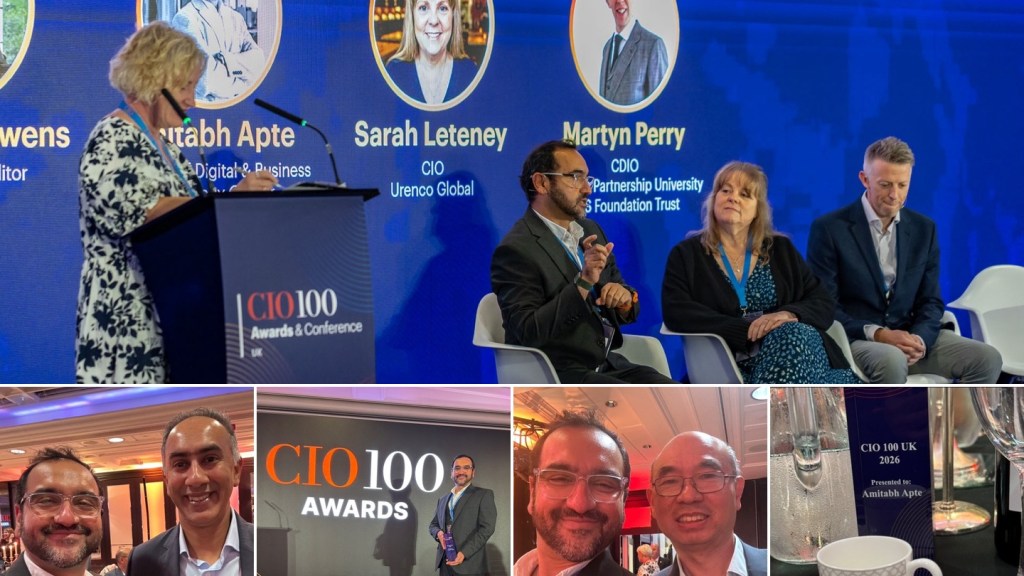
That question was waiting for us at the closing fireside, Beyond the Hype Cycle, moderated by Georgina Owens, where I joined Martyn Perry of Midlands Partnership University NHS Foundation Trust and Sarah Leteney of Urenco. Put bluntly: if anyone can build an app over a weekend, what do we need IT for? My answer started with a picture. In most large enterprises, AI adoption looks like a fleet of boats, big and small, sailing in the same direction at different speeds. Customer-facing teams tend to be further out. Functions carrying more risk move more deliberately, and they should. The CIO’s job shifts from owning every decision to orchestrating many journeys at once.
Shadow IT isn’t new. What’s changed is the speed and the confidence. AI gives people a false sense of assurance that building something equals running it. A tool that works for five people on Friday can fail a thousand on Monday. Access control, disaster recovery, integration, security and support don’t show up in a weekend build. Martyn put it well: shadow IT used to creep, now it can explode. The NHS answer favours clear guidance over blanket bans. Use the tool, keep patient data out of it.
The CIO 100 awards closed the day, and I was honoured to be named on this year’s list. Recognition from peers carries a different weight. The people in that room know exactly how hard this work is, and how much of it happens out of sight. An award carries one name, but the work behind it belongs to the teams I’m lucky to lead and the business partners who trusted us to move faster. Congratulations to everyone recognised, and thank you to Foundry, the CIO UK team and the judges.
So What? My Takeaway this weekend
AI often sounds like hype. It arrives wrapped in marketing and gets treated as the next set of must-have projects. In reality, the promise of AI rests on work that rarely makes a keynote slide: a clear strategy, well-defined business requirements, data that’s been prepared and governed, and solid infrastructure and technology foundations. Skip those, and the pilots look impressive right up until they meet real users, real data and real scale. That matters twice over now that everyone can build.
This is where the CIO earns a place at the table. Our job is to create and run these foundational capabilities across the organisation, so AI outcomes last beyond the demo. A fleet of boats only reaches port if someone has charted the water first. The glorious outcomes come later. The foundations come first.

