Weekend Notebook #2627. Reuters Momentum AI London

Published on LinkedIn and amitabhapte.com on 5th July 2026

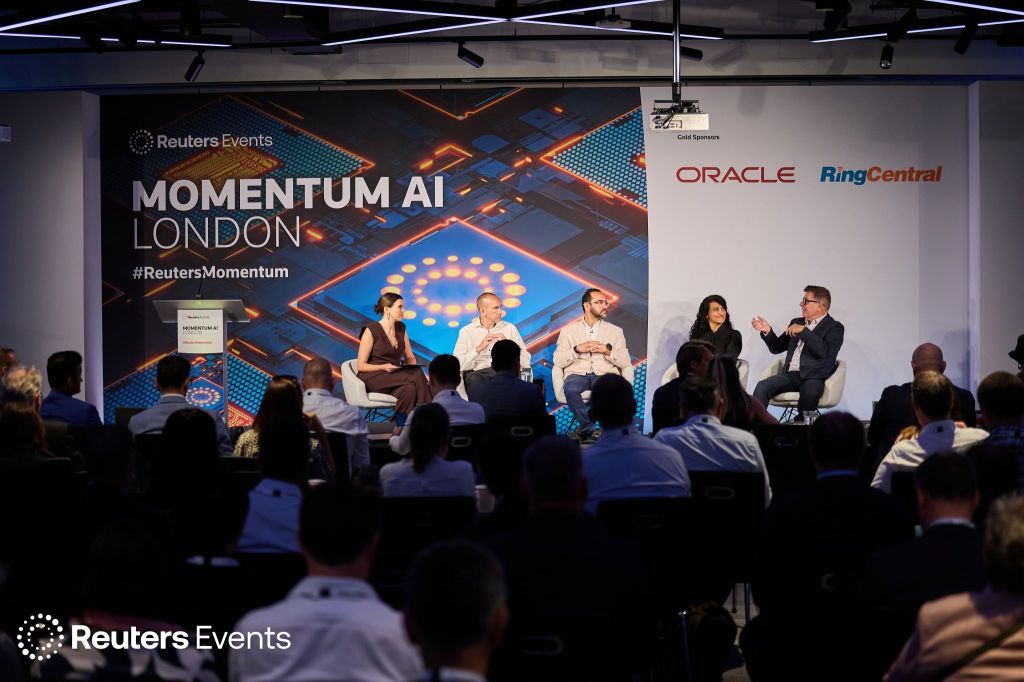
Earlier this week I participated in a panel called “Aligning the C-Suite on Enterprise AI Strategy,” alongside Scott Marcar, Group CIO at NatWest, Colin Bannon, CTO at BT Business, and Rina Ladva, Managing Director UK&I at Miro. The panel moderated by Georgia Lewis Anderson was part of the Reuters Events Momentum AI London.

The mood at this remarkable conference was not the breathless excitement of 2023 or the defensive caution of 2024. It was realism. Senior enterprise leaders did not debate whether AI works and instead were asking something harder: whether their organisations are built to use it well.

Alignment is the constraint. Not capability.

Three ideas kept surfacing in this session, each sharper than the one before.

First: speed without alignment only scales confusion. Many leaders in the room had lived it. Moving fast on AI without shared direction doesn’t accelerate progress, it accelerates the wrong things.

Second: AI is not a technology workstream. It is a core enabler of business strategy, and the organisational structures around it need to reflect that. Who owns it matters as much as what it does. Strategy and platform belong at the centre. Use cases and adoption belong with the business units closest to the customer and the data. Centralise everything and you kill local insight. Decentralise everything and you get thirty versions of the truth.

Third, and most underappreciated: if we designed this workflow from scratch today, would we have done it this way? Most AI programmes layer intelligence onto processes that were never worth preserving. The question is not how to make existing workflows smarter. It is whether those workflows deserve to exist at all.

The news this week reinforced the point from the outside. Microsoft launched a 6,000-person AI implementation unit with $2.5 billion committed, placing specialists inside customer organisations rather than simply selling software. Driven partly by customer frustration with rising AI costs, it signals that the model which sells access to a capable model is no longer sufficient. Helping customers deploy AI in ways that move their P&L is what enterprises are actually willing to pay for.

The ROI question is the wrong question.

The opening session cited research showing 90% of technology leaders say ROI uncertainty is now shaping their investment decisions. That figure is worth sitting with. It may point less to a measurement problem and more to a definition one. Many organisations are still working out what to measure. Time saved is a reasonable starting point, but it rarely tells the whole story.

Value tends to become clearer when a business owner, not just an IT function, is directly connected to the outcome an AI initiative is meant to move. The metric doesn’t change. The accountability does. Organisations still running multiple pilots without clear outcomes are not unusual. What seems to make the difference is having someone whose job it is to make the call on what to scale, and what to stop.

On the topic of AI ROI, Palantir CEO Alex Karp said this week that something has gone completely wrong with token-based AI pricing, arguing enterprises are paying for consumption without capturing value. The AI industry built a billing model around usage. It should have built one around outcomes.

AI moving from Strategy to Action

Two stories this week illustrated how quickly AI is moving from strategy to action. Robinhood launched agentic trading tools that execute stock purchases on behalf of users, with the CEO predicting AI agents will soon match the capabilities of human traders. The pitch is democratisation: bringing institutional-grade tools to everyday investors. Meta announced a move into cloud, selling spare AI compute capacity to external clients, turning infrastructure built for its own models into a new revenue stream.

Both moves point to the same underlying shift. AI is no longer something organisations evaluate. It is something that acts, transacts, and operates at scale. The governance question that dominated our panel, who is accountable when AI makes a decision, is no longer theoretical. It is live, in financial markets, in cloud contracts, and increasingly in enterprise workflows. Most organisations are still catching up to that reality.

My Takeaway This Weekend

I came away from two days in London with a clearer sense of where we actually are. Technology is no longer the hard part. Models work. Infrastructure is scaling. Use cases are real and multiplying. The harder work, the work most organisations are still in the middle of, is building the human architecture around it. Clarity on ownership. Accountability for outcomes. The discipline to stop what is not working, not just the ambition to start new things.

AI is not replacing strategy. If anything, it is making good strategy more important than ever, and exposing the cost of weak alignment faster than before. The leaders who will shape this next phase are not necessarily the ones moving quickest. They are the ones who have built a clear operating model and are holding it with consistency, even as the technology around them keeps moving. That feels like the right challenge to be working on.

Weekend Notebook #2617 – the Abbey Road Studios

Published on LinkedIn and amitabhapte.com | 25th April 2026

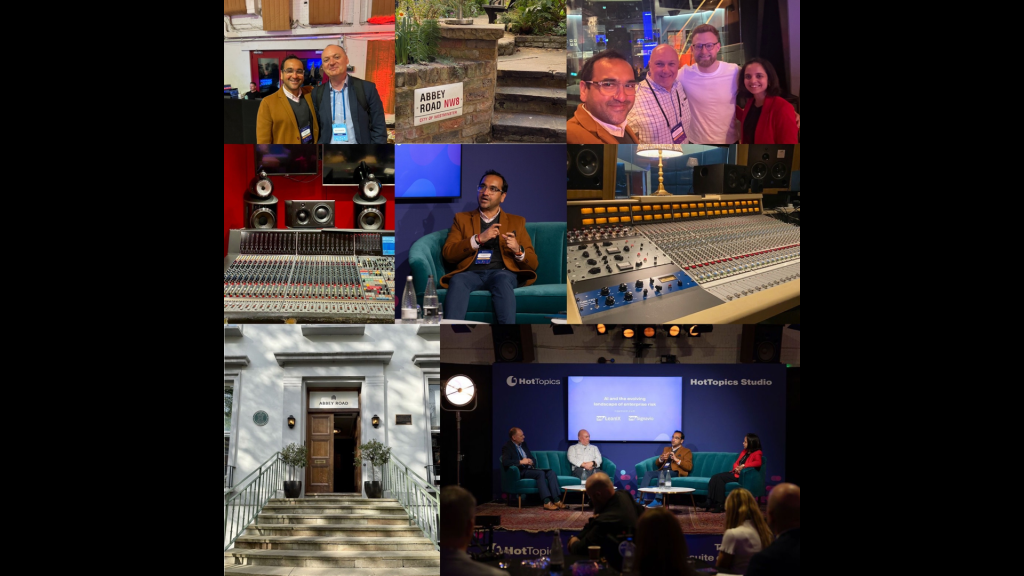
This Weekend’s Notebook comes from a unique place. Abbey Road Studios in London, where The Beatles, Pink Floyd, Oasis and Adele recorded some of their most iconic music. It is a place where creative shifts became cultural shifts.

That felt fitting. Because the conversation this week was about a different kind of shift.

I participated in a panel titled “AI and the Evolving Landscape of Enterprise Risk” with Komal Mathur, Strategic Transformation Lead at SAP, and Gary Osborn, Head of Information Security at Amnesty International, moderated by well-known technology journalist, Mark Chillingworth. We discussed AI strategy, its implications for business organisations and its people, and the emerging governance landscape.

The panel was part of the two-day CIO event hosted by HotTopics, a well-regarded forum for CIOs, CTOs, CISOs, CDOs and technology leaders across the UK and increasingly Europe. The Studio event covered a wide range of themes: AI strategy and governance, cybersecurity and resilience, operating model transformation, talent and skills, and the growing role of technology leadership in shaping business outcomes.

I am sharing a few reflections from the panel and the broader event for the benefit of my network.

My Panel — From AI Tools to AI Systems

The core shift we discussed is simple, but not yet widely understood. AI is no longer just a tool. As it moves into core business systems; supply chain, finance, operations, it starts shaping decisions, not just supporting them. That changes the nature of risk.

For the past two years, most organisations have focused on data risk: leakage, privacy, compliance. Important, but incomplete. The next layer of risk is operational.

A chatbot giving a wrong answer is manageable. An agent taking a wrong action inside a live system is not. Especially at speed and scale.

We are moving from systems that inform decisions to systems that increasingly participate in them. That requires more than policies and principles. It requires governance built into the architecture itself: visibility, control points, and the ability to intervene when systems behave in unexpected ways.

Another theme that came through clearly was the tension leaders are navigating. Business wants speed and advantage. Technology teams want control and stability. Society expects accountability and trust. Balancing all three is becoming a core leadership challenge, and the CIO and the tech leaders are increasingly sitting at the intersections. 

The CIO role is quietly evolving into something closer to a Chief AI Business Risk Officer, whether organisations formalise that or not. Someone has to hold accountability for what autonomous systems do inside the enterprise. That needs to be a business leader with technical depth, not a policy document sitting in a shared drive.

Signals from the Room

Beyond the panel, a few patterns stood out across the two days.

The conversation around AI is maturing. The tone has shifted from “what can it do?” to “how do we manage it responsibly at scale?” Leaders are more candid now about the gap between ambition and readiness.

Cyber and resilience remain front of mind. As systems become more connected and more autonomous, the blast radius of failure increases. Security is no longer a layer. It is a design principle.

Governance is emerging as a differentiator, not a constraint. The ability to scale AI safely and predictably is becoming as important as the ability to deploy it. The organisations pulling ahead are the ones who figured that out first.

Operating models are under real pressure. AI is not just changing tools. It is reshaping workflows, decision rights, and team structures. Most organisations are still working this out, and the cultural change is proving harder than the technology.

And talent remains the binding constraint. Not just technical skills, but leaders who can connect technology, business and risk in the same conversation. That gap came up repeatedly. 

The sustainability aspects of technology, specifically the meaningful upcycling of hardware, devices, peripheral equipment, not just recycling is a cause which CIOs and tech leaders feel worthy of getting behind. The digital divide, the gap between people living at the edge of technology innovation and still a large population feeling left behind needs to be addressed as industry priority. 

The keynote from Eddie “The Eagle” Edwards, who finished last at the 1988 Winter Olympics with borrowed equipment and no support, was a reminder that showing up when nobody expects you to is its own form of leadership. His line stayed with the room: the people who said he did not belong were the same ones who wrote the rules about who was allowed to try.

My Takeaway This Weekend

The strongest signal across the two days was this: AI is moving from the edge of the organisation into its core systems. From answering questions to influencing decisions. Most organisations are still governed for the first. They will need to adapt quickly for the second.

AI risk is no longer about what the model says. It is about what the system does.

The leaders who will move ahead are not those deploying the most AI. They are the ones designing systems, operating models, and governance structures that can handle it responsibly.

Abbey Road Studios was a good reminder. The best work made in those studios was not made by avoiding risk. It was made by people who understood their craft well enough to take deliberate ones.

Weekend Notebook #2614 – when AI sets the Terms

Published on LinkedIn and amitabhapte.com  on 5th April 2026

Three forces are running simultaneously through the AI landscape right now: a scramble for physical control of the underlying infrastructure, a repricing of how AI-driven value gets negotiated, and a fracture in how the world governs it. This week’s signals belong to all three.

1. The Race to Own the Substrate

New IDC data reviewed by Reuters shows Chinese GPU and AI chip makers captured 41% of China’s AI accelerator market in 2025. Huawei alone shipped around 812,000 chips, with Alibaba’s T-Head and Baidu’s Kunlunxin growing behind it. Nvidia still leads at 55%, but the retreat is real. 

The same instinct is driving infrastructure investment across Asia. Airtel raised $1 billion for its data centre arm Nxtra from Carlyle, Alpha Wave, and Anchorage Capital, targeting a scale-up to 1GW of capacity in India, a country that already has Google’s $15 billion data centre commitment and a 20-year tax holiday for hyperscalers. Microsoft’s $10 billion commitment to Japan through 2029 is structured similarly: AI infrastructure, national cybersecurity cooperation, and data processed inside Japan’s borders. These are sovereignty arrangements as much as commercial deals. 

2. AI Is Changing the Terms of Access

In enterprise software, ServiceNow’s CEO Bill McDermott has repositioned the company around a single argument: AI models identify problems but struggle to execute reliably across governed, auditable enterprise workflows. ServiceNow owns the last-mile execution layer, and its Now Assist product is tracking toward a $1 billion annual run rate. The model shift underneath it is structural: from per-seat licensing to outcome-based pricing, what McDermott calls digital labour. 

In capital markets, the dynamic is rawer. SpaceX is targeting a valuation above $2 trillion in what could be the largest IPO in history. According to the New York Times, Musk has required the lead banks, Morgan Stanley, Goldman Sachs, JPMorgan, Bank of America, and Citigroup, to purchase Grok subscriptions as a condition of the mandate. Some have agreed to spend tens of millions per year. AI adoption bundled into the price of deal access is a new distribution model. 

3. AI Governance Is Becoming a Procurement Reality

Several jurisdictions are now introducing procurement standards that require AI vendors to demonstrate safety and privacy safeguards before accessing public sector contracts. California’s Executive Order N-5-26 is a recent example: companies seeking state contracts must disclose safeguards against harmful content, bias, and civil rights violations, with agencies conducting their own independent assessments. The practical result is a growing patchwork of standards that enterprise technology teams will have to navigate across geographies. California’s procurement rules have a history of becoming de facto global benchmarks, much as GDPR did from a single jurisdiction. Any organisation selling AI products into regulated markets or the public sector should treat this as an active compliance question, not a future one.

4. Japan: Automation as Survival, Not Disruption

TechCrunch reported this week on Japan’s push into physical AI, driven by demographic emergency rather than efficiency ambition. With over 28% of the population above 65 and a working-age population contracting annually, Japan is deploying robots to fill positions that cannot be staffed. The government has committed $6.3 billion and is targeting 30% of the global physical AI market by 2040. The industry signal is unambiguous: customer-paid deployments, full-shift operation, measurable productivity. Japan is the clearest preview of what automation looks like when labour scarcity, not cost reduction, is the driver. 

My Takeaway This Weekend

The infrastructure layer of AI is being claimed physically and politically. The business models above it are repricing around outcomes. The governance frameworks meant to contain it are fracturing. And the labour markets it will reshape are already showing, in Japan, what comes next. AI strategy, infrastructure strategy, talent strategy, and governance strategy are now the same conversation. Running them separately is how organisations fall behind without noticing.

Weekend Notebook #2607 – The SaaSpocalypse

Published on LinkedIn and amitabhapte.com on 15th Feb 2026

One word defined markets this week (and to be fair, last week too), SaaSpocalypse.

Coined by Jefferies traders as software stocks entered freefall, the term captures Wall Street’s sudden realization that an entire industry’s business model might have become obsolete. Then, just as quickly, the narrative reversed. By week’s end, the same analysts were calling it overdone.

The Week Markets Cracked

On January 30, Anthropic released 11 open-source plugins for Claude Cowork, an AI assistant that can read files, organize folders, and draft documents. The plugins targeted legal, finance, sales, marketing, and data analytics. The release was framed as a minor product update.

By February 4, nearly $300 billion in market value had evaporated from software stocks.

Thomson Reuters plunged 16% in a single day, its worst drop on record. LegalZoom sank 20%. London’s RELX fell 14%. The software industry ETF had its worst day since April, falling 5.7%. The S&P North American Software Index hit valuation levels not seen since its creation.

We call it the SaaSpocalypse,” said Jeffrey Favuzza at Jefferies. “Trading is very much ‘get me out’ style selling.”

Days later, Anthropic released Claude Opus 4.6, capable of coordinating teams of AI agents and excelling at financial analysis and market intelligence. Markets trembled again. This wasn’t a one-time event. This was systematic replacement.

Then Wall Street Blinked

By February 11, the narrative had shifted entirely.

JPMorgan released a note calling the selloff excessive, citing “overly bearish outlook on AI disruption and solid fundamentals.” The firm identified 10-14 software stocks as resilient, including Microsoft, ServiceNow, CrowdStrike, and Snowflake.

Goldman Sachs CEO David Solomon said the selloff was “too broad.” Bank of America called it “illogical.”

Jefferies analysis found that 42% of software stocks were trading at or near historical low valuations. The S&P North American Software Index had fallen below 20x forward earnings for the first time ever. The sector’s Relative Strength Index hit 18—the most oversold reading since 1990.

Suddenly, the narrative wasn’t “software is dead.” It was “buy the dip.”

Yet even as analysts reversed course, the fundamental question remained unanswered: what changed?

What Actually Changed

Claude Cowork isn’t a chatbot. It’s an AI agent with permissions to act. It can review contracts, draft legal summaries, compile compliance workflows, screen financial data, conduct due diligence, and synthesize market intelligence—tasks that currently generate billions in software subscription revenue.

Thomas Shipp at LPL Financial captured the investor anxiety: “Why do I need to pay for software if internal development now takes developers less time with AI? With Claude Cowork, fewer technical users are now empowered to replace existing workflows.”

The business model shift is clear. AI companies are no longer just selling models. They’re owning workflows directly. That’s what spooked markets.

Then on February 12, Anthropic raised $30 billion at a $380 billion valuation—the largest venture deal of 2026. Revenue now exceeds $14 billion run-rate. Microsoft and Nvidia participated. The signal was unmistakable: AI infrastructure spending isn’t slowing. It’s accelerating.

The Paradox

Markets are pricing two contradictory scenarios simultaneously:

Software is dying because AI will replace it. Yet hyperscalers and AI companies are raising and deploying record capital—Meta broke ground on a $10 billion data center this week, Samsung shipped HBM4 memory samples, and Applied Materials reported continued strength in AI semiconductor spending.

If AI is powerful enough to destroy software, the infrastructure supporting it cannot simultaneously be failing. Both cannot be true.

The software sector is expected to deliver 14.1% earnings growth in 2026. Not collapse. Growth. Slower than semiconductors, yes. But growth nonetheless.

What Leaders Should Do Now

The SaaSpocalypse revealed something more important than market volatility. It exposed how unprepared most organizations are for the shift from software-as-tool to AI-as-workflow.

Three questions every CIO and technology leader should answer this quarter:

First: Which software subscriptions are at immediate risk?

Legal research, financial screening, data synthesis, document drafting, basic analytics—these workflows are directly exposed. Don’t wait for renewal cycles to make decisions. Budget now for the transition, whether that means renegotiating contracts, piloting AI alternatives, or accepting that per-seat pricing will shift to outcome-based models.

Second: Where is your defensible moat?

Generic workflows are vulnerable. Mission-critical systems integrated with proprietary enterprise data are defensible. The companies surviving this transition won’t be those with the best interfaces. They’ll be those whose value lies in irreplaceable data and deeply embedded processes that cannot be easily replicated by AI agents.

If your current software vendor’s primary value is the interface rather than the data beneath it, that vendor is at risk. Plan accordingly.

Third: Are you building AI capability or waiting for it to arrive?

The organizations moving now—deploying agents, experimenting with workflow automation, piloting AI-native tools—will have a 12-24 month advantage over those waiting for their existing vendors to integrate AI features.

This isn’t about abandoning enterprise software overnight. It’s about understanding that the next purchasing cycle will look fundamentally different from the last one. Seat-based pricing is ending. Outcome-based pricing is beginning. The transition period is now.

My Takeaway This Weekend

The SaaSpocalypse wasn’t about one week of market panic. It was about the moment Wall Street recognized that a twenty-year business model is entering its final phase.

The analysts calling the selloff overdone aren’t wrong. Software isn’t dying. Many companies will adapt. Cybersecurity firms, infrastructure platforms, and businesses with genuine data moats will survive and thrive.

But they’re also not addressing the deeper truth: the economics are shifting. From seats to outcomes. From tools to autonomous execution. From helping humans work to replacing work entirely.

The volatility will continue. Markets will swing between “AI destroys everything” and “nothing has changed.” Both narratives miss the point.

What matters isn’t the market’s mood. What matters is whether your organization is prepared for the transition. Because while Wall Street debates valuations, the technology is already here. Anthropic just raised $30 billion. Meta is building gigawatt-scale data centers. AI agents are executing workflows that used to require software subscriptions.

The question isn’t whether this shift is real. The question is whether you’re moving before the market forces you to move.


Weekend Notebook #2603 – Retail, FMCG / CPG & Ecommerce Highlights from NRF 2026

Published on LinkedIn and amitabhapte.com on18th Jan 2026

NRF is where retail reality shows up.

If CES is about what could happen, NRF is about what’s already being rolled out. Under margin pressure. With labour constraints. At scale.

This year, the message was clear. Retailers are done talking about AI as a concept. They are wiring it directly into how stores and supply chains run day to day. Not just big visions. But operating decisions.

Four NRF signals that matter if you’re a CIO or tech leader in retail, CPG, or ecommerce. None are shiny. All are practical.


1. Autonomous retail operations. From dashboards to decisions

Several large retailers showed how decision-making is being pushed closer to real time.

Walmart talked about how AI now drives replenishment, routing, and inventory flow across stores and DCs. Not as reports for planners, but as automated actions, with humans stepping in only when something looks off.

Target shared how they’re using AI to balance pricing, promotions, and inventory at a local level. The focus wasn’t on smarter forecasts. It was on fewer manual overrides and faster execution.

What stood out was the mindset. These teams are moving away from “decision support” tools toward systems that decide by default.

Why it matters
Retail performance increasingly comes down to how quickly you act when conditions change. AI is becoming the only way to keep up without adding headcount.


2. The store becomes a living system

Stores are being treated less like static assets and more like adaptive environments.

Kroger showed how shelf sensors, computer vision, and digital shelf labels are tied together. If an item goes out of stock or demand spikes, the system responds automatically, from replenishment signals to price adjustments.

Best Buy focused on store teams. AI tools help associates with product knowledge, troubleshooting, and customer history, so staff spend less time searching and more time helping.

The tone was practical. Less about “smart stores”, more about removing friction for staff and customers.

Why it matters
Store execution has always been local and messy. AI is finally being used to support that reality, not fight it.


3. Agentic commerce meets retail plumbing

There was much less hype around consumer-facing agents. More focus on foundations.

Retailers talked openly about the work needed to make their systems machine-readable. Clean inventory data. Clear substitution rules. Reliable availability signals. Secure APIs.

Macy’s discussed how modernising product data, fulfilment logic, and order orchestration is a prerequisite for any future AI-driven shopping experience, whether inside their own channels or through third-party platforms.

This wasn’t positioned as innovation. It was positioned as overdue plumbing.

Why it matters
As shopping shifts from browsing to delegation, agents will only work with retailers they can trust. That trust is built in data quality and operational discipline.


4. Retail tech grows up. ROI over rhetoric

The overall mood at NRF was grounded.

Retailers talked about shrink reduction, labour productivity, energy use, and faster rollout of store tech. Fewer moonshots. More numbers.

Several sessions highlighted projects being scaled because they worked, and others quietly shelved because they didn’t.

This felt like a turning point. Retail tech is being judged like any other capital investment.

Why it matters
The days of running pilots for the sake of learning are ending. What survives now must survive procurement, operations, and the P&L.


Closing takeaway

NRF made one thing very clear. Retail is where AI stops being theoretical.

This is where it either improves availability, reduces waste, supports staff, and protects margins, or it gets switched off.

For CIOs and tech leaders, the challenge isn’t finding more AI use cases. It’s building operating models that trust automation, accept machine decisions, and know when humans should step in.

The future store won’t look futuristic. It will just work better. That’s the real signal from NRF.

Weekend Notebook #2602 – Retail, FMCG / CPG & Ecommerce Highlights from CES 2026

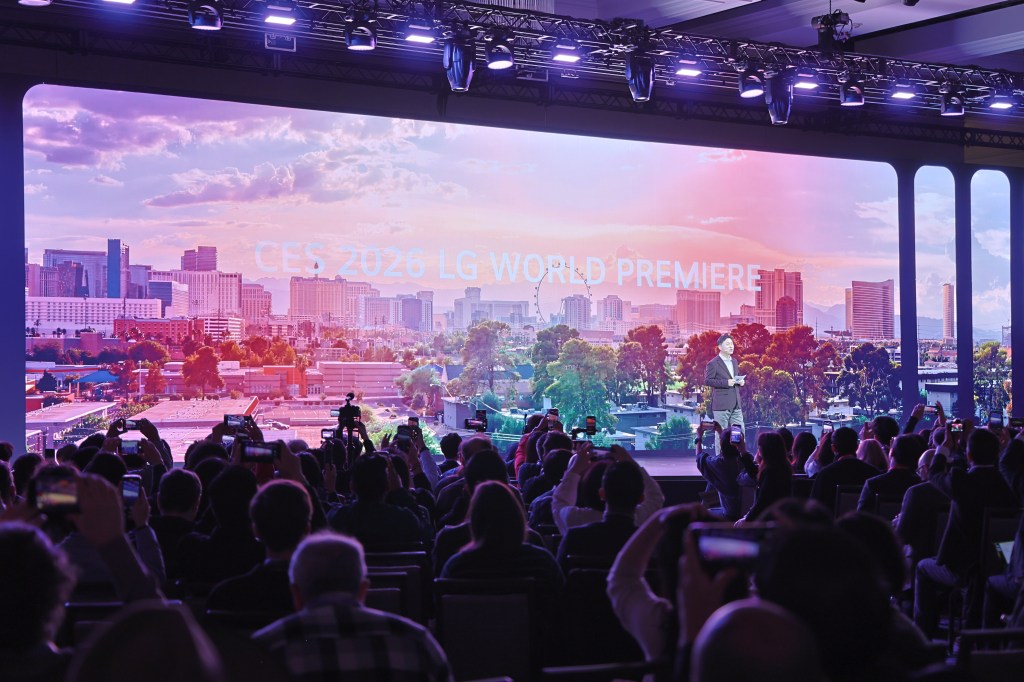
CES 2026 – Photo credit the Consumer Technology Association (CTA)

Published on LinkedIn and amitabhapte.com on11th Jan 2026

CES used to showcase device & gadget-based innovation. The signal this year from CES 2026 was about industrialization of intelligence across the FMCG supply chain. Homes and stores are becoming computational environments where the ‘shopper’ is increasingly an algorithm, not a human eyes-on-glass participant. If you’re a CIO or Tech Leader in CPG / FMCG or retail, the challenge isn’t the hardware on the floor, it’s how you show up in a world where the consumer operating model has moved from discovery to delegation.

Four CES 2026 signals that matter, if you are in a CPG, FMCG, Retail or Ecommerce business. None of these are optional, they compound.

1. Agentic commerce: the invisible shelf

We’ve moved from chatbots to agents that transact. Increasingly, the “shopper” is an algorithm acting on constraints, not a human browsing a shelf.

Google is sketching a future where personal agents negotiate directly with merchant systems on inventory, price and fulfilment early patterns of “consumer‑to‑merchant” protocols rather than static product pages. Instacart is building on its OpenAI‑powered experiences to offer conversational journeys that move from recipe discovery straight to cart fulfilment. Amazon’s “Buy for Me” now allows an AI agent to complete purchases on third‑party brand sites from within the Amazon app, turning intent into transaction with minimal user friction. Rufus, Amazon’s AI shopping assistant, already summarises reviews and compares products and categories with judgment, compressing the classic research journey into a single conversational flow.

Why it matters – Discovery shifts from search placement to context, constraints and routines. Metadata, APIs and consent models now determine brand visibility more than end‑cap positioning or SEO.

2. Physical AI: from demos to throughput

Robotics at CES 2026 showed a clear shift from demos to economics. Walmart’s AI “super agent” framework and its use of AI for defect detection, routing and pallet optimization in distribution centres are now reference points for AI‑first supply chains, even when discussed beyond a single event. LG unveiled the CLOiD Home Robot at CES 2026, a multi‑purpose home assistant with articulated arms and fingers designed to handle everyday household tasks as part of its “Zero Labor Home” vision. In logistics, robotics companies such as Pickle Robotics, working with carriers like UPS, are demonstrating how AI‑powered robots can unload irregular freight at high speed, a direct signal for how mixed CPG loads will be handled in future yards.

Why it matters – Robotics is becoming a strategic hedge against labour volatility and demand spikes. The measure of success has shifted from novelty to throughput, shrink reduction, safety, and OTIF performance.

3. Precision FMCG & beauty tech: products become systems

Consumables are evolving into hardware‑software ecosystems, especially in beauty and wellness.

L’Oréal continued its CES beauty‑tech run with infrared‑enhanced hair styling tools and flexible LED‑based anti‑aging wearables that blur the line between device, formulation and service. Kolmar Korea’s “Scar Beauty Device” won a CES 2026 Best of Innovation Award in Beauty Tech, combining AI‑based scar analysis with precision piezo‑electric delivery and around 180 blended colors for hyper‑personalised concealment and treatment in one system. LG Household & Health Care’s ultra‑thin “Hyper Rejuvenating Eye Patch,” a flexible LED eye patch paired with AI‑driven skin diagnosis and personalised ingredient prescription, shows how even a patch can become a dynamic, data‑driven.

Why it matters – Products no longer end at purchase; they evolve through data, diagnostics and software updates. CIOs and Tech Leaders in CPG / FMCG are now part of product, ethics and lifecycle design, not just “back‑office IT.”

4. Smart retail operations: stores as computers

The store is becoming a sensing, learning system. Samsung’s latest Micro LED and transparent display concepts at CES 2026 were framed as intelligent, context‑aware surfaces, equally applicable to flagship stores, QSR menus and in‑home experiences. Freestyle‑style beverage platforms from players like Coca‑Cola’s dispenser and app telemetry provides a template for how retail and vending data loop back into R&D. These patterns signal stores that behave more like software: instrumented, testable and continuously updated

Why it matters – The feedback loop from consumption to R&D is collapsing. Retail data is no longer just marketing input; it is product strategy and portfolio design.

Closing takeaway

CES 2026 made one thing clear. Intelligence is no longer a layer on top of FMCG and retail operations. It is becoming the operating system. Shopping is moving from discovery to delegation. Products are evolving after purchase. Stores, homes, and supply chains are becoming computational environments that sense, decide, and act.

For CIOs and tech leaders in CPG, FMCG, retail, and e-commerce, the advantage will not come from adopting more technology. It will come from designing brands, data, and operations that are readable by agents, executable by machines, and continuously improved by feedback.

The future shelf is already invisible. The only question is how your brand shows up on it.

Weekend Notebook #2601 – Scale vs. Substance

Published on LinkedIn and amitabhapte.com on4th Jan 2026

As we enter 2026, the AI industry remains gripped by what feels like scale fever. The prevailing assumption is that enough capital, energy, and hardware will eventually resolve into utility. The pipes are being laid at extraordinary speed. The open question is whether repeatable business value will follow.

The $40 Billion “More” – The scale of investment is now detached from traditional venture logic. Masayoshi Son has fully funded SoftBank’s $40 billion investment into OpenAI. This forms the down payment for Stargate, the hyperscale data-centre joint venture with Oracle. What’s notable is not just the size, but the intent. This is infrastructure being built ahead of clearly defined workloads. In my experience, one pattern holds. Infrastructure only creates value when it attracts the right tenants. We are, in effect, constructing the most expensive library in history. The job of leadership is not to admire the architecture, but to ensure the books are being checked out. And that they move the P&L.

The Efficiency Pivot – While the West continues to scale outward, parts of the East are scaling inward. DeepSeek is promoting training approaches that prioritise efficiency over brute force, aiming to stay competitive despite chip constraints. This isn’t a novelty. It’s a reminder that optimisation has always been a counterweight to abundance. For organisations operating with finite compute budgets, this matters. The strategic question is shifting. Not how many GPUs we can acquire, but how effectively we can utilise what we already have. Software-level optimisation is becoming as important as hardware procurement. The era of “buy more” is giving way to “use better”.

The Platform Mirage – OpenAI is experimenting with embedding third-party services directly into ChatGPT, allowing users to interact with tools like Spotify or Zillow through a single conversational interface. The ambition is clear. Replace the mobile grid with a universal text box. In practice, most of these integrations function as lightweight connectors. They struggle to match the speed, clarity, and precision of dedicated interfaces. This pattern isn’t new. The 2016 chatbot wave promised similar consolidation and quietly receded for the same reason. For complex enterprise tasks, purposeful graphical interfaces remain faster than conversation. Chat is powerful for intent discovery and orchestration. It is rarely the most efficient execution layer.

Resilience as a Requirement – Value is increasingly concentrating in specialised infrastructure and operational plumbing. Octopus Energy is spinning out Kraken, its AI-driven utility operating system, at an $8.65 billion valuation. At the same time, governments are hardening their positions. India is investing $4.6 billion in local component manufacturing while issuing strict compliance mandates on AI platforms. These signals point to the same conclusion. Resilience is no longer a secondary consideration. Regionalised supply chains, local compliance, and operational sovereignty are becoming baseline requirements. They are not inefficiencies to be minimised. They are the cost of continuity in a fragmented world.

My mindshare beyond Tech: the digital detox paradox – One of the most popular resolutions for 2026 is not a new app but deleting them. The Wall Street Journal reports a surge in digital detoxing, driven by growing recognition that constant notification cycles erode focus rather than enhance productivity. The irony is structural. At the same moment we are investing billions in agentic systems designed to capture attention, users are reclaiming time away from screens. As a CIO, my responsibility is to ensure systems are always on. As a leader, I know that the best thinking often happens when people are not. High-performance cultures depend on deep work. And deep work is the first casualty of the notification bell.

Weekend Notebook #52 – Enterprise AI grows up and narrative still matters

Published on LinkedIn and amitabhapte.com on 28th Dec 2025


This week in AI – The State of Enterprise AI, 2025

The State of Enterprise AI 2025 from OpenAI report offers a timely and necessary reality check.

AI adoption is no longer the challenge. Delivering consistent, repeatable business impact is.

Most large organisations now deploy AI across multiple functions. Yet only a minority report meaningful value at scale. The gap between experimentation and transformation remains stubbornly wide.

Three signals from the report stand out.

1. AI is now a leadership mandate.
AI has moved firmly onto board and executive agendas. The conversation has shifted from “Should we adopt AI?” to “Why aren’t we scaling it faster?”. This pressure is cascading rapidly through organisations, often faster than operating models, skills, and governance structures can adapt.

2. Pilots are plentiful. Scale is rare.
Enterprises are running many AI initiatives, but few are embedded into core workflows. The barriers are not model capability. They are data quality, integration complexity, unclear ownership, skills gaps, and organisational inertia. In short, enterprise readiness, not technology, is the limiting factor.

3. Focus determines value.
Companies seeing returns are selective. They prioritise a small number of high-impact use cases, redesign processes end to end, and invest deliberately in governance, skills, and change management. AI succeeds when it becomes part of how work gets done, not when it is layered on top of existing processes.

One pattern is unmistakable. AI investment is rising sharply, but productivity gains are not rising at the same pace. That gap defines the current phase of enterprise AI.


My takeaway this weekend

Enterprise AI has entered its execution phase. This is no longer about experimentation or tooling. It is about operating discipline, clear decision rights, and cultural adoption.

The organisations that win will be those that industrialise AI with the same rigour they apply to finance, supply chain, or manufacturing. AI advantage will be built through focus, integration, and sustained leadership attention, not through volume of pilots.


Beyond AI: my mindshare – Great TV Endures

As the holiday period starts, the Times 100 Best TV Shows of 2025 makes for a good read. A few personal favourites made the list, including Netflix’s Adolescence, Apple TV’s Slow Horses, and the BBC’s The Celebrity Traitors. What have you been watching this year?

Weekend Notebook #51 – when AI stops advising and starts acting

Published on LinkedIn and amitabhapte.com on21st Dec 2025


This week in AI – from Intelligence to Agency

Something subtle but decisive shifted this week.

Not in capability.
Not in valuation.
But in intent.

Across security, payments, software creation, and capital allocation, AI is no longer being positioned as a decision-support layer. It’s being designed as an execution layer.

That distinction changes everything.

For years, AI sat comfortably in the advisory role. It analysed. It recommended. It optimised. Humans still pulled the final lever. That boundary is now eroding, not through a single breakthrough, but through quiet, cumulative design choices.

Consider cybersecurity. Google Cloud’s expanded partnership with Palo Alto Networks is not just a large services deal. It reflects a deeper truth. In an AI-shaped threat landscape, human-in-the-loop defence is too slow. Security systems are being rebuilt to detect, decide, and respond autonomously. Defence is becoming algorithmic by necessity, not ambition.

The same shift is visible in commerce. Visa’s AI agents completing real consumer purchases may sound incremental, but it marks a psychological crossing. When AI systems transact on our behalf, trust is no longer abstract. It’s operational. The question stops being “is this recommendation accurate?” and becomes “am I willing to let this system act for me?”

That leap from suggestion to execution is irreversible.

Capital markets are aligning to the same logic. SoftBank’s scramble to close the final tranche of its OpenAI commitment is not about hype or fear of missing out. It’s about securing influence over platforms that will increasingly do, not merely advise. Lightspeed’s $9 billion fund, alongside similar mega-raises, reflects the same recalibration. AI companies are no longer lightweight software plays. They are infrastructure operators, with execution risk, physical constraints, and balance sheets to match.

Even software creation itself is being reframed. Nvidia and Alphabet backing Lovable is not just about no-code tools. It’s about collapsing intent into output. When natural language becomes a production interface, creation shifts from specialised craft to conversational control. The bottleneck moves from technical skill to clarity of thought.

Across all of this, one pattern holds.

AI is migrating from intelligence to agency.
From knowing to doing.
From tools we consult to systems we delegate to.

And that is not a technical evolution. It is a leadership one.


My takeaway this weekend

We are crossing the line from assisted intelligence to delegated authority.

That transition is happening faster than most organisations realise, and far faster than governance, culture, or leadership muscle memory can absorb. AI systems are beginning to act inside workflows, markets, and creative pipelines that were designed for human accountability.

The risk is not runaway intelligence.
It’s misplaced trust.

The leaders who will navigate this next phase successfully won’t be the ones chasing the most autonomy, but the ones redesigning decision rights, escalation paths, and responsibility models for a world where machines execute at machine speed.

AI leadership is no longer about adoption.

It’s about delegation, and knowing exactly where not to delegate.


Beyond AI: my mindshare – The World Meditation Day

Today, on World Meditation Day, the contrast couldn’t be sharper.

We are building systems that move faster, decide quicker, and act without hesitation. At the same time, the human nervous system is struggling to keep pace. Cognitive overload is becoming the hidden tax of digital acceleration.

Meditation feels almost countercultural in this context, but that’s precisely the point.

With over 700 studies linking meditation to focus, emotional regulation, and resilience, it’s no longer a spiritual indulgence. It’s a leadership capability. In environments where decisions are increasingly automated, clarity of intent becomes the scarcest resource.

Stillness trains that clarity.

As AI systems take on more execution, the human role shifts upward, toward judgement, ethics, and meaning. Those are not skills we can rush or automate. They require space. Attention. Presence.

This isn’t about slowing progress.
It’s about strengthening the human core that guides it.

In an age of delegation, inner discipline becomes the final guardrail.

Weekend Notebook #46 – Gartner IT Symposium Special Edition

Published on LinkedIn and amitabhapte.com on16th Nov, 2025


This week in AI – Five AI Signals from Barcelona

Barcelona had a different energy this year. The conversation has moved on from what AI can do. That phase is over. The focus now is on how organisations absorb the speed, scale, and structural change AI is introducing.

Across the keynotes, roundtables, and research sessions, five themes kept surfacing, sometimes quietly, sometimes unmistakably.

Theme One: The widening transformation gap.
Some organisations have begun treating AI as infrastructure, with governance, data foundations, ownership, and responsible deployment embedded into normal operations. Others remain stuck in pilot mode, experiments that never scale, uneven adoption, unclear accountability, and a general hesitancy to move. As one analyst put it: AI capability is rising fast, but organisational readiness is not. That tension is now shaping the competitive landscape.

Theme Two: The rise of agentic architecture.
By 2028, most B2B buying will be mediated by AI agents, and most customer processes will be handled by multiagent systems. This is not workflow automation. It is workflow replacement. Processes that once followed structured steps are becoming dynamic, context-aware, and decision-driven. Interfaces are shifting toward conversations. Enterprise platforms, from ERP to CRM, are reorganising around intelligence that acts, not waits.

Theme Three: Governance as the new accelerator.
Not in the traditional compliance sense. Governance has become the mechanism that determines speed. The organisations moving fastest weren’t the ones with the most models; they were the ones with clean data, disciplined model management, strong provenance, clear policies, and embedded risk thinking. In a world shaped by evolving regulation, geopolitical pressure, and rising expectations of trust, governance is no longer the brake, it is the runway.

Theme Four: Real value from AI.
This was the moment the conversations got honest. Leaders are discovering that “time saved” does not equal “value created”. Productivity gains are only the beginning. Real value emerges when organisations reengineer processes, redesign decision flows, renegotiate outsourcing, adopt hybrid human–agent operating models, and build AI-native products and services. The organisations making genuine progress are not adding more AI, they are rethinking how the enterprise works.

Theme Five: The shift in leadership expectations.
Technology leadership is expanding from delivery to direction. CIOs, CDOs, and emerging CAIOs are increasingly expected to influence beyond their function, connecting strategy, architecture, operating models, and transformation; converting AI potential into outcomes; and aligning people and processes around new ways of working. Influence, not technical mastery, is becoming the real differentiator.

My takeaway from the weekend

“The next chapter of AI will not be won by those with the most initiatives. It will be won by those with the most coherent organisational design, the strongest architecture, the clearest governance, and the most aligned leadership.”


Beyond AI: my mindshare – Four Human Lessons from Barcelona

Ironically, the most impactful sessions had nothing to do with technology. Four speakers; Bear Grylls, Jo Malone, Chris Barton, and Charles Duhigg, offered a blueprint for the human side of transformation, which felt even more relevant amid all the agent diagrams and architecture slides.

Bear Grylls spoke about resilience. Fear is normal. Vulnerability builds trust. Pressure creates capability. And isolation, not danger, is what truly undermines performance. In a world where leaders face ambiguous AI decisions daily, his message felt practical and grounding.

Jo Malone spoke about instinct. Her philosophy was disarmingly simple: notice what others overlook, trust your senses before the data arrives, and treat simplicity as a form of intelligence. AI may amplify creativity, but instinct and taste continue to differentiate great work from average output.

Chris Barton, the founder of Shazam, spoke about perseverance. Shazam was considered impossible for years. Constraints became catalysts. A thousand small iterations produced a breakthrough. His message was clear: as AI automates the easy work, human advantage shifts to originality, first-principles thinking, and unreasonable persistence.

Charles Duhigg delivered a masterclass in communication. Great leaders, he argued, are “supercommunicators”, people who ask deeper questions, match the type of conversation others are having, loop back understanding, and create psychological safety. In an AI-powered world where information is abundant, but alignment is scarce, communication becomes a strategic asset.

“Together, these four voices reveal the traits organisations need most now: resilience, intuition, perseverance, and connection. These are the qualities that anchor teams through uncertainty and accelerate transformation. AI can amplify what we do, but only character determines what we become.”