
Published on LinkedIn and amitabhapte.com | 25th April 2026
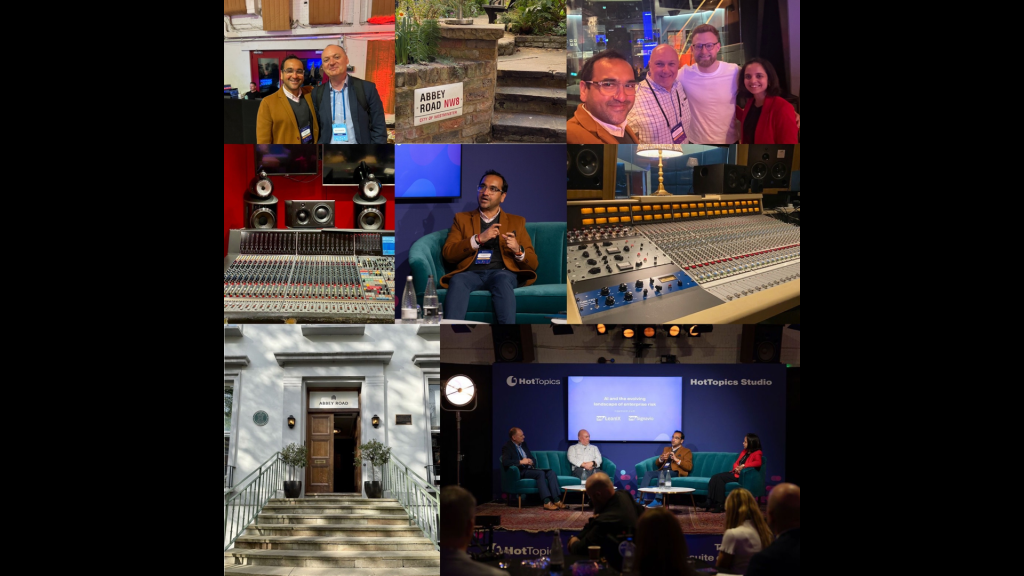
This Weekend’s Notebook comes from a unique place. Abbey Road Studios in London, where The Beatles, Pink Floyd, Oasis and Adele recorded some of their most iconic music. It is a place where creative shifts became cultural shifts.
That felt fitting. Because the conversation this week was about a different kind of shift.
I participated in a panel titled “AI and the Evolving Landscape of Enterprise Risk” with Komal Mathur, Strategic Transformation Lead at SAP, and Gary Osborn, Head of Information Security at Amnesty International, moderated by well-known technology journalist, Mark Chillingworth. We discussed AI strategy, its implications for business organisations and its people, and the emerging governance landscape.
The panel was part of the two-day CIO event hosted by HotTopics, a well-regarded forum for CIOs, CTOs, CISOs, CDOs and technology leaders across the UK and increasingly Europe. The Studio event covered a wide range of themes: AI strategy and governance, cybersecurity and resilience, operating model transformation, talent and skills, and the growing role of technology leadership in shaping business outcomes.
I am sharing a few reflections from the panel and the broader event for the benefit of my network.
My Panel — From AI Tools to AI Systems
The core shift we discussed is simple, but not yet widely understood. AI is no longer just a tool. As it moves into core business systems; supply chain, finance, operations, it starts shaping decisions, not just supporting them. That changes the nature of risk.
For the past two years, most organisations have focused on data risk: leakage, privacy, compliance. Important, but incomplete. The next layer of risk is operational.
A chatbot giving a wrong answer is manageable. An agent taking a wrong action inside a live system is not. Especially at speed and scale.
We are moving from systems that inform decisions to systems that increasingly participate in them. That requires more than policies and principles. It requires governance built into the architecture itself: visibility, control points, and the ability to intervene when systems behave in unexpected ways.
Another theme that came through clearly was the tension leaders are navigating. Business wants speed and advantage. Technology teams want control and stability. Society expects accountability and trust. Balancing all three is becoming a core leadership challenge, and the CIO and the tech leaders are increasingly sitting at the intersections.
The CIO role is quietly evolving into something closer to a Chief AI Business Risk Officer, whether organisations formalise that or not. Someone has to hold accountability for what autonomous systems do inside the enterprise. That needs to be a business leader with technical depth, not a policy document sitting in a shared drive.
Signals from the Room
Beyond the panel, a few patterns stood out across the two days.
The conversation around AI is maturing. The tone has shifted from “what can it do?” to “how do we manage it responsibly at scale?” Leaders are more candid now about the gap between ambition and readiness.
Cyber and resilience remain front of mind. As systems become more connected and more autonomous, the blast radius of failure increases. Security is no longer a layer. It is a design principle.
Governance is emerging as a differentiator, not a constraint. The ability to scale AI safely and predictably is becoming as important as the ability to deploy it. The organisations pulling ahead are the ones who figured that out first.
Operating models are under real pressure. AI is not just changing tools. It is reshaping workflows, decision rights, and team structures. Most organisations are still working this out, and the cultural change is proving harder than the technology.
And talent remains the binding constraint. Not just technical skills, but leaders who can connect technology, business and risk in the same conversation. That gap came up repeatedly.
The sustainability aspects of technology, specifically the meaningful upcycling of hardware, devices, peripheral equipment, not just recycling is a cause which CIOs and tech leaders feel worthy of getting behind. The digital divide, the gap between people living at the edge of technology innovation and still a large population feeling left behind needs to be addressed as industry priority.
The keynote from Eddie “The Eagle” Edwards, who finished last at the 1988 Winter Olympics with borrowed equipment and no support, was a reminder that showing up when nobody expects you to is its own form of leadership. His line stayed with the room: the people who said he did not belong were the same ones who wrote the rules about who was allowed to try.
My Takeaway This Weekend
The strongest signal across the two days was this: AI is moving from the edge of the organisation into its core systems. From answering questions to influencing decisions. Most organisations are still governed for the first. They will need to adapt quickly for the second.
AI risk is no longer about what the model says. It is about what the system does.
The leaders who will move ahead are not those deploying the most AI. They are the ones designing systems, operating models, and governance structures that can handle it responsibly.
Abbey Road Studios was a good reminder. The best work made in those studios was not made by avoiding risk. It was made by people who understood their craft well enough to take deliberate ones.

