
Published on LinkedIn and amitabhapte.com on 19th Apr 2026
Three stories this week. One company managing simultaneous geopolitical pressure from three directions. A financial system confronting a risk it did not design for. And a market that is struggling to tell the difference between genuine AI transformation and an opportunistic rebrand. Each deserves a clear head.
1. Anthropic: Three Moves in One Week
Claude Opus 4.7 launched as Anthropic’s most capable generally available model, with step-change gains in agentic coding and complex engineering. Anthropic was explicit that Opus 4.7 trails the unreleased Mythos Preview. The release is also a governance experiment: the company deliberately reduced Opus 4.7’s offensive cyber capabilities during training and is using real-world deployment to test the guardrails it will eventually need for Mythos-class models at scale.
On the same day, Anthropic announced a 158,000 square foot London office for 800 staff, four times its current UK headcount, in the Knowledge Quarter alongside DeepMind, Meta, and OpenAI, which announced its own permanent London hub days earlier. The move deepens Anthropic’s work with the UK AI Security Institute, which evaluated Mythos Preview this week. With a Pentagon blacklisting in force, London is becoming both a talent hub and a political hedge.
The third move was a product one. Anthropic launched Claude Design, a new experimental tool that lets users create prototypes, slides, one-pagers, and visual assets through conversation. The target audience is explicitly non-designers: founders, product managers, analysts. You describe what you want, Claude produces an initial version, and you refine from there. It is a small product launch in the context of a week dominated by Mythos, but it is strategically coherent. Anthropic is quietly expanding its surface area from developer infrastructure into the everyday workflow of knowledge workers, the same ground occupied by Microsoft Copilot and Google Workspace AI.
| My PoV: Anthropic is simultaneously managing a product too powerful to release publicly, a major geographic expansion, and a steady move into enterprise workflows. The Opus 4.7, London office, and Claude Design announcements are not separate stories. They are three layers of the same strategy: govern the frontier carefully, plant the flag in key markets, and expand the addressable use case before competitors consolidate their positions. |
2. Finance Confronts a Risk It Didn’t Build For
At a G30 session on the sidelines of the IMF spring meetings, Barclays CEO CS Venkatakrishnan was direct: “On Mythos, it’s a serious issue. There will be a Mythos 2 and a Mythos 3, and they’ll come with probably distressing frequency.” His concern is the trajectory, not the model. Legacy banking infrastructure was not designed for an environment where AI can identify and chain software vulnerabilities at pace. The UK government simultaneously issued an open letter to businesses citing the AI Security Institute’s assessment that Mythos is “more capable at cyber offence than any model we have previously assessed.”
On a different but connected front, France’s Finance Minister called for more euro-denominated stablecoins and urged EU banks to accelerate tokenised deposits, naming the risk of “digital dollarization” directly. A 12-bank consortium including ING, UniCredit, and BNP Paribas is targeting a MiCA-compliant euro stablecoin in H2 2026. This is a policy reversal: France’s previous position was that private stablecoins had no place on European soil. Dollar-pegged tokens circulate at over $310 billion. Euro equivalents total under $1 billion. European policymakers have decided the cost of continued inaction now exceeds the risk.
| My PoV: These two stories are more connected than they appear. Both reflect a financial system built for slow-moving threats and predictable regulatory cycles, now confronting neither. Defenders must succeed every time; attackers only once. For boards and risk committees, the right question is not whether Mythos itself is the threat. It is whether your security posture and your digital infrastructure were designed for the world Venkatakrishnan is describing. |
3. Signal and Noise, Harder to Tell Apart
The tech market had a remarkable week. Oracle rose 27%, AMD climbed 42% over 13 consecutive sessions, and Microsoft posted its best week since 2015. Some of this reflected geopolitical peace hopes. But the underlying driver was real: Oracle’s cloud infrastructure revenue grew 84% year-on-year, AMD’s data centre GPU share is genuinely expanding, Azure is accelerating on AI workloads. The software sector is still down 19% year-to-date on AI disruption fears. The companies rebounding are the ones showing they know which side of that disruption they are on.
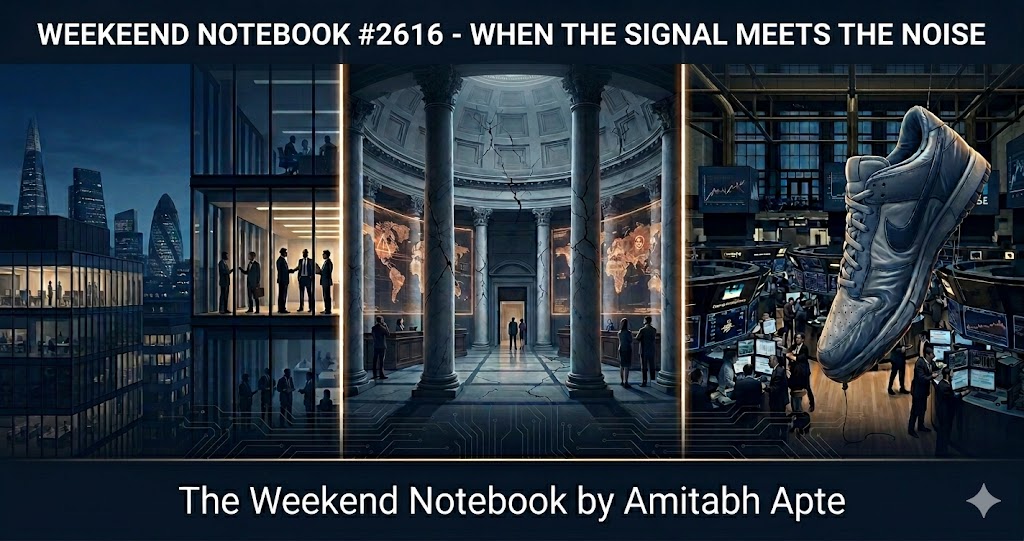
Then there is Allbirds. The wool sneaker brand, once valued at over $4 billion, announced it is selling its footwear assets and rebranding as “NewBird AI,” a GPU-as-a-service provider. It raised $50 million in convertible financing. Its stock rose 582% before falling 30% the next day. The company has no AI infrastructure expertise, no cloud customer base, and no obvious path to competing with CoreWeave or the hyperscalers. This is not an AI story. It is a distress story wearing an AI badge, and it follows a pattern that anyone who watched the dot-com era will recognise.
Tesla launched robotaxis in Dallas and Houston this weekend with unsupervised Model Y vehicles. The direction is right. The operational reality is modest: one active vehicle in each city at launch, four days before Q1 earnings. Waymo runs over 500,000 paid rides weekly across eleven cities. Tesla’s Austin fleet reached 46 vehicles after nearly a year and logged 14 crashes. The gap between the announcement and the business is still large.
| My PoV: Oracle and AMD are rebounding on real infrastructure economics. Allbirds is the 1999 “.com rename” in 2026 clothing. Tesla’s robotaxi expansion is directionally meaningful but operationally early. The discipline of separating these is not a nice-to-have. The market is currently rewarding the story and the substance equally, and that gap will close. |
My Takeaway This Weekend
AI capability is advancing faster than governance can absorb. The infrastructure sustaining it is generating real returns. And the speculative energy around the narrative is producing decisions that deserve more scepticism than they are getting. All three are true simultaneously. The leaders who navigate this well are the ones who can hold all three frames at once, without collapsing into either uncritical enthusiasm or reflexive caution.

