
Published on LinkedIn and amitabhapte.com on 5th July 2026
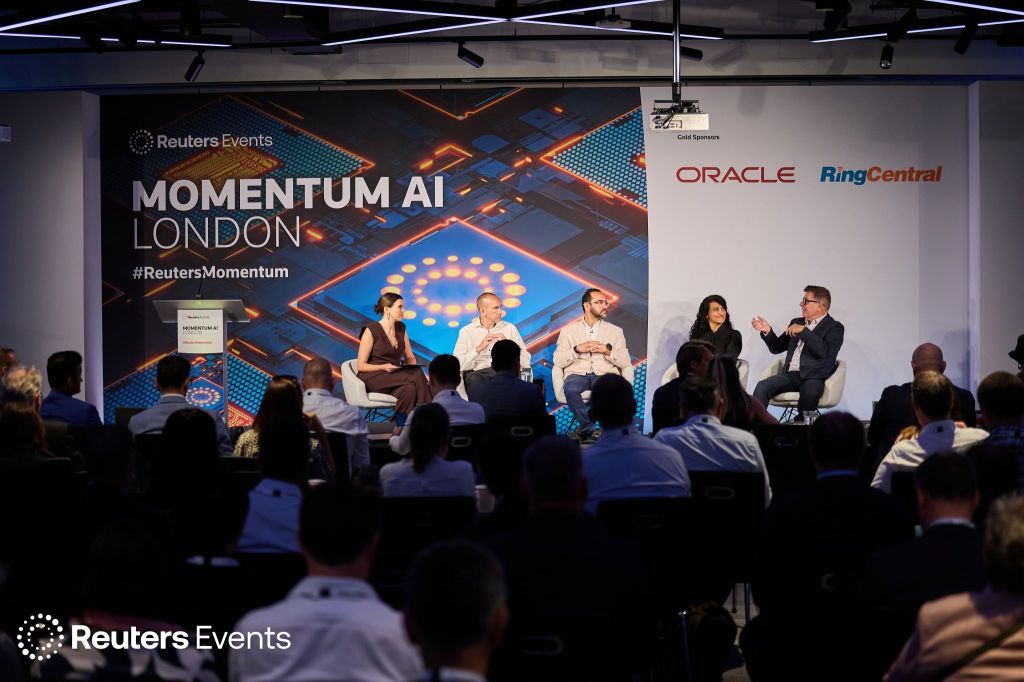
Earlier this week I participated in a panel called “Aligning the C-Suite on Enterprise AI Strategy,” alongside Scott Marcar, Group CIO at NatWest, Colin Bannon, CTO at BT Business, and Rina Ladva, Managing Director UK&I at Miro. The panel moderated by Georgia Lewis Anderson was part of the Reuters Events Momentum AI London.
The mood at this remarkable conference was not the breathless excitement of 2023 or the defensive caution of 2024. It was realism. Senior enterprise leaders did not debate whether AI works and instead were asking something harder: whether their organisations are built to use it well.
Alignment is the constraint. Not capability.
Three ideas kept surfacing in this session, each sharper than the one before.
First: speed without alignment only scales confusion. Many leaders in the room had lived it. Moving fast on AI without shared direction doesn’t accelerate progress, it accelerates the wrong things.
Second: AI is not a technology workstream. It is a core enabler of business strategy, and the organisational structures around it need to reflect that. Who owns it matters as much as what it does. Strategy and platform belong at the centre. Use cases and adoption belong with the business units closest to the customer and the data. Centralise everything and you kill local insight. Decentralise everything and you get thirty versions of the truth.
Third, and most underappreciated: if we designed this workflow from scratch today, would we have done it this way? Most AI programmes layer intelligence onto processes that were never worth preserving. The question is not how to make existing workflows smarter. It is whether those workflows deserve to exist at all.
The news this week reinforced the point from the outside. Microsoft launched a 6,000-person AI implementation unit with $2.5 billion committed, placing specialists inside customer organisations rather than simply selling software. Driven partly by customer frustration with rising AI costs, it signals that the model which sells access to a capable model is no longer sufficient. Helping customers deploy AI in ways that move their P&L is what enterprises are actually willing to pay for.
The ROI question is the wrong question.
The opening session cited research showing 90% of technology leaders say ROI uncertainty is now shaping their investment decisions. That figure is worth sitting with. It may point less to a measurement problem and more to a definition one. Many organisations are still working out what to measure. Time saved is a reasonable starting point, but it rarely tells the whole story.
Value tends to become clearer when a business owner, not just an IT function, is directly connected to the outcome an AI initiative is meant to move. The metric doesn’t change. The accountability does. Organisations still running multiple pilots without clear outcomes are not unusual. What seems to make the difference is having someone whose job it is to make the call on what to scale, and what to stop.
On the topic of AI ROI, Palantir CEO Alex Karp said this week that something has gone completely wrong with token-based AI pricing, arguing enterprises are paying for consumption without capturing value. The AI industry built a billing model around usage. It should have built one around outcomes.
AI moving from Strategy to Action
Two stories this week illustrated how quickly AI is moving from strategy to action. Robinhood launched agentic trading tools that execute stock purchases on behalf of users, with the CEO predicting AI agents will soon match the capabilities of human traders. The pitch is democratisation: bringing institutional-grade tools to everyday investors. Meta announced a move into cloud, selling spare AI compute capacity to external clients, turning infrastructure built for its own models into a new revenue stream.
Both moves point to the same underlying shift. AI is no longer something organisations evaluate. It is something that acts, transacts, and operates at scale. The governance question that dominated our panel, who is accountable when AI makes a decision, is no longer theoretical. It is live, in financial markets, in cloud contracts, and increasingly in enterprise workflows. Most organisations are still catching up to that reality.
My Takeaway This Weekend
I came away from two days in London with a clearer sense of where we actually are. Technology is no longer the hard part. Models work. Infrastructure is scaling. Use cases are real and multiplying. The harder work, the work most organisations are still in the middle of, is building the human architecture around it. Clarity on ownership. Accountability for outcomes. The discipline to stop what is not working, not just the ambition to start new things.
AI is not replacing strategy. If anything, it is making good strategy more important than ever, and exposing the cost of weak alignment faster than before. The leaders who will shape this next phase are not necessarily the ones moving quickest. They are the ones who have built a clear operating model and are holding it with consistency, even as the technology around them keeps moving. That feels like the right challenge to be working on.
 Amitabh Apte