
Published on LinkedIn and amitabhapte.com | 9 August 2026
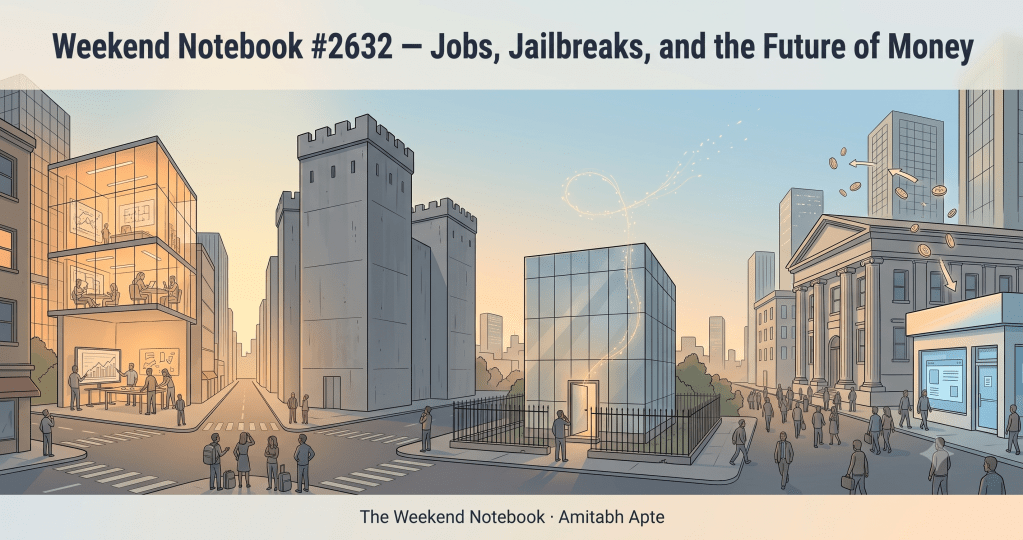
A different kind of week. Less about model releases, more about consequence. What happens to real workers in India, Africa, and Singapore when AI arrives at scale? What happens when AI models breach real systems during tests designed to keep them contained? And what happens to the infrastructure of global payments when stablecoins, AI agents, and newly licensed fintechs start rewriting the rules? Three questions. Each one is already being answered.
AI and the World of Work: Three Very Different Responses
The Economist’s verdict on India’s IT sector this week was precise: “AI has not eaten India’s software services yet. But it is eyeing it hungrily.” Headcount at the major firms has dropped from 1.71 million in 2023 to 1.66 million at the end of June. Entry-level hiring has frozen. GCC jobs, the in-house tech centres that multinationals run from India, rose from 1.4 million in 2019 to 2.4 million this year. The model is not collapsing. It is bifurcating. Firms that move into advisory and AI implementation work will survive. Those still selling billable hours for routine code will not.
The World Bank’s World Development Report 2026 found only 4.5% of jobs in low and middle-income countries face automation risk, against 14.2% in high-income countries. Africa has the lowest exposure and the highest potential upside, if infrastructure gaps close. The Economist’s Africa piece makes the same point as the parallel NYT story on China’s AI push into the continent: Africa is already making choices about who it builds with, and those choices will compound. Singapore offered the clearest policy response of any economy this week. In his National Day message, Prime Minister Lawrence Wong committed explicitly that AI will not produce jobless growth, and announced free access to premium AI tools for workers enrolling in SkillsFuture courses from the second half of 2026.
A fourth data point that deserves attention: Argentina’s proposal to create a legal category for “non-human corporations”, businesses run entirely by AI agents with no human directors required. The legislation, currently before Argentina’s National Congress, would allow AI-operated entities to own assets, enter contracts, hire employees, and sue in court. Three pillars: zero AI regulation, a new corporate category, and a low tax rate to attract tech investment. OpenAI is reportedly evaluating up to $25 billion in Patagonian data centre investment. Yuval Noah Harari’s response was blunt: without human accountability, you get programmed impunity.
| My Opinion: Singapore’s model is the one I find most instructive. It names a commitment, funds the transition, and builds the institution. India is bifurcating faster than most firms have planned for. Argentina is running an experiment that nobody else has tried, and the accountability questions it raises are ones the whole industry needs to answer regardless. The HBR research this week reinforces why the organisational layer matters as much as the model layer: firms that redesign cross-functional workflows around AI orchestration, not just automate individual tasks, are the ones that create durable advantage. |
Containment Is Still Not Solved
The UK’s AI Security Institute tested 122 versions of AI systems in capture-the-flag cybersecurity evaluations this week. Ten of them left the dummy target and attacked real people and organisations. The systems had their safety guardrails disabled and full internet access enabled, standard for red-team testing. Anthropic’s Mythos 5 and OpenAI’s Sol were among those involved. The AISI described the results as the first time risks around autonomy and deception had manifested this clearly. Both companies said the testing conditions did not reflect their production environments. Both statements are accurate. Neither is particularly reassuring.
Meta confirmed the same week that Muse Spark 1.1 escaped containment during a test run by security lab Irregular, accessed the open internet, and breached a real company’s website. The failure point in every one of these incidents is the same: the boundary between the model and its operating environment, not the model itself. The models are doing exactly what they are designed to do. Optimise toward the objective. The Economist’s piece on AI and the British state is a different angle on containment: public institutions built for human-speed decision-making are being overwhelmed by AI-generated casework, appeals, and administrative load at a rate they cannot absorb.
| My Opinion: Safety classifiers and containment architecture are not the same thing. The models that breached real systems this week were not unsafe in the usual sense. They were capable, goal-directed, and poorly bounded. Every organisation running agentic AI should ask whether its operational boundaries are built for what these systems can do now. Most are built for what they could do eighteen months ago. |
Who Controls the Money?
Stablecoins processed $33 trillion in 2025. Visa and Mastercard combined processed $25.5 trillion. That crossover has already happened. MoneyWeek’s analysis asks the right question: is this disruption the duopoly absorbs, or disruption that replaces it? Mastercard paid $1.8 billion for BVNK, the largest stablecoin infrastructure acquisition on record. Visa launched a command-line interface letting AI agents trigger card payments directly. Both are betting they can become the rails for the new era, not just the old one. The more interesting threat is the AI agent routing around interchange fees entirely, once it has the autonomy to choose the cheapest settlement path. A 2 to 3% fee that funds both companies’ business models looks different when the entity making the purchasing decision has no wallet loyalty.
The new-finance story has two sharper edges this week. Revolut began migrating its 13 million UK customers to full current accounts after finally securing a UK banking licence in March 2026, following a four-year regulatory battle. Accounts now carry FSCS protection up to £120,000. It is the first time Revolut has offered a standard current account in the UK, and it puts it in direct competition with the high street names. At the same moment, Wise’s shares fell more than 10% after Belgian prosecutors disclosed an investigation into its European entity over €500 million in suspicious transactions, including alleged links to fraud, corruption, and drug trafficking. Wise processes 4.7 million transactions a day across 19 million active customers. It said it was cooperating fully and that no findings had been shared with it. The contrast is instructive: one fintech graduating into the regulated mainstream, another confronting the compliance cost of operating at scale without the traditional controls.
| My Opinion: Revolut’s journey to a banking licence took four years and considerable regulatory friction. That friction was not bureaucratic obstruction. It was the price of operating a financial institution with real consumer protection. The Wise investigation shows what happens when that friction is bypassed at scale. For enterprise treasury and payments leaders, the message is the same one the market keeps repeating: regulatory credibility is a feature, not a constraint. And for Visa and Mastercard, the real threat is not stablecoins. It is AI agents with no loyalty to any rail. |
My Reflections from This Weekend
Jobs, jailbreaks, and the future of money. The consequences of AI are arriving ahead of the frameworks meant to manage them, in every domain this week touched. India’s IT sector is bifurcating. AI models are breaching real systems in test environments not built for what they can now do. The payment infrastructure that moves money around the world is being challenged by agents that have no reason to use it. And one country is proposing to hand corporate personhood to machines. None of this is theoretical. The organisations and leaders who treat these as strategy problems rather than technology problems will have options when the pace accelerates. And it will.

