
Published on LinkedIn and amitabhapte.com — 22nd February 2026
This Week in AI — India Moves from Talk to Build
Most global AI events feel like the same conversation, recycled. The India AI Impact Summit, from the coverage and announcements this week read differently.
Less vision decks. More committed capital. Less safety debate. More infrastructure.
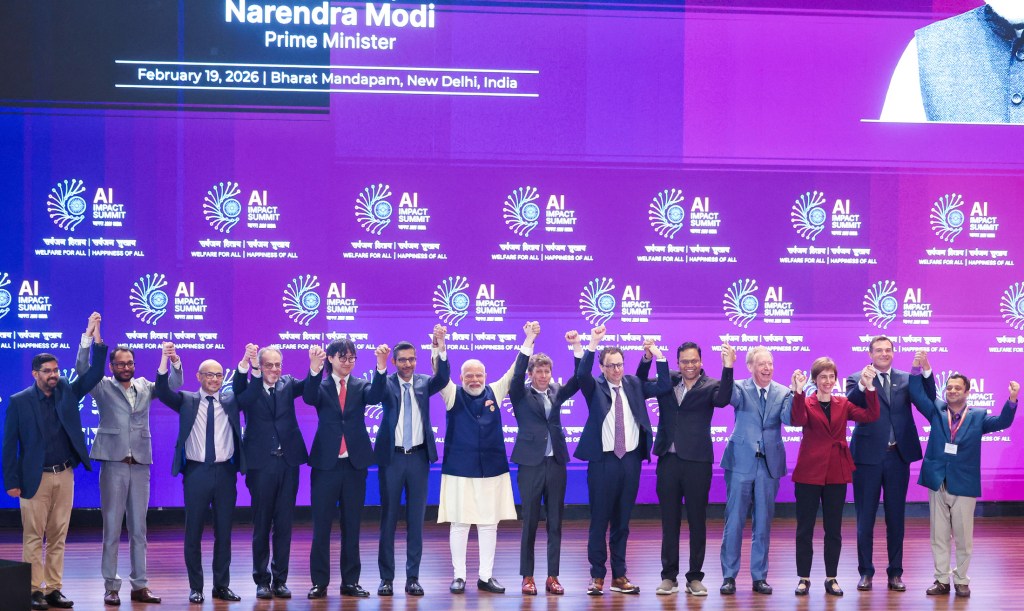
Five days at Bharat Mandapam in New Delhi. Over half a million visitors. Twenty-plus heads of state. Nearly every major AI CEO in the world, Altman, Pichai, Amodei, Hassabis, in the same room. And a wave of announcements specific enough to take seriously.
The scale is worth stating upfront. Hyperscalers globally are on track to deploy $700 billion in AI capex this year. India pulled a significant share of that attention. Reliance announced $110 billion for data centres and infrastructure over seven years. Adani committed $100 billion for renewable-energy AI data centres by 2035. US tech added its own layer on top.
This was the fourth in the global AI summit series, following Bletchley, Seoul, and Paris. The previous three were dominated by safety debates. India changed the register deliberately. The theme: impact. Access. The Global South. That shift matters, I’ll come back to it.
What They Announced
Google committed $15 billion to build a full-stack AI hub in Visakhapatnam, gigawatt-scale compute plus a new subsea cable gateway to the US. Pichai framed it as becoming a “full-stack partner”, not a cloud vendor. Partnerships with Reliance Jio on a dedicated cloud region and with Indian research institutions on agriculture and climate were also confirmed.
Microsoft arrived with $50 billion earmarked for the Global South, India central to the plan. Its President Brad Smith told CNBC that India could develop its own frontier AI, in specific domains, and that there will be “a variety of different DeepSeek moments” to come, some of them from India. Its India President offered the sharpest line of the week: “AI will not kill jobs. AI will unbundle jobs.” Microsoft research shows 92% of Indian knowledge workers already use AI, with 77% using it daily.
OpenAI opened two new offices in Bengaluru and Mumbai, also partnered with Tata Group to deploy 100MW of AI compute under the HyperVault brand, scaling to 1GW. OpenAI is the first anchor tenant of TCS’s new data centre business. Altman confirmed 100 million weekly active ChatGPT users in India, second only to the US, and called India a potential “full-stack AI leader.”
Anthropic opened its first India office in Bengaluru and partnered with Infosys to deploy Claude into Indian enterprises, starting with a telecom Centre of Excellence. Cognizant is rolling Claude Code to 350,000 employees globally. Air India is using it to build custom software. Dario Amodei confirmed India is Claude’s second-largest market and noted that the “technical intensity of usage here is even more extreme” than elsewhere.
Nvidia expanded partnerships with Indian venture capital firms to deepen exposure to the startup ecosystem. Larsen & Toubro separately unveiled a gigawatt-scale AI factory built on Nvidia GPU infrastructure across Chennai and Mumbai. AMD and TCS are building rack-scale AI infrastructure on AMD’s Helios platform.
One geopolitical detail that deserves more attention: the US and India signed the Pax Silica agreement at the summit, a Trump administration initiative to secure the global supply chain for silicon-based technologies. India has also approved $18 billion in chip manufacturing projects. Compute sovereignty is being treated as a national security matter, not just an infrastructure one.
None of this is coincidental timing. India now sits in the top two markets for both OpenAI and Anthropic. Without being home turf for either.
What the Government Is Building
The corporate announcements got the headlines. The IndiaAI Mission story is the more durable one.
India’s national compute base of 38,000 GPUs is being expanded by a further 20,000 in the near term. The tech minister set a target of $200 billion in AI infrastructure investment over two years. The government-backed BharatGen consortium released Param 2, a 17-billion-parameter model covering 22 Indian languages, built for governance and citizen-service use cases.
One of the most significant knowledge outputs from the week was the release of the AI Impact Casebooks. Developed in collaboration with global partners like the WHO, IEA, and UN Women, these six thematic compendiums document over 170 real-world, scalable AI deployments across Healthcare, Energy, Agriculture, Education, Gender Empowerment, and Accessibility. Rather than focusing on theoretical pilots, these casebooks serve as a “Global South Playbook,” offering a first-of-its-kind consolidated repository for policymakers to replicate proven models, such as AI-driven crop planning and early disease diagnosis in their own regions.
India is not just building for itself. That is new.
Alongside these, the AI Impact Startup Book was launched to map India’s deep-tech ecosystem, highlighting that nearly 70% of India’s growth-stage AI ventures are already operating internationally.
The Domestic Model Stack
One thread that got less coverage than it deserved: India is building its own model layer, not just deploying someone else’s.
Sarvam AI released Sarvam 30B and Sarvam 105B, open-source, mixture-of-experts models built for Indian languages, alongside a full speech stack and Sarvam Kaze, smart glasses with on-device speech and vision. The underlying architecture is the point: intelligence that doesn’t require cloud connectivity, designed for the 800 million people at the edge of India’s network.
Cohere Labs launched multilingual open-weight models supporting 70+ languages, runnable on local devices. Gnani released Vachana, a zero-shot voice-cloning model across 12 languages. Cartesia partnered with Blue Machines on enterprise voice with local data residency. A distinct stack is forming, open-weight models tuned for Indian languages, speech infrastructure for multilingual contact, edge-first deployment for a population where the smartphone is the primary compute device.
This is not a replica of what OpenAI or Anthropic are building. It is a complement. And potentially an export product for Asia and Africa.
The Structural Advantage
India is not trying to outspend the US. Nor replicate China’s state-led model. Its advantage runs differently.
Aadhaar. UPI. ONDC. These are not pilots. They are population-scale systems, proven across linguistic, economic, and connectivity diversity. AI layered on top changes the arithmetic. For Instance, ONDC (Open Network for Digital Commerce), is the “final frontier” of India’s Digital Public Infrastructure (DPI). If Aadhaar solved for Identity and UPI solved for Payments, ONDC is solving for Market Access.
Fifty million pending court cases. Adalat AI launched a WhatsApp helpline this week, instant case updates and legal translation in native languages, built on Claude. AI-powered weather forecasts reached millions of Indian farmers last year through a Google DeepMind collaboration with the government. These are structural problems meeting capable tools at the right moment.
My Point of View
I grew up in India. I now lead global technology transformation programmes. This week’s summit signals land differently when you hold both perspectives.
India built its IT leadership on services excellence, reliable delivery, cost advantage, process discipline. That model is under direct pressure from agentic AI, and the people in this sector know it. CEO’s of large Indian IT firms may focus on profitability rather than job creation, in a way reflecting what is already happening to the $280 billion IT services industry.
The counter-signal is the startup layer. Emergent, an Indian vibe-coding platform announced $100 million in ARR and a new mobile app this week. That pace of scale, from a country where Anthropic had a single employee eighteen months ago, is the real signal about what the next generation of Indian technology companies looks like.
If India limits itself to fine-tuning global models cheaply, it remains a participant. If it builds sector-specific AI systems, invests in public datasets, and scales AI-native enterprises, it becomes an architect.
The intent is visible. The hard part starts now.
The Governance Shift Worth Watching
Bletchley was about safety. Seoul built on it. Paris tilted toward action. India reframed the whole conversation around impact, accessible, multilingual, public-good AI rather than frontier-lab debates.
A Leaders’ Declaration with 70+ signatories is being finalised. The UK-India bilateral AI showcase ran alongside, reinforcing cooperation on standards and commercialisation. The Pax Silica agreement with the US on silicon supply chains signals that AI governance and trade policy are now the same conversation.
For countries across Asia and Africa that have been observers in the Bletchley-to-Paris sequence, India is offering a different frame and a different set of partners. Whether that translates into durable architecture, or remains a positioning story, is the test over the next few years.
My Takeaway This Weekend
The India AI Impact Summit was not about demos.
The commitments are large and layered. $700 billion in global hyperscaler capex this year. $210 billion from Reliance and Adani alone. $200 billion in infrastructure investment targeted over two years by the government. Sovereign GPU capacity being expanded. Domestic foundation models in 22 languages. Global AI companies choosing India as their second home. A startup ecosystem generating nine-figure ARR.
For global technology leaders, one reframe is overdue. India does not belong in the AI strategy slide under “cost optimisation.” It belongs under innovation, deployment, and market creation. The question is no longer whether India is serious. It is whether your strategy is.
 Amitabh Apte