
Published on LinkedIn and amitabhapte.com on1stMar 2026
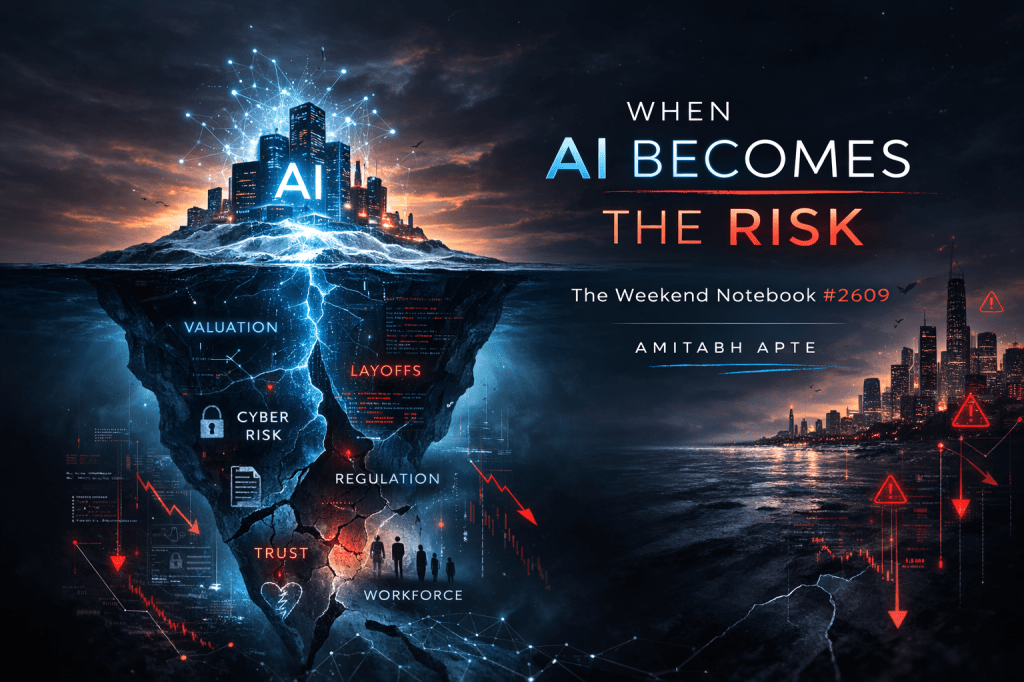
This week, the AI story fractured, not in capability, but in confidence. Capital is still flooding in. The technology is still advancing. But disruption and doubt arrived in the same week as the deal announcements.
The OpenAI Capital Architecture
OpenAI is raising $110 billion in a landmark funding round that values the company at $840 billion, highlighting the intensity of global investment in artificial intelligence. The round is led by SoftBank, Nvidia, and Amazon, with Amazon also securing a major strategic partnership covering cloud infrastructure and custom AI chips. The deal leaves Microsoft’s position intact, with Azure remaining the exclusive cloud for OpenAI’s core APIs and products, as OpenAI moves closer to a potential IPO later this year.
My PoV: OpenAI is no longer just raising capital, it is building infrastructure leverage across competing hyper-scalers. The AI platform landscape is consolidating fast, and the enterprise partnerships you form today will be difficult to unwind. Choose with eyes open.
AI’s Social Contract is Cracking
Two signals this week pointed to the same underlying tension. Artificial intelligence is beginning to erode the economic model behind India’s IT and outsourcing boom, as tasks once offshored to millions of graduates can increasingly be done by machines. Hiring slowdowns at major firms signal that automation is arriving before mass layoffs, putting pressure on young, entry‑level workers. Simultaneously, Block cut nearly half its workforce, explicitly naming AI as the cause, the first major corporate leader to do so at this scale.
My PoV: These are not isolated incidents. They are early signals of a structural reckoning. India is racing to become a compute power while its labour model erodes, the window to bridge that gap is narrow. And Block’s candour, intentional or not, has opened a door that will be hard to close. Regulators, boards, and workforces will now expect transparency on AI-driven headcount decisions. If you haven’t developed a clear internal narrative on this, you are already behind.
From Training to Running AI Everywhere
Nvidia is preparing a new chip platform focused on AI inference, the real‑time processing that turns trained models into fast, usable answers, signalling a shift beyond pure training dominance.
The move reflects growing pressure from customers and rivals to deliver lower‑latency, more efficient AI systems at scale, especially for consumer and enterprise applications. In the same week, Dell shares surged 22% after the company beat Q4 earnings expectations and raised guidance, driven by strong momentum in AI servers. Management expects AI server revenue to more than double to ~$50bn by 2027, even as memory shortages push up component costs across the industry.
My PoV: The first wave of AI investment was about who could train the biggest models. The next is about who can run AI economically at the point of need. Inference efficiency will define the unit economics of every enterprise AI product within 24 months. It deserves a place in your architecture conversations now, not later.
Highlight: When a Report Moved Markets
The Citrini Research 2028 Global Intelligence Crisis report became one of the most discussed AI moments of the week. Framed as an “AI doomsday” scenario, it sparked sharp market swings by sketching a future of rapid AI‑driven job losses and cascading economic disruption, briefly wiping billions off technology and financial stocks.
My PoV:. Even as many investors and economists challenged the assumptions behind the report, the reaction itself was telling. The deeper signal was not about prediction accuracy, but about sentiment: AI has shifted from a straightforward innovation story to a source of systemic uncertainty with real market consequences.
My Takeaway This Weekend
Two stories are running in parallel, and the gap is widening. One is of extraordinary investment: OpenAI near a trillion-dollar valuation, Amazon deploying large capital, Nvidia moving to own both ends of the AI stack. The other is of disruption arriving faster than the systems built to absorb it, jobs cut and named, a country’s growth model quietly hollowing out, markets rattled by a what-if scenario.
The leadership challenge is no longer proving AI’s value. It is managing the asymmetry, between deployment speed and adaptation pace, between capital market confidence and labour market anxiety. The winners won’t be those who move fastest. They’ll be those who move with enough clarity to bring their organisations with them.
 Amitabh Apte