
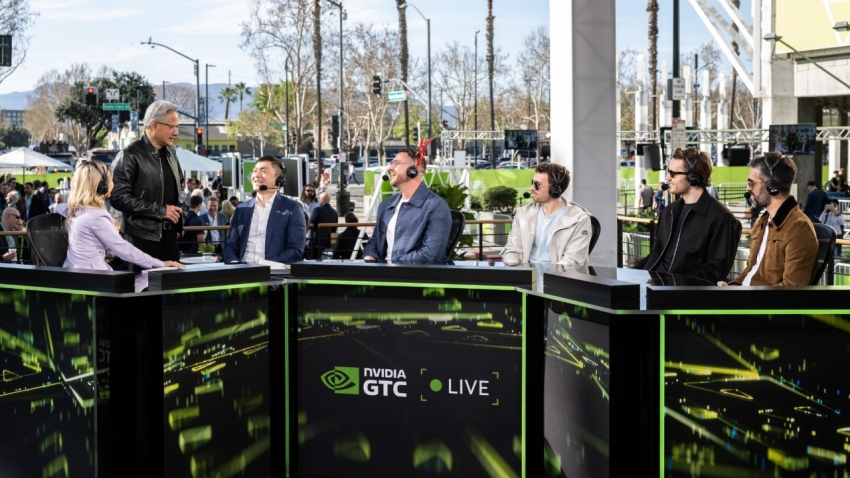
GTC Live 2026 Keynote Pregame – photo credit NVIDIA GTC
Published on LinkedIn and amitabhapte.com on 22nd Mar 2026
GTC 2026 drew 30,000 people to San Jose. Jensen Huang announced $1 trillion in confirmed orders for Blackwell and Vera Rubin systems through 2027, double last year’s projection. But the number was not the headline. The architecture behind it was.
From Data Centres to AI Factories
Huang reframed the data centre entirely. The new construct is the AI factory, a facility whose primary output is not storage or compute, but tokens. Every query answered, every decision supported, every automated workflow consumes them. The new efficiency metric is not uptime. It is token throughput per watt.
This changes the business case for infrastructure investment. Data centres were cost centres. AI factories are production lines. When the output has a unit price, the conversation with the business shifts fundamentally.
Nvidia’s keynote slides showed 40% of its order pipeline now coming from enterprise, sovereign AI, and industrial customers, not just hyperscalers. The enterprise wave is no longer coming. It has arrived.
My PoV: CIOs who still frame infrastructure purely as a cost management conversation are using the wrong model. Token economics and inference costs belong in your architecture discussions now. Your business leaders will ask about them within 18 months.
The Agent is a Platform
The most important slide of the keynote carried a simple title: ‘Agents: A New Computing Platform.’ Huang’s argument was precise. The PC was a platform. The smartphone was a platform. The agent is next, with its own architecture: a reasoning core connected to memory, sub-agents, tools, files, and a multi-modal prompt layer.
Nvidia made this concrete with NemoClaw, an enterprise-ready implementation of the OpenClaw agentic framework, bringing autonomous agents inside the enterprise firewall with privacy controls and policy guardrails. Huang also noted that Nvidia’s own engineers will receive annual token budgets as a productivity metric. Token consumption is becoming a measure of knowledge work output.
My PoV: If the agent is a platform, enterprise architecture must be designed around it, not retrofitted for it. The question is not which agent tool to pilot. It is what your data, security, and integration architecture looks like when agents become the primary consumers of enterprise systems.
Enterprise IT: From SaaS to Agent-as-a-Service
One slide showed two pictures. On the left: today. Data centre, SaaS software, GSI, humans on top. On the right: tomorrow. An AI factory generating tokens, software and AI providers connected by agents, and humans repositioned as enterprise information workers directing and overseeing rather than executing.
Huang called this the Enterprise IT Renaissance. Not disruption. Not replacement. Renaissance. And the implications for software were explicit: every SaaS company must become an Agentic-as-a-Service company. The subscription model built on human users logging in is giving way to a consumption model built on agents accessing capabilities programmatically.
My PoV: This is the most significant vendor landscape shift since the move to cloud. The roadmap conversations you have with your major software vendors over the next twelve months should be explicitly about their agentic strategy. If they do not have a credible one, that is a signal worth taking seriously.
My Takeaway This Weekend
GTC 2026 was not a product launch. It was an architectural declaration. The era of AI as a layer on top of existing systems is ending. What follows is AI as the foundation, with tokens as the unit of value, agents as the primary computing paradigm, and enterprise IT reborn around AI factories.
The organisations that rearchitect early will compound advantage. Those that treat this as another cycle to manage carefully will find the gap harder to close each quarter.
 Amitabh Apte