
Published on LinkedIn and amitabhapte.com on 24th May 2026
Three stories this week. Google reminded the market it has structural advantages no challenger can easily replicate. European infrastructure stocks confirmed AI capex is now a global wealth story, not a West Coast one. And a Formula 1 team alongside a decade of productivity research told the honest story about what AI can and cannot yet do in production.
1. Google Fights Back, and the Numbers Are Serious
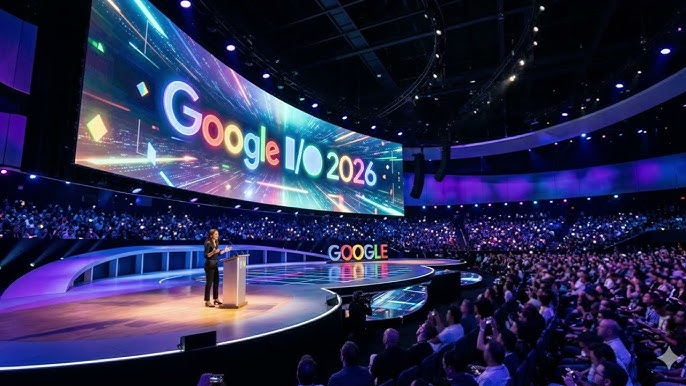
Google I/O 2026 was not a product showcase. It was a statement of scale. Google’s models now process 3.2 quadrillion tokens per month, up 7x from last year. AI Overviews has 2.5 billion monthly users. AI Mode in Search crossed 1 billion monthly active users in just one year. Thirteen Google products each have over a billion users. No AI challenger has a distribution surface remotely close to this.
The headline product was Gemini Spark, a 24/7 personal AI agent that runs in the background on Google Cloud, continuing tasks even when your phone is locked. It integrates with Gmail, Docs, Calendar, and third-party apps. Users teach it recurring workflows: scan bills monthly, generate documents from meeting notes, draft follow-up emails. The model underneath, Gemini 3.5 Flash, now outperforms the previous flagship on agentic benchmarks at four times the speed of GPT-5.5 and Claude Opus 4.7.
The Economist put it plainly: Google is dethroning OpenAI as the king of consumer AI. More people now download Gemini than ChatGPT. Search, Android, Chrome, Gmail: the distribution advantage is not just a moat, it is a compounding asset. Pichai was also notably candid in a post-I/O interview, saying he understands why people are anxious about AI and is not dismissing it. Measured rather than triumphant, in a week of substantial announcements.
| My PoV: OpenAI built the category. Google is using 25 years of distribution infrastructure to absorb it. The practical implication for enterprise leaders: Gemini Spark’s deep Workspace integration means the AI agent most likely to reach your workforce at scale may not arrive through a procurement decision. It will arrive through the productivity suite you already pay for. That changes the governance conversation significantly. |
2. The AI Wealth Is Spreading to Europe
A quieter story has been building in Europe. This week it became hard to ignore. Aixtron is up 189% year-to-date, Technoprobe 129%, STMicroelectronics 133%, Nokia 108%. Nokia, written off by most investors as a legacy phone maker, has repositioned as an AI networking infrastructure provider. Its AI and cloud infrastructure revenue grew 49% in Q1 2026. JP Morgan’s framing is precise: “In Europe, scarcity amplifies the trend. There are few large, liquid AI pure-plays, so flows concentrate in a small group of perceived AI proxies.”
But the returns are not sentiment alone. These companies make equipment that goes into every AI data centre being built globally: compound semiconductor deposition tools, optical fibre networking, chip testing rigs, power semiconductors for data centre power management. The Stoxx Europe Semiconductor index is up 74% in 2026, against 2% for the broad Stoxx Europe 600. That divergence inside a flat market tells the structural story. The picks and shovels are as European as they are American.
| My PoV: Nokia’s transformation from legacy telecom to AI networking player is a case study in what a decisive infrastructure pivot can do to a company’s market position. The question for technology leaders is not which European stocks to own. It is which of your infrastructure and technology partners are making a similar transition, and whether your roadmap accounts for their success or failure in doing so. |
3. AI in Production: The Honest Numbers
Ferrari and IBM opened their playbook to TechCrunch this week. The Ferrari app, rebuilt on IBM watsonx, converts millions of race telemetry data points into personalised narratives for 400 million Tifosi worldwide. Results: 62% increase in engagement over race weekends, 56% more race-active users, 35% more time in app. The goal is not broadcasting at fans. It is making each of them feel known. AI makes personalisation at 400 million people simultaneously possible. No human content team could do that.
The FT’s productivity analysis offered the necessary counterweight. A study by nonprofit METR found AI tools made software developers’ tasks take 20% longer. An NBER survey of thousands of executives found negligible measured productivity impact in 2025. UC Berkeley researchers found AI-assisted workers took on more tasks but did more overall work, with multitasking driving cognitive fatigue rather than efficiency. The gap between the productivity AI promises and what organisations are measuring remains wide.
| My PoV: Both stories are true simultaneously. Ferrari’s results are real where the use case is specific, the data is clean, and the workflow is redesigned around AI. The productivity paradox persists where AI is added to existing processes without changing them. The tool gets deployed. The process does not change. That distinction is the most useful frame I have seen this year for separating AI deployments that will deliver from those that will not. |
My Takeaway This Weekend
Distribution at scale is a different kind of moat than model capability. Gemini Spark running behind a billion Gmail inboxes is a more durable competitive position than any benchmark score. Europe’s infrastructure rally confirms the AI buildout is global. And the Ferrari versus productivity research contrast is the clearest lens available for evaluating your own AI deployments. The difference is not the technology. It is whether the process was actually redesigned to use it.

