
Published on LinkedIn and amitabhapte.com | 14 June 2026
This week, the biggest IPO in history closed. London hosted two of the most significant AI gatherings in Europe. And the structural logic of the AI industry revealed itself with unusual clarity: the infrastructure is now worth more than the intelligence running on it, and the institutions deploying AI are being watched more closely than ever.
When a Rocket Company Became the Landlord of AI
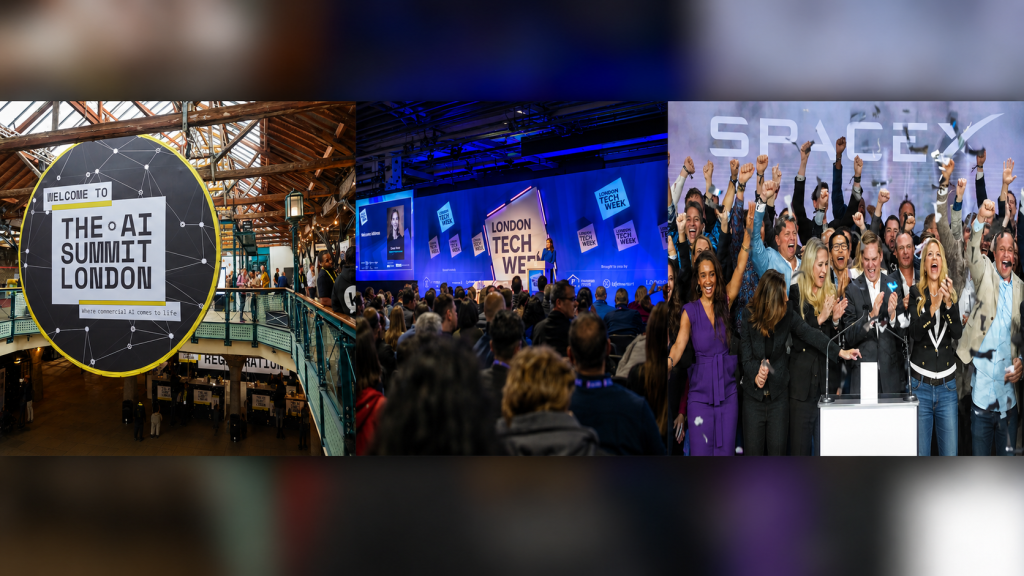
On 12 June, SpaceX listed on Nasdaq under the ticker SPCX, raising $75 billion at a $2 trillion valuation. Shares closed 19% above the IPO price on the first day of trading, briefly pushing market capitalisation past $2.3 trillion and making SpaceX the sixth most valuable company in the United States. Elon Musk, who told staff he once gave the company less than a 10% chance of succeeding, became the world’s first trillionaire. Some 4,400 current and former employees became millionaires on the same day.
But the more structurally important story was not the listing itself. It was what underpinned the valuation. Bloomberg reported that SpaceX originally built its Colossus 1 data centre in Memphis to train Grok, its own AI model. When internal teams ran into technical difficulties using the facility, the company rented the entire capacity to Anthropic at $1.25 billion a month. It then signed Google at $920 million a month for capacity at a second site. Two of the most prominent AI labs in the world, direct competitors, are now paying a rocket and satellite company a combined $2.17 billion a month to access compute. AI’s landlord is not a hyperscaler. It is a space company.
| My PoV: The SpaceX IPO is not simply a capital markets story. It is a signal about where value is accumulating in the AI stack. The most expensive real estate in technology right now is GPU capacity, and the companies that own it, whatever their original business, are becoming strategic infrastructure providers. SpaceX built data centres to train its own AI. When that did not work as planned, it became a landlord. That pivot is now worth more than the rocket business on a recurring revenue basis. For enterprise technology leaders, the implication is direct: the AI platforms you are evaluating today are themselves dependent on infrastructure relationships that are opaque, concentrated, and subject to 90-day cancellation clauses. Understanding that dependency is no longer optional due diligence. It is basic risk management. |
London Tech Week 2026: From Concept to Consequence
London Tech Week ran from 8 to 12 June at Olympia London, drawing more than 30,000 attendees from over 130 countries across 600-plus speakers and five days of programming. The 12th edition had a different weight to it. AI featured in roughly half the sessions, and the recurring message was consistent: the technology has moved from conceptual to something every organisation now has to put to work. The mood was well-funded and purposeful, even as equity markets wobbled outside.
The opening emphasis was on investment and national ambition, with AI framed as a defining economic opportunity for the UK. Microsoft’s UK CEO noted the company had provided free AI training to more than 1.5 million people in the UK over the past year, and described AI skills as no longer just an input to growth but a licence to participate. A new Deep Tech Stage gave dedicated billing to space, robotics, quantum, and life sciences. Sessions on scaling enterprise AI featured household names from consumer goods to retail. The signal from the floor was clear: London is positioning as Europe’s applied AI capital, not just a financial hub.
| My PoV: London Tech Week is a useful barometer precisely because it brings together enterprise operators, not just founders and investors. The shift this year from showcasing AI capability to debating AI implementation is the same shift playing out inside most large organisations. The question at every table is no longer whether to adopt. It is how to govern, how to scale, and how to build operating models that can absorb the pace of change without losing accountability. That conversation is now mainstream. |
The AI Summit London: Ten Years In, the Conversation Has Shifted
Running on 10 and 11 June at Tobacco Dock as the flagship AI event of London Tech Week, the AI Summit London marked its 10th anniversary with more than 5,000 attendees, 300 speakers, and 10 dedicated stages. The framing of the 2026 edition was explicit: a decade into the commercial AI conversation, the summit was designed to move the agenda past experimentation and into enterprise-wide execution. The question being asked across every track was not whether AI can deliver value. It is how fast organisations can scale it responsibly across real operations.
The programme included the UK AI Minister, with sessions spanning enterprise AI strategy, EU AI Act compliance, responsible AI governance, and agentic systems at scale. Speakers from IBM, Barclays, JPMorgan Chase, Marks and Spencer, and Virgin Atlantic anchored the Headliners Stage, sharing operational deployments rather than proofs of concept. New tracks for 2026 covered AI infrastructure, data excellence, and sustainable innovation. The consistent thread across sessions was that governance has become the mechanism that determines deployment speed, not the brake applied to it.
| My PoV: The AI Summit’s ten-year arc mirrors the broader maturity curve of enterprise AI adoption. The first five years were about proving the technology was real. The next three were about building the models. This year the conversation was about organisational design, risk frameworks, and delivery discipline. For senior technology leaders, that shift matters. The competitive advantage in the next phase will not come from access to better models. It will come from building the governance, talent, and operating model that lets you move faster than peers who are still treating AI as an experiment. |
My Takeaway This Weekend
Three stories. One underlying pattern. The infrastructure of AI is now so strategically valuable that a rocket company is its most important landlord. The application of AI is now so widespread that bank regulators are writing formal oversight frameworks. And the conversation at Europe’s leading AI gatherings has moved decisively from what AI can do to how organisations build the discipline to deploy it at scale.
The age of AI experimentation is ending. What replaces it is not a simpler problem. It is a harder one. Building the governance, the talent pipelines, the operating models, and the infrastructure strategies that let organisations move with enough confidence to actually change how they work. That is the leadership agenda for the rest of 2026.
 Amitabh Apte