
Published on LinkedIn and amitabhapte.com | 18 October 2026
Key developments and opinions which caught my attention this week.
This Is What I Read This Week
AI is moving off the screen and into the room. Amazon’s Bee launched two new devices: Frontier, a $74.99 wearable for the wrist or lapel, and Eclipse, a $99.99 card that clips to the back of a phone. Both summarise your conversations and turn them into to-dos and calendar invites. Apple went for the kitchen wall. HomeView is a $299 seven-inch tablet that recognises up to six household members. It goes on sale on 13 November in eight countries.
The consent question is catching up. CNBC looked at how AI wearables collide with wiretap laws. Several US states, including California, Massachusetts, Pennsylvania and Washington, require everyone in a private conversation to agree before it is recorded or intercepted. Device makers point out that no audio is stored, only processed.
Then came an unlikely pairing. Apple and Meta teamed up so that Meta’s open-weight Muse Spark Open model, with 816 billion parameters, can run on a cluster of four Mac Studios with no cloud bill. For a busy engineering team, AI starts to look like a capital purchase instead of a monthly subscription.
Two AI financing stories caught my eye this week. The cost of insuring CoreWeave’s debt against default passed 1,000 basis points, a record, and its 2031 bond briefly yielded above 16%. Reuters called it a test of the market’s maths on the AI build-out: about $50bn of debt, still loss-making, set against a $104bn contracted backlog and a commitment from its chip supplier to buy any unused capacity until 2032. At the other end, Anthropic told prospective investors that third-quarter revenue reached $16.8bn, up 45% on the quarter, though growth is slowing with the profit measure adjusted. A listing is expected in November at a valuation of up to $2 trillion.
So What? My PoV and Takeaway This Weekend
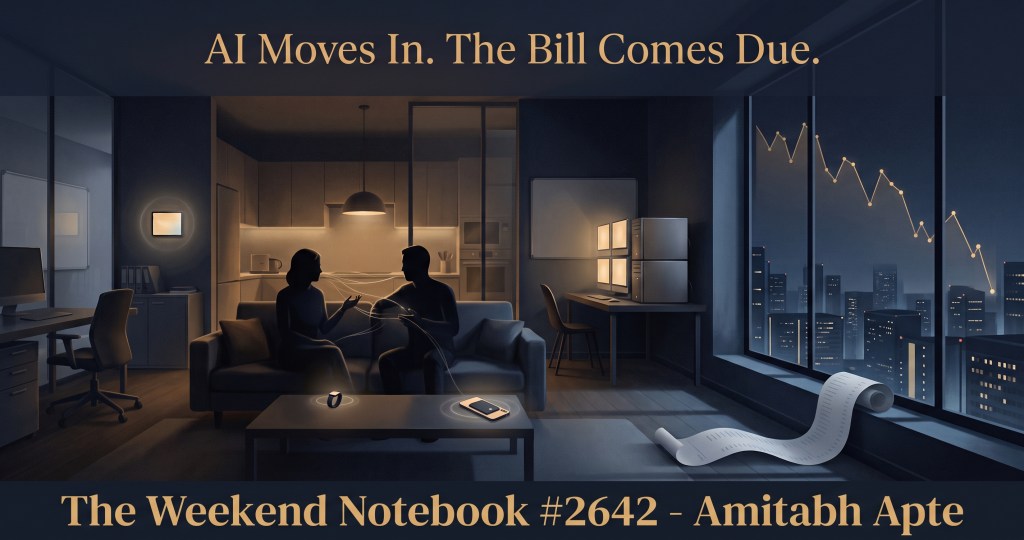
Two forces pulled in opposite directions this week. Intelligence is moving closer to us: onto the wrist, the back of the phone, the kitchen wall and the desk. Meanwhile the debt that built the cloud underneath it is being re-priced. The backlogs are real, and so is revenue growing by billions a quarter. I see this as a verdict on who carries the risk, and on when the cash arrives if rates stay high. And if a model that needed a data centre last year now runs on four desktop machines, some of that demand may never reach the cloud at all.
My takeaways this week – We probably need a wearables policy now in the workplace given a flurry of AI device announcements from major players. We also need to look at AI suppliers’ balance sheets as closely as their benchmarks, because concentration risk in the AI stack may soon become a business continuity question. While running models on your own hardware is becoming a real choice for sensitive data and steady workloads.

