
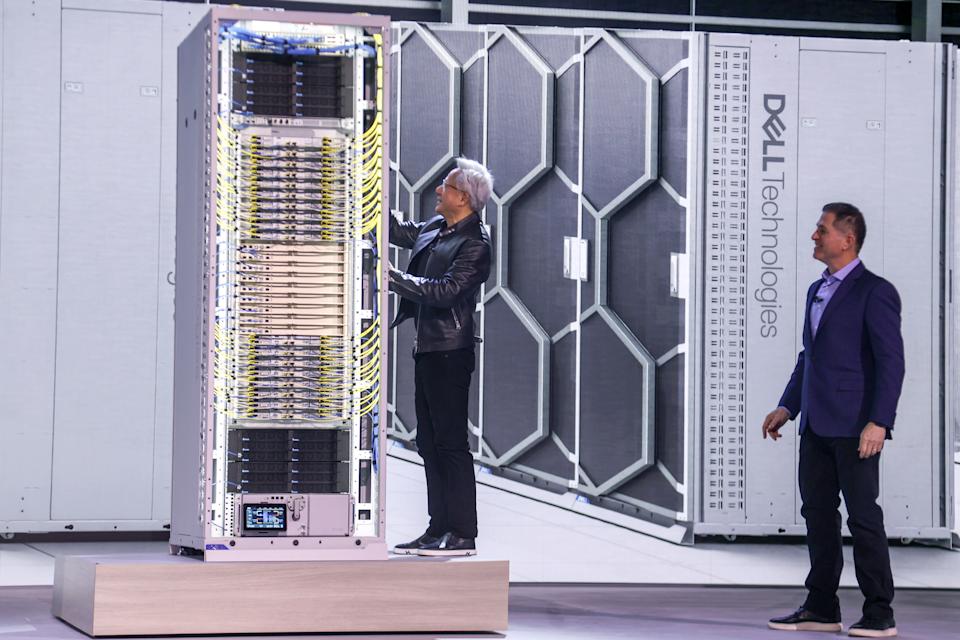
Michael Dell, watches as Jensen Huang signs a server during Dell World Annual Convention in Las Vegas, Nevada, (Ian Maule/Bloomberg via Getty Images
Published on LinkedIn and amitabhapte.com on 31st May 2026
Three stories this week. The AI earnings cycle produced numbers that ended the debate about whether capex translates into revenue. The infrastructure arms race went global, with energy emerging as the constraint no one planned for. And AI collided with the next generation, in classrooms and exam halls, raising questions that money alone cannot fix.
1. The Numbers Stop Being Theoretical
Dell Q1 FY27: revenue $43.8 billion, up 88%. AI server revenue $16.1 billion, up 757%. Orders booked $24.4 billion in a single quarter. Full-year AI server guidance raised to $60 billion. Management was unambiguous: demand is not the constraint. Supply is.
Snowflake surged 36% in a single session, its best day ever, after AI accounts grew from 9,100 to 13,600 in one quarter. Product revenue up 34%. The broader software sector, under pressure all year on fears AI would destroy SaaS economics, rallied hard. ServiceNow up 5%, Palantir 6%. The SaaSpocalypse thesis did not survive the week.
Anthropic raised $65 billion at a $965 billion valuation, overtaking OpenAI to become the most valuable private AI company in the world. Annualised revenue crossed $47 billion, up from $9 billion at end of 2025. Three months ago the valuation was $380 billion. The velocity of the repricing reflects operating performance, not just sentiment.
| My PoV: Dell, Snowflake, and Anthropic together close the debate. AI investment is producing measurable revenue at scale and the compounding is accelerating. Organisations still in evaluation mode are not just behind on deployment. They are behind on the data that should be informing their next decision. |
2. Infrastructure: Energy Is the New Constraint
SoftBank committed €75 billion to build 5 GW of AI data centre capacity in France, announced at the Choose France summit. Masayoshi Son was explicit about why France: nuclear power. Cheap, reliable, carbon-light electricity was the deciding factor, not talent or tax breaks. The first phase, €45 billion for 3.1 GW by 2031, is SoftBank’s largest AI infrastructure bet in Europe, with Schneider Electric as partner in Dunkirk.
The Axios report this week made the underlying dynamic plain: electricity has become one of the most valuable strategic assets in business. Ford launched Ford Energy, a subsidiary targeting data centre storage. Automakers, utilities, and industrial companies are entering the energy business because AI is pulling them there. The gold rush beneath the AI boom is not chips. It is electrons.
European Commission officials flew to San Francisco to negotiate Mythos access for European banks. They were told any decision requires US government approval. US institutions can use the world’s most powerful cyber defence AI. European institutions cannot. That is not a technology gap. It is a geopolitical one.
| My PoV: SoftBank chose France for its nuclear grid. Energy sovereignty is now a first-order variable in compute strategy. Countries and organisations that control reliable power have a structural advantage that policy incentives cannot easily replicate. This belongs in your infrastructure roadmap, not just your sustainability report. |
3. Cyber, Education and the Next Generation
In India, a 19-year-old ethical hacker found critical vulnerabilities in the CBSE national exam grading portal, which handles results for nearly two million students. An unsecured AWS bucket exposed scanned answer booklets and question papers. He had flagged it months earlier. No response. The board eventually brought in IIT cybersecurity specialists. In New York, a malware attack on the Canvas learning platform disrupted thousands of students mid-term. The pattern is consistent: institutions are digitising faster than they are securing what they deploy.
The president of the American Federation of Teachers, representing 1.8 million members, called for screen bans for pre-K through Grade 2, a ban on student-facing AI in elementary schools, and no companion chatbots for anyone under 16. Her framing: “Intentional or not, all this tech has been a huge experiment on kids.” The Los Angeles Unified School District separately removed tablets for its youngest students. The backlash is organised, bipartisan, and growing.
| My PoV: The CBSE and Canvas incidents are not outliers. They are the predictable result of deploying digital systems at speed without security architecture to match. The teachers’ union push is not anti-technology. It is a signal that the people bearing the consequences of AI deployment were not part of the design conversation. Deployment speed without stakeholder readiness creates the kind of backlash that slows everything down. Speed and trust are not opposites. One enables the other. |
My Takeaway This Weekend
Dell, Snowflake, and Anthropic confirm the cycle has turned. Returns are real and accelerating. SoftBank’s France bet confirms energy is a first-order variable in AI strategy, not a footnote. And the week ended with a teenager patching a national exam system and 1.8 million teachers saying enough.
The infrastructure is being built at an extraordinary pace. The governance, security, and human readiness to absorb it are not keeping up. Closing that gap is not a technology problem. It is the leadership problem of the next two years.

