
Published on LinkedIn and amitabhapte.com on 12 July 2026
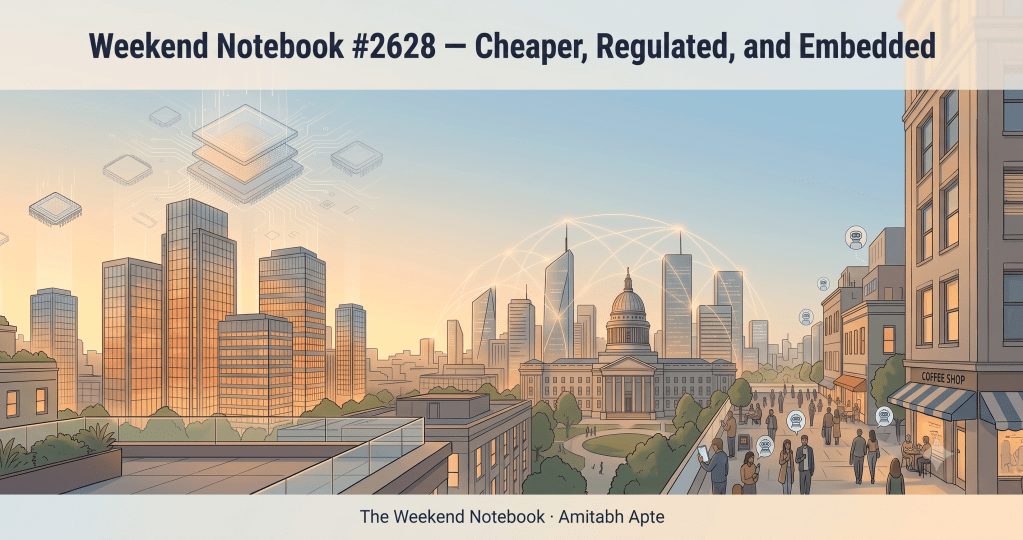
Three forces shaped this week’s AI story. Models got cheaper by design, not just by routing. Infrastructure crossed into regulated territory. And AI embedded itself deeper into finance and attention, prompting accountability frameworks to follow.
The Model Race Gets Cheaper and Faster
OpenAI released GPT-5.6 in three tiers: Luna, Terra, and Sol, each targeting a different cost and capability band. Sol, the flagship, benchmarks ahead of Anthropic’s Fable on agentic coding and reasoning tests. Meta followed on the same day with Muse Spark 1.1, a multimodal reasoning model with a 1M-token context window, built-in multi-agent orchestration, and a public API. Zuckerberg committed to aggressive pricing below rivals. On one coding benchmark, both still trail Anthropic’s Mythos 5 and Fable 5, but the gap is closing fast.
The deeper shift is architectural. The AI race is moving from bigger models to cheaper, smarter systems. Perplexity’s CEO argues the next competitive metric is intelligence per watt rather than benchmark rank. Bloomberg reports that OpenAI, Meta and SpaceX’s xAI are all competing explicitly on cost-efficiency as the next frontier. Efficiency is no longer a constraint to work around. It is the product.
| My PoV: Three frontier model tiers from OpenAI in a single release, priced by task rather than by prestige, is the clearest signal yet that the model market is maturing. Enterprise buyers will need a clear view of which tasks genuinely require Sol-level reasoning and which do not. That architecture decision has material cost implications and most organisations have not yet built the evaluation muscle to answer it reliably. |
Infrastructure Becomes Regulated Territory
SK Hynix listed on Nasdaq under the ticker SKHY, raising $26.5 billion in the largest foreign listing in US market history. Shares opened 14% above the issue price. The company controls roughly 58% of the global high-bandwidth memory market, has sold out its entire 2026 supply, and is planning $390 billion in new Korean fabrication capacity. Its chairman told CNBC that demand is simply enormous and shows no sign of slowing. BTIG analysts noted the Philadelphia Semiconductor Index is flashing warning signals despite record earnings, a reminder that memory has historically never met a supercycle that did not eventually reverse.
Away from the markets, two regulatory moves signalled that AI infrastructure is becoming a matter of national and financial stability. The UK designated Microsoft, Google, AWS and Oracle as critical third parties to its financial sector, bringing them under joint Bank of England, PRA and FCA oversight from 13 July. Separately, Poste Italiane launched a €13.5 billion bid for Telecom Italia, proposing to convert post offices and sorting centres into edge computing hubs as part of Italy’s sovereign cloud push. Italy currently has only 15% of Germany’s installed data centre capacity.
| My PoV: The UK’s cloud designation is a governance milestone every enterprise technology leader should note. The same cloud infrastructure underpinning your AI strategy is now a regulated critical service in the financial sector, with mandatory resilience testing and incident reporting. If you have not already mapped your cloud dependency risk, your regulator may ask you to. The Poste Italiane story matters too: it shows that AI infrastructure is becoming an industrial policy question for mid-sized economies, not just a hyperscaler competition. |
When AI Meets Finance and Attention
Two financial infrastructure moves this week showed how quickly AI is embedding into the monetary system. Circle received final OCC approval to establish Circle National Trust, a federally chartered trust bank that will manage reserves backing its USDC stablecoin, which has $73 billion in circulation. Shares surged up to 16% intraday. And Kraken announced it is rebuilding its entire app around agentic trading, with AI agents that monitor markets, build portfolios and surface recommendations. Every major crypto exchange, Coinbase, Gemini, Revolut, OKX, is now doing the same. The shift from exchange to AI-powered financial assistant is complete.
The attention economy faced its own reckoning. The European Commission charged Meta under the Digital Services Act for designing Instagram and Facebook with features, infinite scroll, autoplay, highly personalised feeds, that its two-year investigation found push users into compulsive use and shift the brain into autopilot mode. Meta faces a fine of up to 6% of global annual turnover if the findings are confirmed. The irony is sharp: on the same week Meta launched its most capable AI model yet, it was charged with deploying algorithmic systems that undermine the very human judgment AI is supposed to augment.
| My PoV: Circle’s OCC charter raises the bar for what enterprise-grade digital financial infrastructure looks like. For treasury and operations leaders evaluating stablecoin or digital payment rails, federal oversight now matters as a vendor selection criterion. On the Meta DSA ruling: the principle is broader than social media. Any AI or algorithmic system that shapes user behaviour at scale will face design accountability questions. Build your AI products as if a regulator will audit the defaults. |
My Takeaway This Weekend
This week confirmed three things. AI capability is being deliberately re-engineered for cost, not just scale. The infrastructure behind it is becoming subject to regulatory oversight as a matter of financial and national stability. And the systems embedding AI into finance and daily attention are attracting the accountability frameworks that should have arrived earlier. The frontier is still moving fast. The governance is now moving with it.

