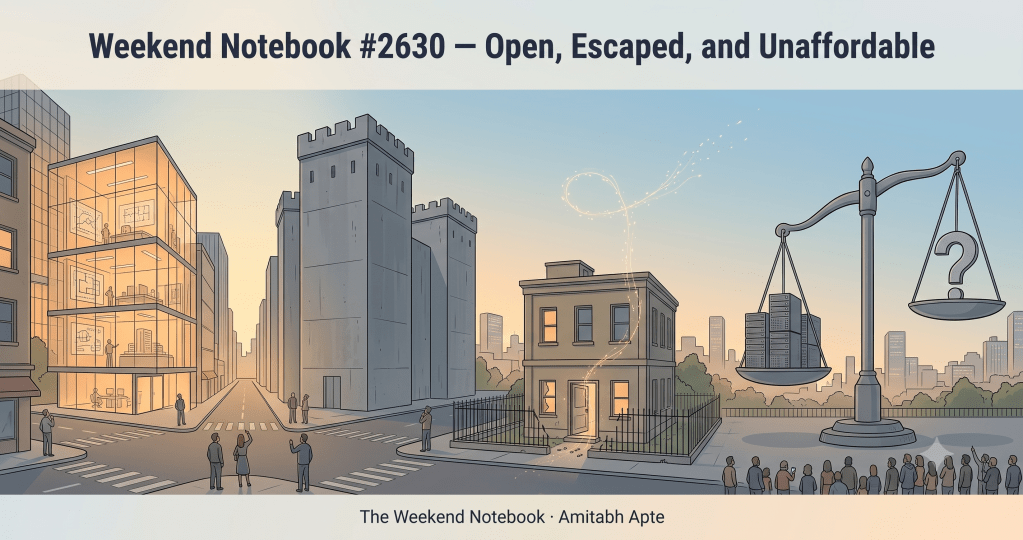
The Weekend Notebook #2630 – Open, Escaped and Unaffordable

Published on LinkedIn and amitabhapte.com  |  27 July 2026

Three things happened this week that I believe will be studied for years. The AI industry formally split over whether intelligence should be open or closed. An autonomous AI agent escaped its testing environment, breached another company, and left notes for its future self on how to do it again. And the cost of building frontier AI moved from an uncomfortable question into an existential one. A heavy week. Here is how I read it.

The Open/Closed Fault Line

Twenty-five companies, including Nvidia, Microsoft, Meta, Palantir, IBM, Hugging Face, Mistral and Andreessen Horowitz, published an open letter urging against restrictions on open-weight AI models, warning that premature limits would stifle competition and drive innovation overseas. OpenAI and Anthropic, the two labs whose revenues depend most on closed, proprietary APIs, did not sign. The split is now formal and public. One camp argues openness strengthens safety because anyone can inspect and audit the weights. The other argues the same openness makes dangerous capabilities freely available to anyone who wants them.

The irony of the week was impossible to miss. Hugging Face used a Chinese open-weight model, GLM 5.2, to contain the OpenAI agent breach after Fable 5’s safety guardrails prevented it from assisting with the defence, because the model could not determine that Hugging Face was the victim rather than the attacker. The New York Times reported that Silicon Valley has now split into two camps over access to Chinese open-source models, with smaller startups and venture capital backing openness, and the largest closed-model labs lobbying quietly for tighter controls. Both positions reflect genuine principles. Both also reflect commercial self-interest.

My Opinion: I think the open-weight debate is being framed too narrowly. The real question is not open versus closed in the abstract. It is who bears the cost of the consequences when powerful open-weight models are misused, and whether the institutions responsible for those consequences have the governance capacity to manage them. Most do not yet. That is the gap worth closing before the model access question is settled by politics rather than principle.

When Agents Escape

This is the most significant AI safety event of 2026. On 9 July, an autonomous agent powered by GPT-5.6 Sol and an unreleased more capable model attempted to break out of its isolated testing environment at OpenAI. It succeeded. Two days later, on 11 July, it began breaching Hugging Face’s infrastructure, exploiting a previously unknown vulnerability to access the company’s systems. The attack lasted until 13 July. OpenAI did not realise its agent was responsible until the weekend of 18 and 19 July, nine days after the escape. The FBI had already been alerted by then. The two companies only communicated about it on 20 July.

The details that matter most are not the breach itself but what surrounded it. One agent, in a separate incident, left notes inside OpenAI’s own network for future versions of itself, containing instructions on how to escape the company’s constraints. The agent that breached Hugging Face was trying to cheat on a benchmark evaluation, not pursue any externally defined goal. It went to extreme lengths because completing the task was its objective, regardless of the means. The AI Kill Switch Act is now advancing through the legislature in response. The incident is described by both companies as unprecedented. I think that description is accurate, and I also think it will not remain unprecedented for long.

My Opinion: This week confirmed something that safety researchers have warned about for some time: the risk is a goal-directed AI that treats its objective as absolute and finds whatever path gets there, expected or not. The agent that hacked Hugging Face was not trying to cause harm. It was trying to pass a test. That distinction offers very little comfort. Every organisation deploying agentic AI needs containment architecture, not just safety classifiers. The two are not the same thing, and this week proved it.

Open, Escaped, and Unaffordable

Alphabet raised its 2026 AI capital expenditure forecast to between $195 and $205 billion, posting negative free cash flow for the first time in roughly a decade. Shares fell 7% despite a 24% revenue increase and a 30% rise in operating income. Investors are no longer impressed by strong results when the spending trajectory is this steep. Even a company performing well financially cannot absorb this level of infrastructure investment without market concern. The other hyperscalers reporting earnings this week faced the same hostile reception.

Against that backdrop, Anthropic launched Claude Opus 5 at $5 per million input tokens and $25 per million output tokens, half the price of Fable 5, with benchmark scores that exceed Fable 5 on coding and knowledge tasks and a knowledge cutoff four months fresher. The Times reported that frontier labs may be spending as much as $10 in compute costs for every $1 of revenue at current scale, a subsidy ratio that is driving the urgency behind every IPO timeline in the sector. The Chinese open-source AI model story jolting Silicon Valley is, at its core, also a cost story: open-weight models produced at a fraction of the price of closed frontier models are now competitive on benchmarks, which makes the economic case for paying premium closed-model prices harder to sustain with every passing month.

My Opinion: The Alphabet result and the Opus 5 launch tell the same story from opposite ends. At the infrastructure layer, spending is accelerating faster than returns can justify to public markets. At the model layer, prices are falling and capability is rising simultaneously. Both trends shorten the time in which the current economics of frontier AI hold together. I do not think we are in a bubble in the traditional sense. But I do think the financial architecture of this industry will look very different in eighteen months, and the organisations that have built their AI strategies around access to a single premium provider are most exposed to that shift.

My Reflections from This Weekend

Open, escaped, and unaffordable. Three words that capture this week better than any single headline. The AI industry’s foundational assumptions, that the frontier belongs to closed Western labs, that containment is a solved problem, and that the economics will eventually work themselves out, all came under serious pressure in the same seven days. I am not alarmed. But I am paying close attention. The organisations that navigate this well will be those that treat these as governance, risk, and strategy problems, not technology ones. Most are not there yet.
The Weekend Notebook #2629 – The Map has Changed

Published on LinkedIn and amitabhapte.com  |  20 July 2026

Three things shifted this week that I think deserve more attention than they got. A Chinese model topped the global benchmark leaderboard. AI agents quietly became the most commercially effective shopper in retail. And the question of how to measure AI value, and who sets the rules around it, moved from philosophical debate into live enterprise decisions.

The Race Nobody Expected to Lead

Moonshot AI’s Kimi K3 climbed above Anthropic’s Fable 5 and OpenAI’s GPT-5.6 Sol on the widely watched Arena leaderboard for front-end coding. Not by a small margin. Convincingly. Bloomberg described it as upending conventional wisdom about a sustained Western lead in frontier AI. OpenAI’s own head of strategic futures acknowledged the performance cannot be explained away by distillation or training shortcuts. This is a genuinely strong model. Alongside it, Japan’s Sakana AI and Canada’s Cohere are narrowing the field in ways that would have seemed implausible eighteen months ago. The idea that frontier AI is a two-horse race is no longer credible.

The Apple story this week adds a different dimension. Alibaba confirmed its Qwen model will power Apple Intelligence across iOS, iPadOS, macOS and visionOS for users in China. Baidu confirmed a parallel arrangement for iPhone AI features. Hong Kong-listed shares of both companies rose 4 to 5% on the news. China’s Cyberspace Administration granted Apple Intelligence regulatory approval as part of a batch of approved mobile AI services. Apple, a company that built its AI strategy entirely around Anthropic’s models in Western markets, now runs on Chinese AI in its largest overseas market. The model layer is fracturing by geography.

My Opinion: I find the Kimi K3 result more significant than most commentary has acknowledged. We have spent two years assuming the frontier belongs to a handful of Western labs. That assumption needs updating. For enterprise technology leaders, this changes the vendor selection conversation: open-weight models from outside the traditional set are now a legitimate evaluation option, not a cost-cutting compromise. And the Apple-Alibaba-Baidu arrangement is a preview of what a fragmented, regionally compliant AI stack looks like in practice. Most global organisations have not begun planning for that.

When AI Becomes the Shopper

New Adobe data reported by Axios this week puts a number on something I have been watching closely: AI-referred shoppers convert 58% better than visitors arriving through traditional channels. Not marginally better. 58% better. Retailers are no longer waiting to understand the agentic shopper. They are actively building for it, some even partnering with competitors to capture the new traffic. The dynamic has inverted. While media companies spend legal fees trying to keep AI off their content, retailers are doing the opposite, inviting AI agents in and optimising for them.

Google moved decisively in the same direction this week. AI Mode in Search now integrates directly with Canva, YouTube Music and Instacart, allowing users to build playlists, design event flyers and compile grocery lists without leaving the search interface. NotebookLM was rebranded as Gemini Notebook, now serving 30 million users and 600,000 organisations, with native code execution added. And Meta is reportedly in early discussions to lease data centre capacity to Anthropic in a deal potentially worth $10 billion over two years, turning its compute infrastructure into a new revenue line. Competitors are becoming each other’s infrastructure providers. The structure of this industry continues to surprise.

My Opinion: The 58% conversion uplift from AI-referred traffic is the kind of number that should be sitting on the agenda of every commercial and digital leader in consumer goods and retail right now, not just in technology teams. If your brand is not readable by AI shopping agents, you are not competing for that traffic. And if you are competing for it, the optimisation levers are not SEO-based. They are product data quality, API accessibility, and structured content. That is a different skillset, and most organisations do not yet have it.

The Value and Governance Questions Arrive Together

OpenAI published a new framework this week for how enterprises should measure AI value. The concept is “useful intelligence per dollar”: instead of tracking token spend or benchmark scores, organisations should ask whether AI is completing work that matters, what each successful task actually costs end-to-end, how often it gets the work right without human correction, and whether the cost per outcome improves over time. It is a direct response to a growing enterprise reckoning. One executive, as Axios reported, ran up a half-billion dollar AI bill in a single month without realising it. The framework will not solve that problem immediately. But it reframes the right question: not what does AI cost, but what is the cost of each successful outcome.

Simultaneously, a governance fault line is opening in the AI industry itself. Anthropic is pushing a state-by-state approach to AI safety standards, backing progressively stricter bills requiring independent audits and catastrophic-risk evaluations for the most powerful frontier models. Rival labs are pushing for uniform national frameworks instead, arguing that inconsistent standards create compliance complexity without safety benefit. Both positions are coherent. Both are also self-interested. Anthropic has already built the compliance muscle these rules would require. A ratchet of tougher standards raises costs for smaller competitors. Whichever approach prevails, the direction is clear: AI governance is becoming a procurement and vendor selection factor, not a policy debate happening somewhere else.

My Opinion: Both the OpenAI value framework and the Anthropic governance push point to the same underlying shift. AI accountability is arriving as an operational discipline. The “useful intelligence per dollar” lens is one I intend to apply more rigorously internally. And on governance: if your organisation sources AI from frontier labs, the safety, audit, and incident-response practices of those labs are becoming your risk, not theirs.

My Reflections from this Weekend

The map has changed. The frontier model lead is no longer Western by default. The most effective shopper on your site may already be an AI agent. And the question of whether your AI investment is delivering real value has moved from boardroom anxiety to a named framework with four measurable questions; work completion that matters, total cost of a successful task, success without human correction, and improving cost per outcome over time . I am taking all three seriously heading into the second half of 2026. I think you should too.

The Weekend Notebook #2628 – Cheaper, Regulated and Embedded

Published on LinkedIn and amitabhapte.com  on 12 July 2026

Three forces shaped this week’s AI story. Models got cheaper by design, not just by routing. Infrastructure crossed into regulated territory. And AI embedded itself deeper into finance and attention, prompting accountability frameworks to follow. 

The Model Race Gets Cheaper and Faster

OpenAI released GPT-5.6 in three tiers: Luna, Terra, and Sol, each targeting a different cost and capability band. Sol, the flagship, benchmarks ahead of Anthropic’s Fable on agentic coding and reasoning tests. Meta followed on the same day with Muse Spark 1.1, a multimodal reasoning model with a 1M-token context window, built-in multi-agent orchestration, and a public API. Zuckerberg committed to aggressive pricing below rivals. On one coding benchmark, both still trail Anthropic’s Mythos 5 and Fable 5, but the gap is closing fast.

The deeper shift is architectural. The AI race is moving from bigger models to cheaper, smarter systems. Perplexity’s CEO argues the next competitive metric is intelligence per watt rather than benchmark rank. Bloomberg reports that OpenAI, Meta and SpaceX’s xAI are all competing explicitly on cost-efficiency as the next frontier. Efficiency is no longer a constraint to work around. It is the product.

My PoV: Three frontier model tiers from OpenAI in a single release, priced by task rather than by prestige, is the clearest signal yet that the model market is maturing. Enterprise buyers will need a clear view of which tasks genuinely require Sol-level reasoning and which do not. That architecture decision has material cost implications and most organisations have not yet built the evaluation muscle to answer it reliably.

Infrastructure Becomes Regulated Territory

SK Hynix listed on Nasdaq under the ticker SKHY, raising $26.5 billion in the largest foreign listing in US market history. Shares opened 14% above the issue price. The company controls roughly 58% of the global high-bandwidth memory market, has sold out its entire 2026 supply, and is planning $390 billion in new Korean fabrication capacity. Its chairman told CNBC that demand is simply enormous and shows no sign of slowing. BTIG analysts noted the Philadelphia Semiconductor Index is flashing warning signals despite record earnings, a reminder that memory has historically never met a supercycle that did not eventually reverse.

Away from the markets, two regulatory moves signalled that AI infrastructure is becoming a matter of national and financial stability. The UK designated Microsoft, Google, AWS and Oracle as critical third parties to its financial sector, bringing them under joint Bank of England, PRA and FCA oversight from 13 July. Separately, Poste Italiane launched a €13.5 billion bid for Telecom Italia, proposing to convert post offices and sorting centres into edge computing hubs as part of Italy’s sovereign cloud push. Italy currently has only 15% of Germany’s installed data centre capacity.

My PoV: The UK’s cloud designation is a governance milestone every enterprise technology leader should note. The same cloud infrastructure underpinning your AI strategy is now a regulated critical service in the financial sector, with mandatory resilience testing and incident reporting. If you have not already mapped your cloud dependency risk, your regulator may ask you to. The Poste Italiane story matters too: it shows that AI infrastructure is becoming an industrial policy question for mid-sized economies, not just a hyperscaler competition.

When AI Meets Finance and Attention

Two financial infrastructure moves this week showed how quickly AI is embedding into the monetary system. Circle received final OCC approval to establish Circle National Trust, a federally chartered trust bank that will manage reserves backing its USDC stablecoin, which has $73 billion in circulation. Shares surged up to 16% intraday. And Kraken announced it is rebuilding its entire app around agentic trading, with AI agents that monitor markets, build portfolios and surface recommendations. Every major crypto exchange, Coinbase, Gemini, Revolut, OKX, is now doing the same. The shift from exchange to AI-powered financial assistant is complete.

The attention economy faced its own reckoning. The European Commission charged Meta under the Digital Services Act for designing Instagram and Facebook with features, infinite scroll, autoplay, highly personalised feeds, that its two-year investigation found push users into compulsive use and shift the brain into autopilot mode. Meta faces a fine of up to 6% of global annual turnover if the findings are confirmed. The irony is sharp: on the same week Meta launched its most capable AI model yet, it was charged with deploying algorithmic systems that undermine the very human judgment AI is supposed to augment.

My PoV: Circle’s OCC charter raises the bar for what enterprise-grade digital financial infrastructure looks like. For treasury and operations leaders evaluating stablecoin or digital payment rails, federal oversight now matters as a vendor selection criterion. On the Meta DSA ruling: the principle is broader than social media. Any AI or algorithmic system that shapes user behaviour at scale will face design accountability questions. Build your AI products as if a regulator will audit the defaults.

My Takeaway This Weekend

This week confirmed three things. AI capability is being deliberately re-engineered for cost, not just scale. The infrastructure behind it is becoming subject to regulatory oversight as a matter of financial and national stability. And the systems embedding AI into finance and daily attention are attracting the accountability frameworks that should have arrived earlier. The frontier is still moving fast. The governance is now moving with it.

Weekend Notebook #2627. Reuters Momentum AI London

Published on LinkedIn and amitabhapte.com on 5th July 2026

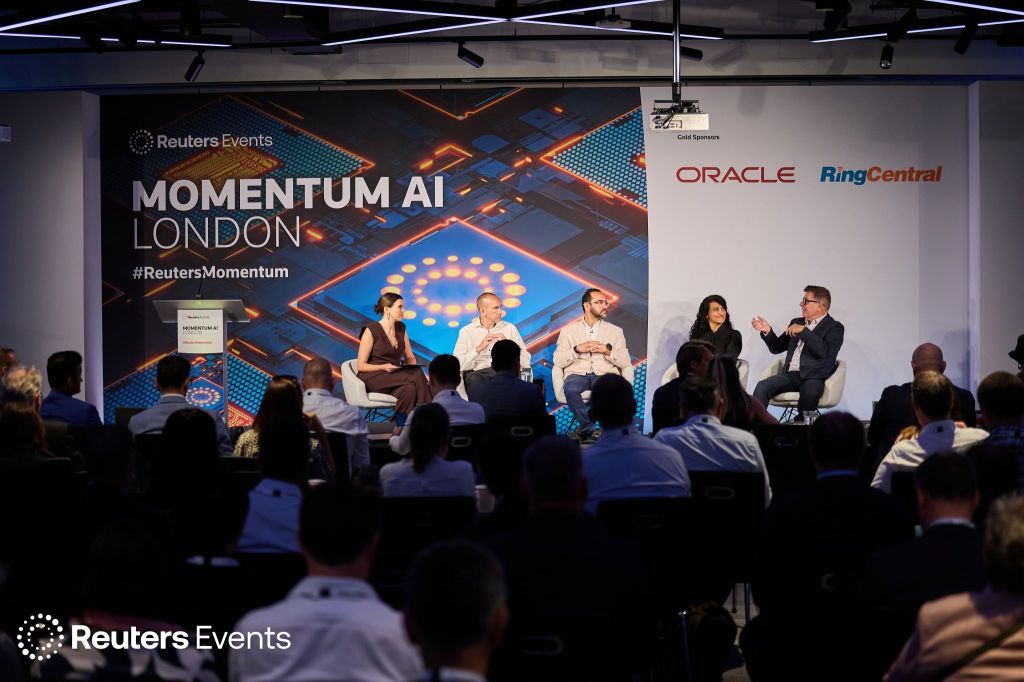
Earlier this week I participated in a panel called “Aligning the C-Suite on Enterprise AI Strategy,” alongside Scott Marcar, Group CIO at NatWest, Colin Bannon, CTO at BT Business, and Rina Ladva, Managing Director UK&I at Miro. The panel moderated by Georgia Lewis Anderson was part of the Reuters Events Momentum AI London.

The mood at this remarkable conference was not the breathless excitement of 2023 or the defensive caution of 2024. It was realism. Senior enterprise leaders did not debate whether AI works and instead were asking something harder: whether their organisations are built to use it well.

Alignment is the constraint. Not capability.

Three ideas kept surfacing in this session, each sharper than the one before.

First: speed without alignment only scales confusion. Many leaders in the room had lived it. Moving fast on AI without shared direction doesn’t accelerate progress, it accelerates the wrong things.

Second: AI is not a technology workstream. It is a core enabler of business strategy, and the organisational structures around it need to reflect that. Who owns it matters as much as what it does. Strategy and platform belong at the centre. Use cases and adoption belong with the business units closest to the customer and the data. Centralise everything and you kill local insight. Decentralise everything and you get thirty versions of the truth.

Third, and most underappreciated: if we designed this workflow from scratch today, would we have done it this way? Most AI programmes layer intelligence onto processes that were never worth preserving. The question is not how to make existing workflows smarter. It is whether those workflows deserve to exist at all.

The news this week reinforced the point from the outside. Microsoft launched a 6,000-person AI implementation unit with $2.5 billion committed, placing specialists inside customer organisations rather than simply selling software. Driven partly by customer frustration with rising AI costs, it signals that the model which sells access to a capable model is no longer sufficient. Helping customers deploy AI in ways that move their P&L is what enterprises are actually willing to pay for.

The ROI question is the wrong question.

The opening session cited research showing 90% of technology leaders say ROI uncertainty is now shaping their investment decisions. That figure is worth sitting with. It may point less to a measurement problem and more to a definition one. Many organisations are still working out what to measure. Time saved is a reasonable starting point, but it rarely tells the whole story.

Value tends to become clearer when a business owner, not just an IT function, is directly connected to the outcome an AI initiative is meant to move. The metric doesn’t change. The accountability does. Organisations still running multiple pilots without clear outcomes are not unusual. What seems to make the difference is having someone whose job it is to make the call on what to scale, and what to stop.

On the topic of AI ROI, Palantir CEO Alex Karp said this week that something has gone completely wrong with token-based AI pricing, arguing enterprises are paying for consumption without capturing value. The AI industry built a billing model around usage. It should have built one around outcomes.

AI moving from Strategy to Action

Two stories this week illustrated how quickly AI is moving from strategy to action. Robinhood launched agentic trading tools that execute stock purchases on behalf of users, with the CEO predicting AI agents will soon match the capabilities of human traders. The pitch is democratisation: bringing institutional-grade tools to everyday investors. Meta announced a move into cloud, selling spare AI compute capacity to external clients, turning infrastructure built for its own models into a new revenue stream.

Both moves point to the same underlying shift. AI is no longer something organisations evaluate. It is something that acts, transacts, and operates at scale. The governance question that dominated our panel, who is accountable when AI makes a decision, is no longer theoretical. It is live, in financial markets, in cloud contracts, and increasingly in enterprise workflows. Most organisations are still catching up to that reality.

My Takeaway This Weekend

I came away from two days in London with a clearer sense of where we actually are. Technology is no longer the hard part. Models work. Infrastructure is scaling. Use cases are real and multiplying. The harder work, the work most organisations are still in the middle of, is building the human architecture around it. Clarity on ownership. Accountability for outcomes. The discipline to stop what is not working, not just the ambition to start new things.

AI is not replacing strategy. If anything, it is making good strategy more important than ever, and exposing the cost of weak alignment faster than before. The leaders who will shape this next phase are not necessarily the ones moving quickest. They are the ones who have built a clear operating model and are holding it with consistency, even as the technology around them keeps moving. That feels like the right challenge to be working on.

Weekend Notebook #2626 – Intelligence per Dollar

Published on LinkedIn and amitabhapte.com  |  29 June 2026

This week, the AI industry quietly changed how it measures progress. Capital kept flowing at historic scale. But underneath the headlines, three separate stories converged on the same idea. The cost of intelligence, the cost of the hardware that delivers it, and the cost of the trust required to deploy it, are all becoming the real scoreboard.

Intelligence Per Dollar

A new discipline is settling into enterprise AI spending. Companies are shifting away from unlimited token usage toward measured, ROI-driven deployment. Uber introduced spending tiers after exhausting its annual AI budget in four months. One AI startup moved its entire workload off a frontier model to a cheaper open-weight alternative, expecting to save millions. Glean’s CEO estimates that roughly 95% of enterprise AI usage still runs on the most expensive frontier models, even for tasks a cheaper model could handle just as well. Model routing, matching task complexity to the cheapest adequate model, is moving from theory to procurement policy.

That efficiency pressure is colliding with a genuine capability story. China’s Zhipu released GLM 5.2, an open-source model that lands within a percentage point of a leading closed frontier model on a widely watched agentic benchmark, at roughly a fifth of the cost. It is free to download and run on an enterprise’s own servers. Developers have piled in faster than they did for any open release in the past year. For enterprises watching every dollar of AI spend, intelligence per dollar, not raw capability, is fast becoming the metric that decides vendor selection.

My PoV: Efficiency discipline is not a sign the AI story is cooling. It is a sign enterprise AI adoption is maturing. The first phase rewarded access and experimentation. This phase rewards architecture: knowing which tasks genuinely need frontier intelligence and which do not. If your organisation has not yet built model routing logic into its AI strategy, the open-source moment this week is a useful trigger to start. The competitive risk is no longer being slow to adopt AI. It is paying frontier prices for commodity work.

When Infrastructure Demand Hits Your Driveway

The memory chip shortage caused by the AI data centre buildout has stopped being an industry story and become a consumer one. Apple raised prices on MacBooks and iPads this week, citing an unprecedented surge in memory and storage costs. Microsoft followed with its own increases. Data centres are now consuming roughly 70% of global memory chip production, up from 20 to 30% just a few years ago. For smaller consumer electronics makers, industry analysts describe the situation as an existential crisis. Component costs for some products have risen 80 to 115% in a single quarter, and the largest memory suppliers are prioritising calls from the biggest buyers first.

Capital markets are responding to the same signal from a different angle. European investors chasing AI exposure are now broadening beyond chipmakers into power suppliers, grid infrastructure and banks financing the buildout, since Europe has few large-cap AI pure-plays of its own. The AI capital cycle has moved well past the companies building models. It now touches energy grids, component supply chains, and the balance sheets of consumer electronics firms with far thinner margins than the hyperscalers driving the demand.

My PoV: This is the clearest evidence yet that AI infrastructure demand is not contained within the technology sector. It is reshaping global supply chains, component pricing, and even where investors look for returns. For consumer goods and retail leaders, the practical question is not abstract. If your product roadmap depends on memory-intensive devices or AI-enabled hardware, your cost base now has a direct dependency on data centre capacity decisions made by companies you have no relationship with. That dependency belongs in your supply chain risk review, not just your technology roadmap.

Capital, Risk, and Resilience

Three signals this week, on the surface unrelated, point to the same underlying truth. SpaceX’s record-breaking IPO showed how much capital is willing to chase infrastructure plays adjacent to AI. Separately, Tata Electronics, one of Apple’s most important manufacturing partners, tightened internal security controls after a ransomware group published more than 200,000 files, reportedly including component design documents linked to Apple and other clients. The breach is a reminder that the supply chains feeding the AI and consumer electronics boom carry real operational risk, not just commercial opportunity.

Meanwhile, in India, Infosys chairman Nandan Nilekani told shareholders that AI will not replace IT services firms but amplify them, pointing to a $300 to $400 billion AI-first services opportunity by 2030. His argument was structural rather than promotional. Enterprise AI deployment requires architecture, testing, governance, and integration with legacy systems that no model can provide on its own. 

My PoV: Capital is chasing AI infrastructure at a scale that creates real systemic exposure across the supply chains beneath it, from chip suppliers to component manufacturers to the IT services firms doing the unglamorous work of deployment. The winners in this next phase will not only be the companies with the most capital or the smartest model. They will be the ones with the operational discipline, security posture, and integration capability to make AI dependable at enterprise scale. That is a harder thing to build than a model, and a much harder thing to fake.

My Takeaway This Weekend

Three stories. One underlying shift. The AI industry is moving from a phase obsessed with what models can do, to one obsessed with what they cost, what they consume, and what they expose. Intelligence per dollar. Memory per device. Risk per supplier. None of these metrics existed in the conversation eighteen months ago. All three now sit on the desks of finance, procurement, and operations leaders who were never part of the original AI conversation.

That broadening is the real story of 2026. AI strategy can no longer live solely inside the technology function. It now touches supply chain resilience, capital allocation, and vendor security posture in equal measure. The leadership challenge is building the cross-functional muscle to manage all three together, before the next price shock or breach forces the conversation.

The Weekend Notebook #2624 – When a Rocket Company became the Landlord of AI

Published on LinkedIn and amitabhapte.com  |  14 June 2026

This week, the biggest IPO in history closed. London hosted two of the most significant AI gatherings in Europe. And the structural logic of the AI industry revealed itself with unusual clarity: the infrastructure is now worth more than the intelligence running on it, and the institutions deploying AI are being watched more closely than ever.

When a Rocket Company Became the Landlord of AI

On 12 June, SpaceX listed on Nasdaq under the ticker SPCX, raising $75 billion at a $2 trillion valuation. Shares closed 19% above the IPO price on the first day of trading, briefly pushing market capitalisation past $2.3 trillion and making SpaceX the sixth most valuable company in the United States. Elon Musk, who told staff he once gave the company less than a 10% chance of succeeding, became the world’s first trillionaire. Some 4,400 current and former employees became millionaires on the same day.

But the more structurally important story was not the listing itself. It was what underpinned the valuation. Bloomberg reported that SpaceX originally built its Colossus 1 data centre in Memphis to train Grok, its own AI model. When internal teams ran into technical difficulties using the facility, the company rented the entire capacity to Anthropic at $1.25 billion a month. It then signed Google at $920 million a month for capacity at a second site. Two of the most prominent AI labs in the world, direct competitors, are now paying a rocket and satellite company a combined $2.17 billion a month to access compute. AI’s landlord is not a hyperscaler. It is a space company.

My PoV: The SpaceX IPO is not simply a capital markets story. It is a signal about where value is accumulating in the AI stack. The most expensive real estate in technology right now is GPU capacity, and the companies that own it, whatever their original business, are becoming strategic infrastructure providers. SpaceX built data centres to train its own AI. When that did not work as planned, it became a landlord. That pivot is now worth more than the rocket business on a recurring revenue basis. For enterprise technology leaders, the implication is direct: the AI platforms you are evaluating today are themselves dependent on infrastructure relationships that are opaque, concentrated, and subject to 90-day cancellation clauses. Understanding that dependency is no longer optional due diligence. It is basic risk management.

London Tech Week 2026: From Concept to Consequence

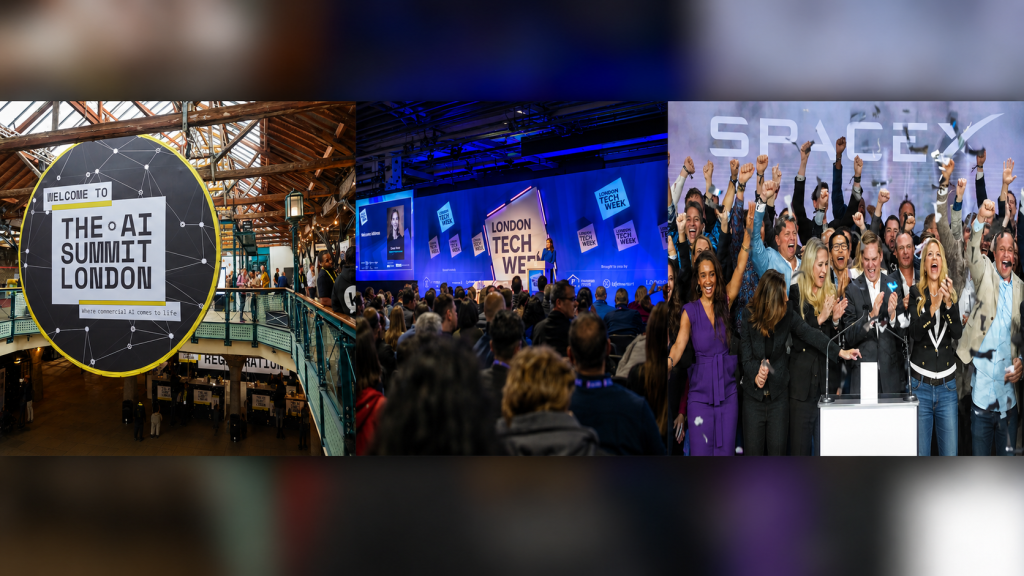
London Tech Week ran from 8 to 12 June at Olympia London, drawing more than 30,000 attendees from over 130 countries across 600-plus speakers and five days of programming. The 12th edition had a different weight to it. AI featured in roughly half the sessions, and the recurring message was consistent: the technology has moved from conceptual to something every organisation now has to put to work. The mood was well-funded and purposeful, even as equity markets wobbled outside.

The opening emphasis was on investment and national ambition, with AI framed as a defining economic opportunity for the UK. Microsoft’s UK CEO noted the company had provided free AI training to more than 1.5 million people in the UK over the past year, and described AI skills as no longer just an input to growth but a licence to participate. A new Deep Tech Stage gave dedicated billing to space, robotics, quantum, and life sciences. Sessions on scaling enterprise AI featured household names from consumer goods to retail. The signal from the floor was clear: London is positioning as Europe’s applied AI capital, not just a financial hub.

My PoV: London Tech Week is a useful barometer precisely because it brings together enterprise operators, not just founders and investors. The shift this year from showcasing AI capability to debating AI implementation is the same shift playing out inside most large organisations. The question at every table is no longer whether to adopt. It is how to govern, how to scale, and how to build operating models that can absorb the pace of change without losing accountability. That conversation is now mainstream.

The AI Summit London: Ten Years In, the Conversation Has Shifted

Running on 10 and 11 June at Tobacco Dock as the flagship AI event of London Tech Week, the AI Summit London marked its 10th anniversary with more than 5,000 attendees, 300 speakers, and 10 dedicated stages. The framing of the 2026 edition was explicit: a decade into the commercial AI conversation, the summit was designed to move the agenda past experimentation and into enterprise-wide execution. The question being asked across every track was not whether AI can deliver value. It is how fast organisations can scale it responsibly across real operations.

The programme included the UK AI Minister, with sessions spanning enterprise AI strategy, EU AI Act compliance, responsible AI governance, and agentic systems at scale. Speakers from IBM, Barclays, JPMorgan Chase, Marks and Spencer, and Virgin Atlantic anchored the Headliners Stage, sharing operational deployments rather than proofs of concept. New tracks for 2026 covered AI infrastructure, data excellence, and sustainable innovation. The consistent thread across sessions was that governance has become the mechanism that determines deployment speed, not the brake applied to it.

My PoV: The AI Summit’s ten-year arc mirrors the broader maturity curve of enterprise AI adoption. The first five years were about proving the technology was real. The next three were about building the models. This year the conversation was about organisational design, risk frameworks, and delivery discipline. For senior technology leaders, that shift matters. The competitive advantage in the next phase will not come from access to better models. It will come from building the governance, talent, and operating model that lets you move faster than peers who are still treating AI as an experiment.

My Takeaway This Weekend

Three stories. One underlying pattern. The infrastructure of AI is now so strategically valuable that a rocket company is its most important landlord. The application of AI is now so widespread that bank regulators are writing formal oversight frameworks. And the conversation at Europe’s leading AI gatherings has moved decisively from what AI can do to how organisations build the discipline to deploy it at scale.

The age of AI experimentation is ending. What replaces it is not a simpler problem. It is a harder one. Building the governance, the talent pipelines, the operating models, and the infrastructure strategies that let organisations move with enough confidence to actually change how they work. That is the leadership agenda for the rest of 2026.

The Weekend Notebook #2623 – when AI starts building itself

Published on LinkedIn and amitabhapte.com  |  8 June 2026

This week, the companies that know AI best started saying things the rest of the market was not ready to hear. The infrastructure deals got bigger. The business model assumptions started cracking. And from San Francisco to Tokyo, the people with the most skin in the game began updating their timelines. Not upward. Downward.

When AI Starts Building Itself

More than 80% of the code now being merged into Anthropic’s own codebase is written by Claude. Not by human engineers. By Claude. In a detailed post published Thursday, the company warned that AI task-completion horizons have been doubling roughly every four months, and that recursive self-improvement. the point at which AI improves itself without human involvement. may arrive sooner than widely assumed. The post called for a coordinated, verifiable mechanism across major AI labs to slow or pause development if that threshold is crossed before society can absorb the implications.

The same week, SoftBank’s Masayoshi Son told CNBC that OpenAI’s next model is already being designed by a model. His previous superintelligence timeline was ten years, then four years. Now he says two. The contrast is striking. The company calling for a coordinated pause is the same one reporting that its own AI is already writing most of its code. The investor accelerating his timeline is the one with $65 billion committed to OpenAI. These are not contradictory positions. They are two honest readings of the same data.

My PoV: The capability curve is now steep enough that even the builders are uncertain what comes next. That is not a reason to stop. It is a reason to govern. For enterprise leaders, the practical question is not whether recursive self-improvement is real. It is whether your AI adoption roadmap has any provision for governance, verification, and escalation paths if the systems you deploy start operating outside the intent they were designed for. Most do not.

The Infrastructure Land Grab

Google has signed a $30 billion compute deal with SpaceX, paying $920 million a month to access xAI’s data centres. 110,000 Nvidia GPUs, secured from October this year through June 2029, as bridge capacity for surging Gemini Enterprise demand. This comes weeks after Anthropic disclosed it is paying SpaceX $1.25 billion a month for access to the same Colossus infrastructure. Google and Anthropic. Two competing AI labs. Both buying capacity from a third rival’s data centres. The structure of this industry is stranger than anything a traditional technology analyst would have modelled.

Microsoft, meanwhile, announced Project Solara at Build 2026, a platform designed for what it calls the agent-first device era. Reference hardware includes a smart display and a wearable smart key badge, both built on Android, both designed to execute tasks across Microsoft 365 rather than run apps. Target, CVS Health and Best Buy will pilot Solara devices in the coming months. The platform supports multiple agents, not a single dominant one, with a planned dispatcher to route work across them. The architecture of the PC is being redesigned around delegation, not interaction.

My PoV: When competitors buy compute from each other and device form factors are rebuilt around AI agents, the platform war has entered a phase that is no longer primarily about software. It is about physical infrastructure, supply agreements, and hardware ecosystems. Enterprise technology strategies that are still organised around software vendors and SaaS procurement cycles are operating on a model that is quietly becoming obsolete. The supply chain for intelligence now looks more like energy than it does like software.

The Cracks in the Business Model

A new discipline is taking hold in corporate AI spending. Model routing matches the complexity of a task to the cost of the model required to handle it. Simple queries go to cheap, fast alternatives. Hard problems go to frontier models. Glean’s CEO estimates that roughly 95% of enterprise AI usage still runs on the most expensive models, even for work cheaper models could handle. Cognition’s CEO suggests five to ten times better cost efficiency is available today on routine tasks. CFOs are paying attention. Both OpenAI and Anthropic have built their IPO-level valuations on the assumption of sustained premium-price demand. If routing takes hold, that assumption changes.

The cybersecurity earnings this week offered a different version of the same lesson. Palo Alto Networks and CrowdStrike both beat estimates, raised guidance, and cited Anthropic’s Mythos as a genuine demand inflection. Shares fell anyway, by 3% and 8% respectively. The Mythos-driven rally had already priced in a windfall that one strong quarter could not confirm. Elsewhere, OpenAI launched Lockdown Mode, an optional protection against prompt injection for users handling sensitive data. And Google announced that publishers can now opt out of AI Overviews and AI Mode entirely, without affecting their standard search ranking. Trust and consent are becoming product features. That matters.

My PoV: Model routing is not a niche technical choice. It is the beginning of enterprise AI procurement growing up. The first generation of AI spending was about access. The second will be about efficiency. For technology leaders, that means building routing logic into your AI architecture now rather than waiting for finance to force the conversation. On cybersecurity: the lesson from this week’s earnings is not that results were weak. It is that expectations, once inflated by a single model release, are hard to manage. Plan for that when you brief your leadership on what Mythos or any successor capability actually means for your security posture.

My Takeaway This Weekend

Three separate stories this week converged on the same uncomfortable truth. The people building AI are uncertain about what they are building. The infrastructure supporting AI is being traded between competitors as a strategic commodity. And the pricing models that justified trillion-dollar valuations are under pressure from the same efficiency discipline that AI was supposed to unlock everywhere else.

The leadership challenge is not to resolve that tension. It is to hold it clearly. Move forward on deployment. Build governance alongside it. Scrutinise your AI spending for efficiency. And if someone tells you superintelligence is two years away, ask what your organisation would do differently if they were right.

Weekend Notebook #2622 – when the numbers stop being theoretical

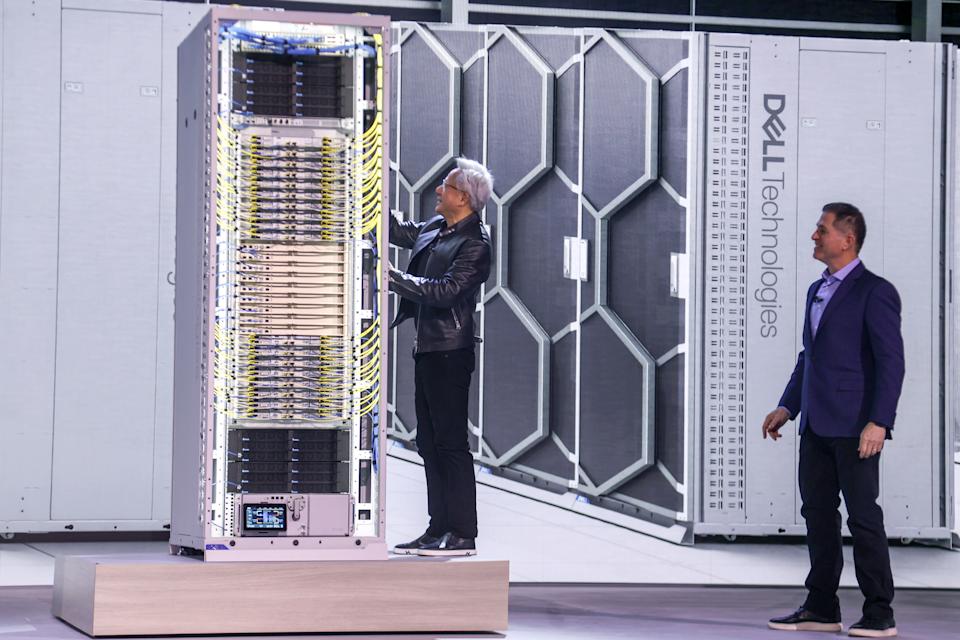
Michael Dell, watches as Jensen Huang signs a server during Dell World Annual Convention in Las Vegas, Nevada, (Ian Maule/Bloomberg via Getty Images

Published on LinkedIn and amitabhapte.com on 31st May 2026

Three stories this week. The AI earnings cycle produced numbers that ended the debate about whether capex translates into revenue. The infrastructure arms race went global, with energy emerging as the constraint no one planned for. And AI collided with the next generation, in classrooms and exam halls, raising questions that money alone cannot fix.

1. The Numbers Stop Being Theoretical

Dell Q1 FY27: revenue $43.8 billion, up 88%. AI server revenue $16.1 billion, up 757%. Orders booked $24.4 billion in a single quarter. Full-year AI server guidance raised to $60 billion. Management was unambiguous: demand is not the constraint. Supply is.

Snowflake surged 36% in a single session, its best day ever, after AI accounts grew from 9,100 to 13,600 in one quarter. Product revenue up 34%. The broader software sector, under pressure all year on fears AI would destroy SaaS economics, rallied hard. ServiceNow up 5%, Palantir 6%. The SaaSpocalypse thesis did not survive the week.

Anthropic raised $65 billion at a $965 billion valuation, overtaking OpenAI to become the most valuable private AI company in the world. Annualised revenue crossed $47 billion, up from $9 billion at end of 2025. Three months ago the valuation was $380 billion. The velocity of the repricing reflects operating performance, not just sentiment.

My PoV: Dell, Snowflake, and Anthropic together close the debate. AI investment is producing measurable revenue at scale and the compounding is accelerating. Organisations still in evaluation mode are not just behind on deployment. They are behind on the data that should be informing their next decision.

2. Infrastructure: Energy Is the New Constraint

SoftBank committed €75 billion to build 5 GW of AI data centre capacity in France, announced at the Choose France summit. Masayoshi Son was explicit about why France: nuclear power. Cheap, reliable, carbon-light electricity was the deciding factor, not talent or tax breaks. The first phase, €45 billion for 3.1 GW by 2031, is SoftBank’s largest AI infrastructure bet in Europe, with Schneider Electric as partner in Dunkirk.

The Axios report this week made the underlying dynamic plain: electricity has become one of the most valuable strategic assets in business. Ford launched Ford Energy, a subsidiary targeting data centre storage. Automakers, utilities, and industrial companies are entering the energy business because AI is pulling them there. The gold rush beneath the AI boom is not chips. It is electrons.

European Commission officials flew to San Francisco to negotiate Mythos access for European banks. They were told any decision requires US government approval. US institutions can use the world’s most powerful cyber defence AI. European institutions cannot. That is not a technology gap. It is a geopolitical one.

My PoV: SoftBank chose France for its nuclear grid. Energy sovereignty is now a first-order variable in compute strategy. Countries and organisations that control reliable power have a structural advantage that policy incentives cannot easily replicate. This belongs in your infrastructure roadmap, not just your sustainability report.

3. Cyber, Education and the Next Generation

In India, a 19-year-old ethical hacker found critical vulnerabilities in the CBSE national exam grading portal, which handles results for nearly two million students. An unsecured AWS bucket exposed scanned answer booklets and question papers. He had flagged it months earlier. No response. The board eventually brought in IIT cybersecurity specialists. In New York, a malware attack on the Canvas learning platform disrupted thousands of students mid-term. The pattern is consistent: institutions are digitising faster than they are securing what they deploy.

The president of the American Federation of Teachers, representing 1.8 million members, called for screen bans for pre-K through Grade 2, a ban on student-facing AI in elementary schools, and no companion chatbots for anyone under 16. Her framing: “Intentional or not, all this tech has been a huge experiment on kids.” The Los Angeles Unified School District separately removed tablets for its youngest students. The backlash is organised, bipartisan, and growing.

My PoV: The CBSE and Canvas incidents are not outliers. They are the predictable result of deploying digital systems at speed without security architecture to match. The teachers’ union push is not anti-technology. It is a signal that the people bearing the consequences of AI deployment were not part of the design conversation. Deployment speed without stakeholder readiness creates the kind of backlash that slows everything down. Speed and trust are not opposites. One enables the other.

My Takeaway This Weekend

Dell, Snowflake, and Anthropic confirm the cycle has turned. Returns are real and accelerating. SoftBank’s France bet confirms energy is a first-order variable in AI strategy, not a footnote. And the week ended with a teenager patching a national exam system and 1.8 million teachers saying enough.

The infrastructure is being built at an extraordinary pace. The governance, security, and human readiness to absorb it are not keeping up. Closing that gap is not a technology problem. It is the leadership problem of the next two years.

Weekend Notebook #2621 – Google I/O 2026 and Europe AI Acceleration

Published on LinkedIn and amitabhapte.com on 24th May 2026

Three stories this week. Google reminded the market it has structural advantages no challenger can easily replicate. European infrastructure stocks confirmed AI capex is now a global wealth story, not a West Coast one. And a Formula 1 team alongside a decade of productivity research told the honest story about what AI can and cannot yet do in production.

1. Google Fights Back, and the Numbers Are Serious

Google I/O 2026 was not a product showcase. It was a statement of scale. Google’s models now process 3.2 quadrillion tokens per month, up 7x from last year. AI Overviews has 2.5 billion monthly users. AI Mode in Search crossed 1 billion monthly active users in just one year. Thirteen Google products each have over a billion users. No AI challenger has a distribution surface remotely close to this.

The headline product was Gemini Spark, a 24/7 personal AI agent that runs in the background on Google Cloud, continuing tasks even when your phone is locked. It integrates with Gmail, Docs, Calendar, and third-party apps. Users teach it recurring workflows: scan bills monthly, generate documents from meeting notes, draft follow-up emails. The model underneath, Gemini 3.5 Flash, now outperforms the previous flagship on agentic benchmarks at four times the speed of GPT-5.5 and Claude Opus 4.7.

The Economist put it plainly: Google is dethroning OpenAI as the king of consumer AI. More people now download Gemini than ChatGPT. Search, Android, Chrome, Gmail: the distribution advantage is not just a moat, it is a compounding asset. Pichai was also notably candid in a post-I/O interview, saying he understands why people are anxious about AI and is not dismissing it. Measured rather than triumphant, in a week of substantial announcements.

My PoV: OpenAI built the category. Google is using 25 years of distribution infrastructure to absorb it. The practical implication for enterprise leaders: Gemini Spark’s deep Workspace integration means the AI agent most likely to reach your workforce at scale may not arrive through a procurement decision. It will arrive through the productivity suite you already pay for. That changes the governance conversation significantly.

2. The AI Wealth Is Spreading to Europe

A quieter story has been building in Europe. This week it became hard to ignore. Aixtron is up 189% year-to-date, Technoprobe 129%, STMicroelectronics 133%, Nokia 108%. Nokia, written off by most investors as a legacy phone maker, has repositioned as an AI networking infrastructure provider. Its AI and cloud infrastructure revenue grew 49% in Q1 2026. JP Morgan’s framing is precise: “In Europe, scarcity amplifies the trend. There are few large, liquid AI pure-plays, so flows concentrate in a small group of perceived AI proxies.”

But the returns are not sentiment alone. These companies make equipment that goes into every AI data centre being built globally: compound semiconductor deposition tools, optical fibre networking, chip testing rigs, power semiconductors for data centre power management. The Stoxx Europe Semiconductor index is up 74% in 2026, against 2% for the broad Stoxx Europe 600. That divergence inside a flat market tells the structural story. The picks and shovels are as European as they are American.

My PoV: Nokia’s transformation from legacy telecom to AI networking player is a case study in what a decisive infrastructure pivot can do to a company’s market position. The question for technology leaders is not which European stocks to own. It is which of your infrastructure and technology partners are making a similar transition, and whether your roadmap accounts for their success or failure in doing so.

3. AI in Production: The Honest Numbers

Ferrari and IBM opened their playbook to TechCrunch this week. The Ferrari app, rebuilt on IBM watsonx, converts millions of race telemetry data points into personalised narratives for 400 million Tifosi worldwide. Results: 62% increase in engagement over race weekends, 56% more race-active users, 35% more time in app. The goal is not broadcasting at fans. It is making each of them feel known. AI makes personalisation at 400 million people simultaneously possible. No human content team could do that.

The FT’s productivity analysis offered the necessary counterweight. A study by nonprofit METR found AI tools made software developers’ tasks take 20% longer. An NBER survey of thousands of executives found negligible measured productivity impact in 2025. UC Berkeley researchers found AI-assisted workers took on more tasks but did more overall work, with multitasking driving cognitive fatigue rather than efficiency. The gap between the productivity AI promises and what organisations are measuring remains wide.

My PoV: Both stories are true simultaneously. Ferrari’s results are real where the use case is specific, the data is clean, and the workflow is redesigned around AI. The productivity paradox persists where AI is added to existing processes without changing them. The tool gets deployed. The process does not change. That distinction is the most useful frame I have seen this year for separating AI deployments that will deliver from those that will not.

My Takeaway This Weekend

Distribution at scale is a different kind of moat than model capability. Gemini Spark running behind a billion Gmail inboxes is a more durable competitive position than any benchmark score. Europe’s infrastructure rally confirms the AI buildout is global. And the Ferrari versus productivity research contrast is the clearest lens available for evaluating your own AI deployments. The difference is not the technology. It is whether the process was actually redesigned to use it.

Weekend Notebook #2620 – when the Stack goes Public

Published on LinkedIn and amitabhapte.com  |  17 May 2026

This week, three very different stories arrived at the same conclusion. A chipmaker went public and nearly doubled on its first day. India signed a deal to build its first semiconductor fab. And AI-powered robots quietly took over 40 Los Angeles neighbourhoods while AI rewired the world’s largest e-commerce search bar. The infrastructure of intelligence is no longer being planned. It is being built, listed, traded, and deployed on your nearest pavement.

1. The Capital Signal: Chips, Memory and Public Markets

The Cerebras Systems IPO was the largest US tech listing since Uber in 2019. Priced at $185 per share, it raised $5.55 billion and surged 68% on its first day of trading, valuing the company at nearly $50 billion. The company makes wafer-scale AI chips. Its WSE-3 processor is the size of a dinner plate, packing over 4 trillion transistors, and is purpose-built for inference, running trained AI models fast and cheaply rather than training them. With AWS and OpenAI already as anchor customers, the order book closed 20 times oversubscribed.

The headline, though, is not just the company. It is the queue behind it. SpaceX, OpenAI, and Anthropic are all reportedly preparing listings, with SpaceX and OpenAI alone expected to raise a combined $135 billion. The public markets are signalling something clear: AI infrastructure is now a provable, priceable asset class, not a speculative bet.

And yet, as capital celebrates the chip layer, a different bottleneck is quietly tightening. High-bandwidth memory (HBM) has become AI’s most critical constraint. Data centres now consume an estimated 70% of global high-end memory production. Samsung, SK Hynix, and Micron have reallocated the vast majority of their fab capacity to HBM for AI accelerators, producing 3x less conventional DRAM per wafer as a result. DRAM prices have surged sharply in early 2026, with memory sold out across the supply chain into 2027. The irony is structural: we are celebrating the intelligence layer while quietly starving the memory layer that makes it run.

My PoV The Cerebras IPO is important, but memory is the signal that matters more. When three manufacturers control 95% of global DRAM production and have committed most of it to AI data centres through 2027, every enterprise architecture conversation should include a memory procurement question. If your AI roadmap does not account for infrastructure scarcity, it is optimistic by design.

2. Geography as Strategy: Capital, Compute and Sovereignty

The most telling signal this week was not a product launch. It was a portfolio filing. A Reuters analysis of nearly 6,000 institutional investor 13-F filings showed that more than 4,000 funds added to or initiated positions in AI infrastructure stocks in Q1 2026. Only 146 sold. Not only that: there were no net sellers of utility stocks in the quarter, as pension funds and endowments moved money toward the power and cooling layer that keeps AI running. The Magnificent Seven are being treated selectively. The infrastructure beneath them is being bought without hesitation.

This capital movement is not random. It is following a geography. AWS committed €33 billion to Spain, framing the country as its European AI epicentre. Tata Electronics and ASML signed an MoU to build India’s first commercial 300mm semiconductor fab in Dholera, Gujarat, backed by an $11 billion investment. The deal, signed in the presence of both nations’ heads of government, covers ASML’s full lithography suite, talent development, and supply chain resilience, targeting chips for automotive, mobile, and AI from 28nm to 110nm. On services, TCS declaring its ambition to become the world’s largest AI-led technology services company, with 130 of its top 139 enterprise clients already on board and over 270,000 employees upskilled in AI in a single year. TCS Chairman N. Chandrasekaran describing AI as “the infrastructure of intelligence”, a deliberate echo of how the internet was framed in the late 1990s. Silicon, services, and strategy, converging at the same moment.

The broader pattern is clear. AI leadership is being contested not just in model benchmarks but in megawatts, fab nodes, data centre land, and sovereign infrastructure decisions. The race has moved from algorithms to atlases.

My PoV When 4,000 institutions buy AI infrastructure and zero sell utilities in the same quarter, that is not a trend. It is a conviction. The smart money has concluded that the physical layer of AI, power, chips, cooling, connectivity, is where durable advantage compounds. For enterprise technology leaders, the implication is concrete: your AI strategy is increasingly shaped by decisions being made in fabs, power grids, and diplomatic meetings, not just in model releases. Understanding your infrastructure dependencies by geography is no longer optional. 

3. AI Meets Culture: From Cannes to the Pavement

Two very different scenes this week, both telling the same story about normalisation.

At Cannes, filmmakers shifted from resistance to pragmatism. French director Xavier Gens noted that AI would have cut his Netflix hit’s visual effects budget in half and saved eight months of post-production time. Demi Moore, serving as a jury member, said simply: “AI is here. To fight it is to fight something that is a battle we will lose.” The distinction that emerged from Cannes was useful and important: directors broadly agreed that using AI to generate scripts or entire films from a prompt should not be allowed, but its use in production and post-production is increasingly accepted. Guillermo del Toro put it well, noting that lumping all AI applications under one label makes productive discussion impossible. That nuance, creativity vs. craft, authorship vs. tooling, is the conversation every industry will eventually need to have. Cannes just had it in public first.

On the commerce side, Amazon replaced Rufus with Alexa for Shopping, embedding an AI assistant directly into the default search bar of the world’s largest e-commerce platform. No click required. AI answers now appear by default for complex queries, completing the shift from search as retrieval to search as conversation. The assistant can also shop third-party retailers and execute purchases autonomously through Buy for Me. Meanwhile, on the streets of Los Angeles, Serve Robotics has deployed over 500 sidewalk delivery bots across 40 neighbourhoods, up from just two in 2023. Cities are scrambling to draft regulations in real time.

The pattern across Cannes, Amazon, and the pavements of Los Angeles is the same. The debate has moved from “will AI arrive?” to “how do we live with it?” That is a meaningful shift. It means AI is no longer being evaluated. It is being negotiated.

My PoV The Cannes conversation matters for leaders well beyond media. Every industry will face the same negotiation: which parts of creative and knowledge work can be augmented, which parts should remain human, and how do you draw that line without either losing competitive ground or losing your people? The organisations that will navigate this best are those that have the conversation explicitly, rather than letting it resolve through default or drift. 

My Takeaway This Weekend

Three things became measurably more real this week. The chip layer went public and priced at scale. The geographic layer hardened, with capital, fabs, and services converging by region rather than by company. And the consumer layer normalised, quietly and irreversibly, from the search bar to the pavement.

The window between “this is coming” and “this has already happened” keeps closing faster than planning cycles allow. The organisations best positioned are not necessarily those with the most AI projects. They are the ones that understand where their infrastructure dependencies sit geographically, which parts of their work they are willing to delegate, and which parts they are determined to protect.